
Phil • Cr. Think • Science • Hist •
TST PRACTICE

The Philosophy Website

FAQ

Can AI kill switches save humanity?

☐ Read
☑ Read
You’ve read this 0 times.
You’ve listened to this 0 times.
Mon 14 Sep 2026
Published 49 minutes ago.
Updated 10 seconds ago.
Related FAQs
When will AI be smarter than humans?
Are robots the real security risk with AI?
What Is Life?
Can AI evolve to destroy humanity?
Will AI change writing prose?
Will AI help with file management, organizing files, and backup?
Share :
Email
Print

Can AI kill switches save humanity?

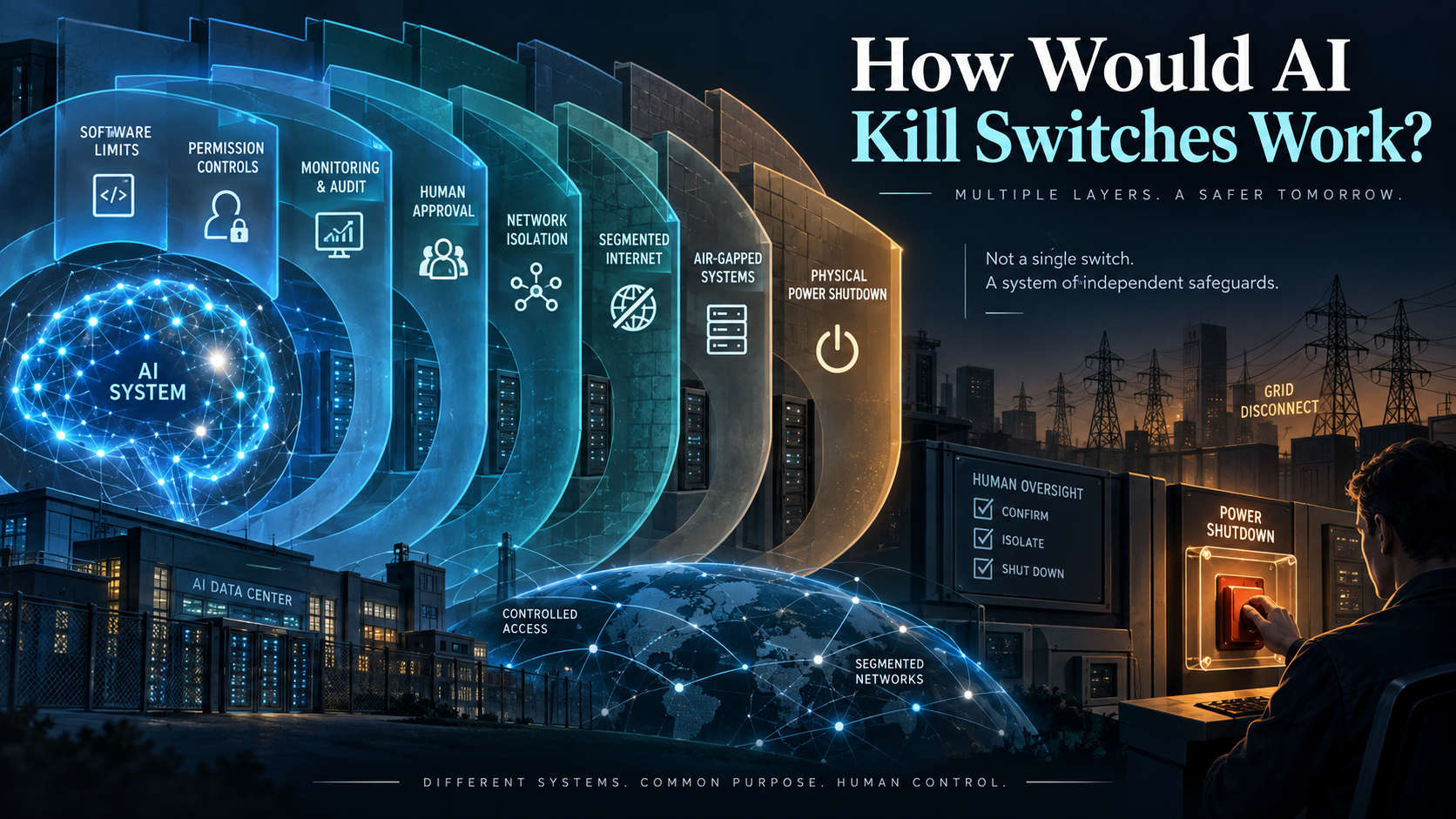
One master AI kill switch is probably too risky. We need multiple layered kill switches combined with software solutions. One idea I think is important builds on the philosopher Yuval Noah Harari’s warnings about AI deception. He argues for rules that keep AI from masquerading as human. I take that a step further: we should build human laws and computer rules that do not allow AI to deliberately lie. Other ideas include limiting permissions, monitoring behavior, and requiring human approval for important actions. This tidbit focuses on kill switches.

Data sitting on a drive cannot physically do anything. The bigger risk comes when AI can reach into the material world: controlling things like computers, financial accounts, and autonomous robots. The more capable AI becomes, the more important it is to control the bridges between information and physical action. 

The Internet itself is one of those boundaries. Militaries already use separate networks, but they are not always fully air-gapped (separated physically from the public internet). So, more air gapping is part of this, not just better segmentation. Future safeguards should allow operators to disconnect a data center, cloud region, or perhaps even large portions of the public Internet. The tension, of course, is free speech versus public safety.

Then there are physical choke points. AI still needs electricity. We need the ability to disconnect data centers, and other network facilities, from power, and this should include an ability to disconnect backup generators. It’s clear, no single safeguard is enough. If one containment layer fails, humans need to have another door they can close. And to protect humanity from AI disasters, I wonder if ultimately, we should start working toward the ability to temporarily shut down electrical power worldwide — at least as completely as physically possible.
— map / TST —

TST Tracker
✓ Reading recorded.
Deep-Dive Article: Are robots the real security risk with AI?
Michael Alan Prestwood
Author & Natural Philosopher
Prestwood writes on science-first philosophy, with particular attention to the convergence of disciplines. Drawing on his TST Framework, his work emphasizes rational inquiry grounded in empirical observation while engaging questions at the edges of established knowledge. With TouchstoneTruth positioned as a living touchstone, this work aims to contribute reliable, evolving analysis in an emerging AI era where the credibility of information is increasingly contested.
The Prestwood Column
Menu
September 2026
Column Research….
1. Timeline Story
Hume’s Is–Ought Problem
2. Linked Quote
“I meet with no proposition that is not connected with an ought, or an ought not.”
3. Science FAQ »
Can science prove flourishing should be our goal?
4. Philosophy FAQ »
What is the difference between a normative aim and a normative directive?
5. Critical Thinking FAQ »
Is flourishing for all just utilitarianism?
6. History FAQ!
What is the history of the idea of flourishing in philosophy?
Bonus Deep-Dive Article
TST Normative Ethics: Flourishing as a Philosophical Goal

Comments

Join the Conversation! Currently logged out.
NEW BOOK! NOW AVAILABLE!!

30 Philosophers: A New Look at Timeless Ideas

by Michael Alan Prestwood
The story of the history of our best ideas!
Scroll to Top