
Explore Science-first Philosophy

FAQ

What does the Kardashev Scale tell us about future civilizations?

Wed 13 Nov 2024
Published 1 year ago.
Updated 2 weeks ago.
Related FAQs
Why do good people obey illegal and immoral commands?
Is the Fermi Paradox still relevant?
Was Plato’s Academy the first university?
What does neuroscience say about “identity?”
What’s the minimum change needed to breathe air on Mars?
Were Plato and Aristotle friends?
Share :
Email
Print

What does the Kardashev Scale tell us about future civilizations?

Imagine civilizations ranked by the energy power they wield, like rungs on a cosmic ladder. That’s the Kardashev Scale. It whispers secrets of tomorrow’s titans. It is the idea of Nikolai Kardashev which sets three large-scale milestones for intelligent life based on energy use. In 1964, he defined them as planetary (Type I), stellar (Type II), and galactic (Type III).

Are we a Type I yet? No, not quite. According to the TST Futurism Timeline, it will take another 150 years or so. Sometime around 2175, we will be able to harness all renewable sources like solar, wind, and geothermal. 

As civilizations ascend from planetary to stellar, from Type I to Type II, their energy footprint illuminates their galaxy. Energy worries no longer exist and the energy needs of individuals are essentially free with only a minimal charge for companies using massive amounts of energy for things like terraforming Mars.

As civilizations ascend from stellar to galactic, from Type II to Type III, their energy footprint expands exponentially and they illuminate the cosmos. They can manipulate the immense power of their host galaxy, perhaps utilizing stellar black holes. At this level, civilizations transcend our current understanding of physics, becoming architects of reality itself.  

According to the TST Futurism Timeline, humanity might reach Type III status as soon as 2,000 years. Perhaps by around 4025, we’ll have developed technologies to tap into the energy of the galaxy. Imagine a windmill energy generating device for the Milky Way galaxy! The possibilities are mind-boggling, imagine the ability to create vast megastructures or even travel between galaxies. The future awaits!
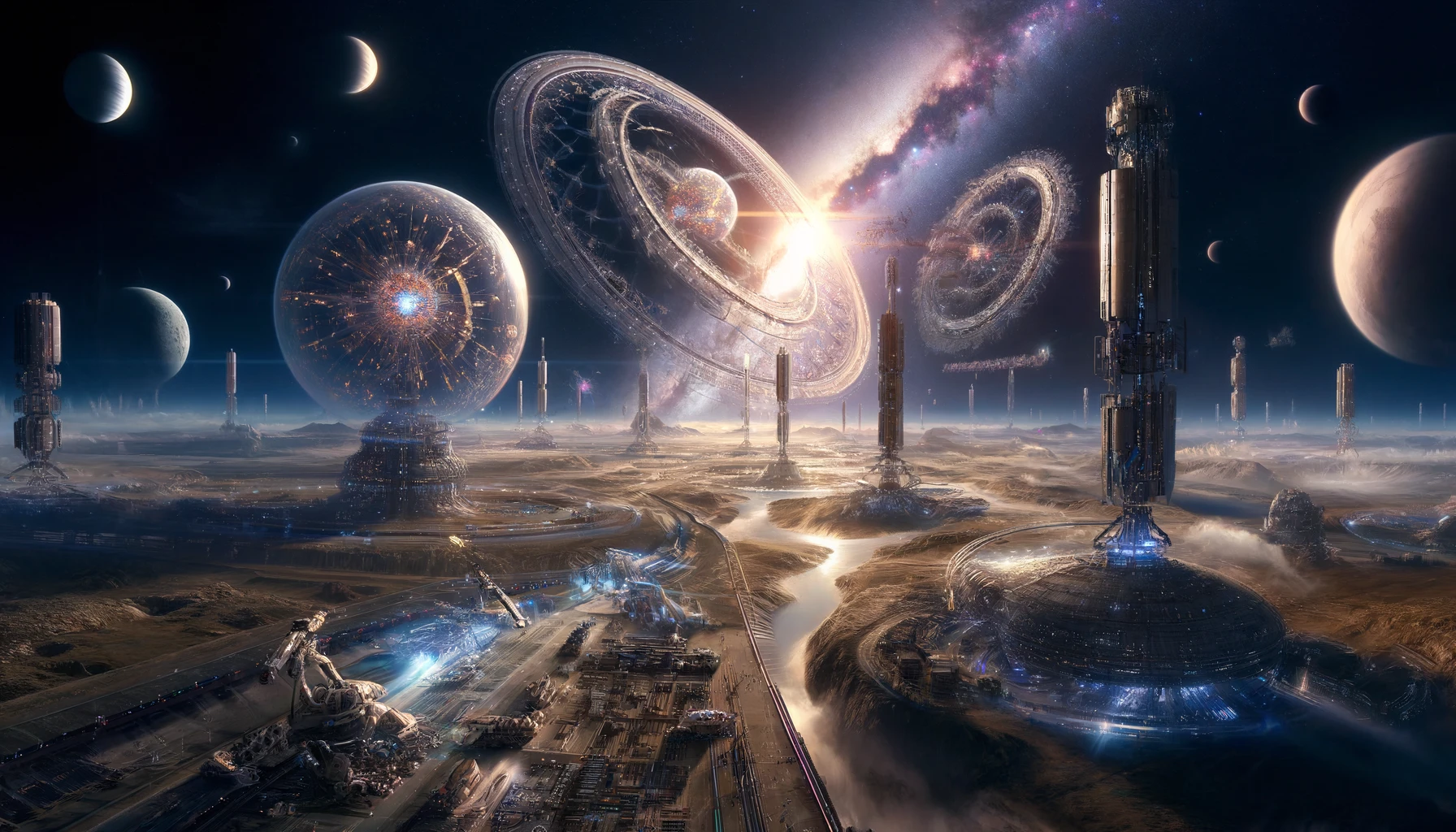
 

— map / TST —

Deep-Dive Article: TST Futurism Timeline
Michael Alan Prestwood
Author & Natural Philosopher
Prestwood writes on science-first philosophy, with particular attention to the convergence of disciplines. Drawing on his TST Framework, his work emphasizes rational inquiry grounded in empirical observation while engaging questions at the edges of established knowledge. With TouchstoneTruth positioned as a living touchstone, this work aims to contribute reliable, evolving analysis in an emerging AI era where the credibility of information is increasingly contested.
This Week @ TST
April 8, 2026
»Column Archive
WWB Research….
1. Story of the Week
Pragmatism
2. Quote of the Week
“Our statements about the external world face the tribunal of sense experience not individually, but only as a corporate body.”
3. Science FAQ »
Why do scientific models work if they aren’t literally true?
4. Philosophy FAQ »
Is agnosticism a ludicrous position to occupy?
5. Critical Thinking FAQ »
Do my people and culture help or harm my critical thinking?
6. History FAQ!
Did Berger and Luckmann really say reality is just made up?
Bonus Deep-Dive Article
TST Doxastic Formation: Public Belief, Tribe, and Worldview

Comments

Join the Conversation! Currently logged out.
NEW BOOK! NOW AVAILABLE!!

30 Philosophers: A New Look at Timeless Ideas

by Michael Alan Prestwood
The story of the history of our best ideas!
Scroll to Top