
Phil • Cr. Think • Science • Hist • …
TST PRACTICE

By Philosopher Michael Alan Prestwood

FAQ

How does the Idea of Ideas handle questions?

☐ Read
☑ Read
You’ve read this 0 times.
You’ve listened to this 0 times.
Wed 21 Oct 2026
Published 3 weeks ago.
Updated 3 weeks ago.
Related FAQs
Does infinity exist?
Universal
Do the empirical and rational categories apply to vocabulary words?
Is math always rational?
Who is the father of numerology?
When does consciousness start?
Share :
Email
Print

How does the Idea of Ideas handle questions?

You know the old adage about questions:

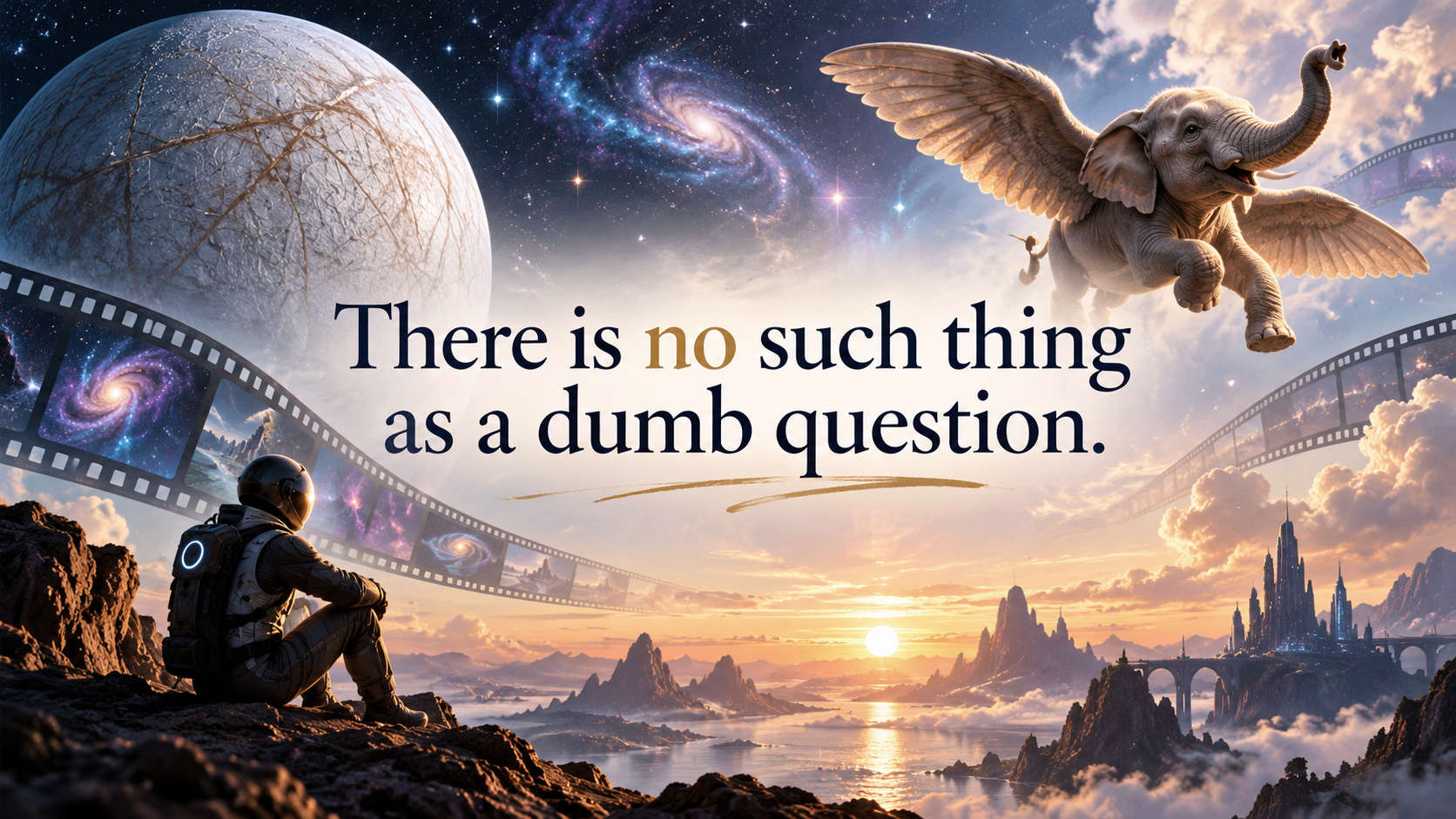
“There is no such thing as a dumb question.”

Well, sometimes old adages carry wisdom. And the Idea of Ideas brings process to that wisdom.

If a question is about the grand rational framework, it’s empirical, rational, or irrational. If it’s about a speculative framework or uses a false presupposition, it’s irrational. The answer itself is different. Answers are about coherence and truth within a framework. That’s different than empirical and rational truth.

The grand rational framework represents our current understanding of reality. Questions about it fall into three categories. Empirical questions clarify the material world directly. Rational questions clarify indirectly. Irrational do neither, but speculative ideas are the the wellspring of future truth, and the disproven clarifies the boundaries of knowledge. The question “Does life exist on Europa?” is speculative without necessarily assuming anything false. “When did elephants begin flying?” contains a false presupposition.

A speculative framework is a framework that includes unvalidated empirical claims, lacks coherence, or contains disproven empirical implications held as true. Think fiction, unproven theories, the currently unknown, and the unknowable. Questions about speculative frameworks are irrational. They have not earned empirical or rational truth status.

For example: “Was Darth Vader Luke Skywalker’s father?” is an irrational question, sure, but within the fictional story it is logically true. To clarify, take: “Do the Star Wars films establish that Vader was Luke’s father?” That’s about reality, it’s an empirical film question with a rationally true answer.
— map / TST —

TST Tracker
✓ Reading recorded.
Part of wisdom is knowing what type of question you're asking before seeking an answer. Empirical questions clarify the material world, rational questions explore relationships, and irrational questions explore speculation or disproven ideas. All are worth asking. Understanding their categories helps us evaluate answers without confusing logical coherence with truth about reality.
Michael Alan Prestwood
Natural Philosopher & Author
Prestwood explores science-first philosophy, with particular attention to the convergence of disciplines. Drawing on his TST Philosophy, his work emphasizes rational inquiry grounded in empirical observation while engaging questions at the edges of established knowledge. With TouchstoneTruth positioned as a living touchstone, this work aims to contribute reliable, evolving analysis in an emerging AI era where the credibility of information is increasingly contested.
The Prestwood Column
Menu
November 2026
Column Research….
1. Timeline Story
Fear-Based Ethics
2. Linked Quote
“A person is a person through other persons; you can’t be human in isolation; you are human only in relationships.”
3. Science FAQ »
Why do complex systems fail when proportionality is removed?
4. Philosophy FAQ »
How does TST Ethics handle the trolley problem?
5. Critical Thinking FAQ »
Why do people confuse rule-following with moral reasoning?
6. History FAQ!
How are original Daoism, Mohism, Confucianism, and Legalism related?
Bonus Deep-Dive Article
TST Moral Calibration: Legal, Moral, and Fair

Comments

Join the Conversation! Currently logged out.
NEW BOOK! NOW AVAILABLE!!

30 Philosophers: A New Look at Timeless Ideas

by Michael Alan Prestwood
The story of the history of our best ideas!
Scroll to Top