
Phil • Cr. Think • Science • Hist • …
TST PRACTICE

By Philosopher Michael Alan Prestwood

FAQ

Does gravity travel, or does it exist everywhere all at once?

☐ Read
☑ Read
You’ve read this 0 times.
You’ve listened to this 0 times.
Wed 21 Aug 2024
Published 2 years ago.
Updated 2 weeks ago.
Related FAQs
What is the TST Ethical Roadmap?
How do knowledge frameworks help transform information into wisdom?
Why are invalid fear-based arguments so effective?
If evolution is true, why haven’t humans evolved in 50,000 years?
Why do people believe wrong things?
When should you stop following the crowd?
Share :
Email
Print

Does gravity travel, or does it exist everywhere all at once?

Light takes eight minutes to travel from the Sun to Earth, does gravity? No, but it’s a bit more complicated than that. To keep it simple, let’s use light to describe what we know.

While light does travel, gravity exists everywhere, all at once as part of the fabric of the universe. That’s what Einstein figured out. Now, if the Sun disappeared, would we feel the effects of that gravity instantly? And then eight minutes later see the Sun disappear? Before Einstein, the answer was yes! Newton described gravity as a force that acts on objects with mass instantaneously.

Einstein showed “the effects” of gravity also travel at the speed of light. So, that “yes” answer went to “no.” So, if the Sun disappeared, we would see and feel the effects eight minutes later.

Einstein’s General Relativity says that thinking of gravity as “traveling instantly” was the wrong way to think about it. In essence, he figured out that gravity is everywhere, all at once. As it changes, those effects change the fabric of spacetime, and those changes ripple out like a wave at the speed of light.

Gravity doesn’t travel; it’s a curvature of spacetime that’s everywhere all at once. However, its effects, like photons of light ripple out like a wave. You can think of it as part of the fabric of spacetime, which is comprised of four fundamental things: gravity, two fields (electromagnetic and Higgs), and a vacuum. While the speculative graviton particle has yet to be found or proven, the others have known carrier particles: photons for the electromagnetic force, W and Z bosons for the weak nuclear force, gluons for the strong nuclear force, and the Higgs boson for the Higgs field.
— map / TST —

TST Tracker
✓ Reading recorded.
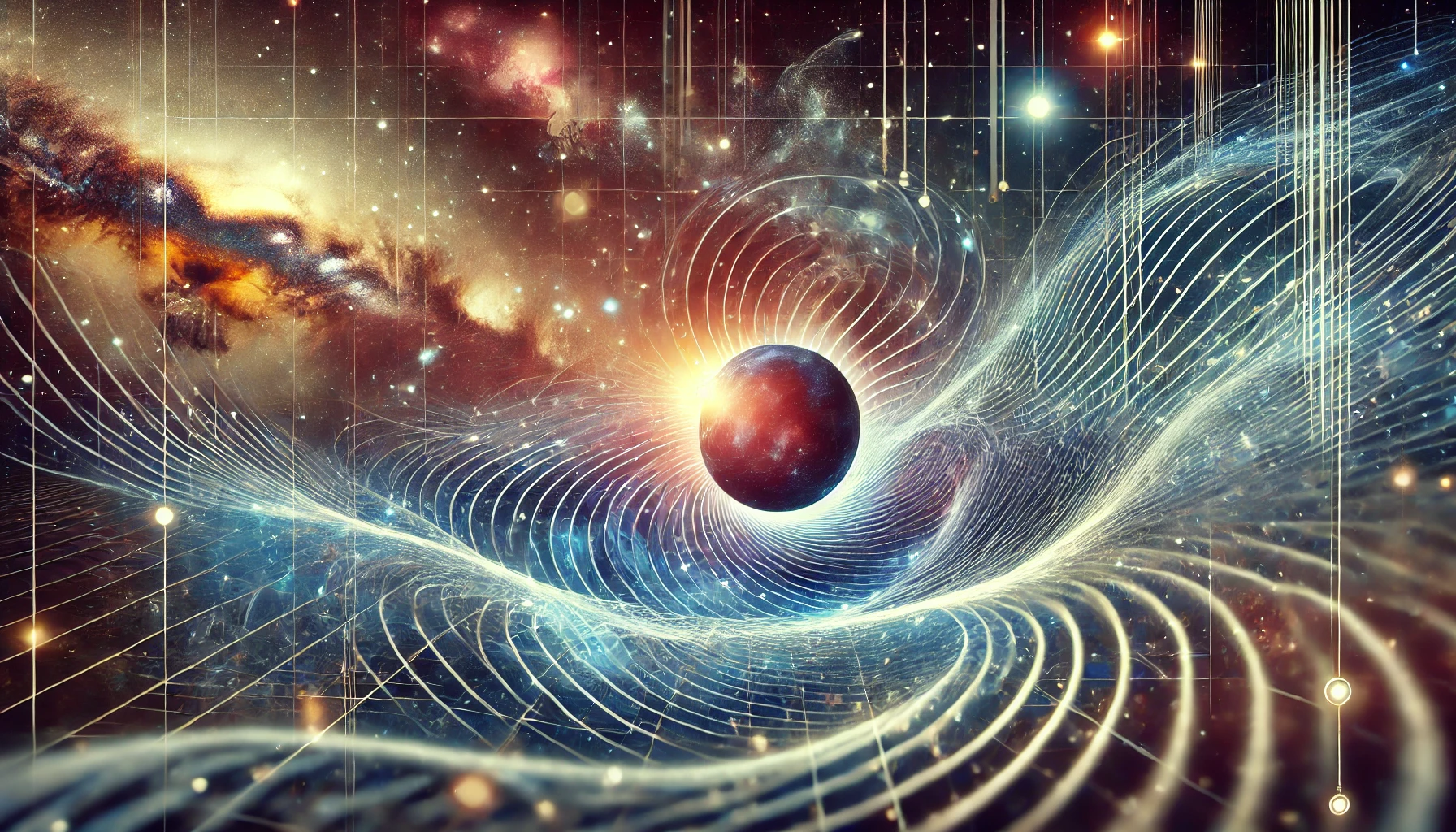
Gravity as a fabric of space-time, with a massive object warping the fabric and distant galaxies and stars in the background. The abstract lines and waves illustrate the gravitational field extending infinitely.
Michael Alan Prestwood
Natural Philosopher & Author
Prestwood explores science-first philosophy, with particular attention to the convergence of disciplines. Drawing on his TST Philosophy, his work emphasizes rational inquiry grounded in empirical observation while engaging questions at the edges of established knowledge. With TouchstoneTruth positioned as a living touchstone, this work aims to contribute reliable, evolving analysis in an emerging AI era where the credibility of information is increasingly contested.
The Prestwood Column
Menu
November 2026
Column Research….
1. Timeline Story
Fear-Based Ethics
2. Linked Quote
“A person is a person through other persons; you can’t be human in isolation; you are human only in relationships.”
3. Science FAQ »
Why do complex systems fail when proportionality is removed?
4. Philosophy FAQ »
How does TST Ethics handle the trolley problem?
5. Critical Thinking FAQ »
Why do people confuse rule-following with moral reasoning?
6. History FAQ!
How are original Daoism, Mohism, Confucianism, and Legalism related?
Bonus Deep-Dive Article
TST Moral Calibration: Legal, Moral, and Fair

Comments

Join the Conversation! Currently logged out.
NEW BOOK! NOW AVAILABLE!!

30 Philosophers: A New Look at Timeless Ideas

by Michael Alan Prestwood
The story of the history of our best ideas!
Scroll to Top