
Explore Natural Philosophy

Phil • Cr. Think • Science • Hist •

FAQ

How does TST Ethics handle the footbridge case?

Mon 6 Jul 2026
Published 2 days ago.
Updated 2 days ago.
Related FAQs
What is the TST Ethics recipe?
What Is the first step toward a flourishing life?
What does it mean to act with good intent?
How does TST Ethics handle the trolley problem?
Why does awareness increase moral responsibility?
Share :
Email
Print

How does TST Ethics handle the footbridge case?

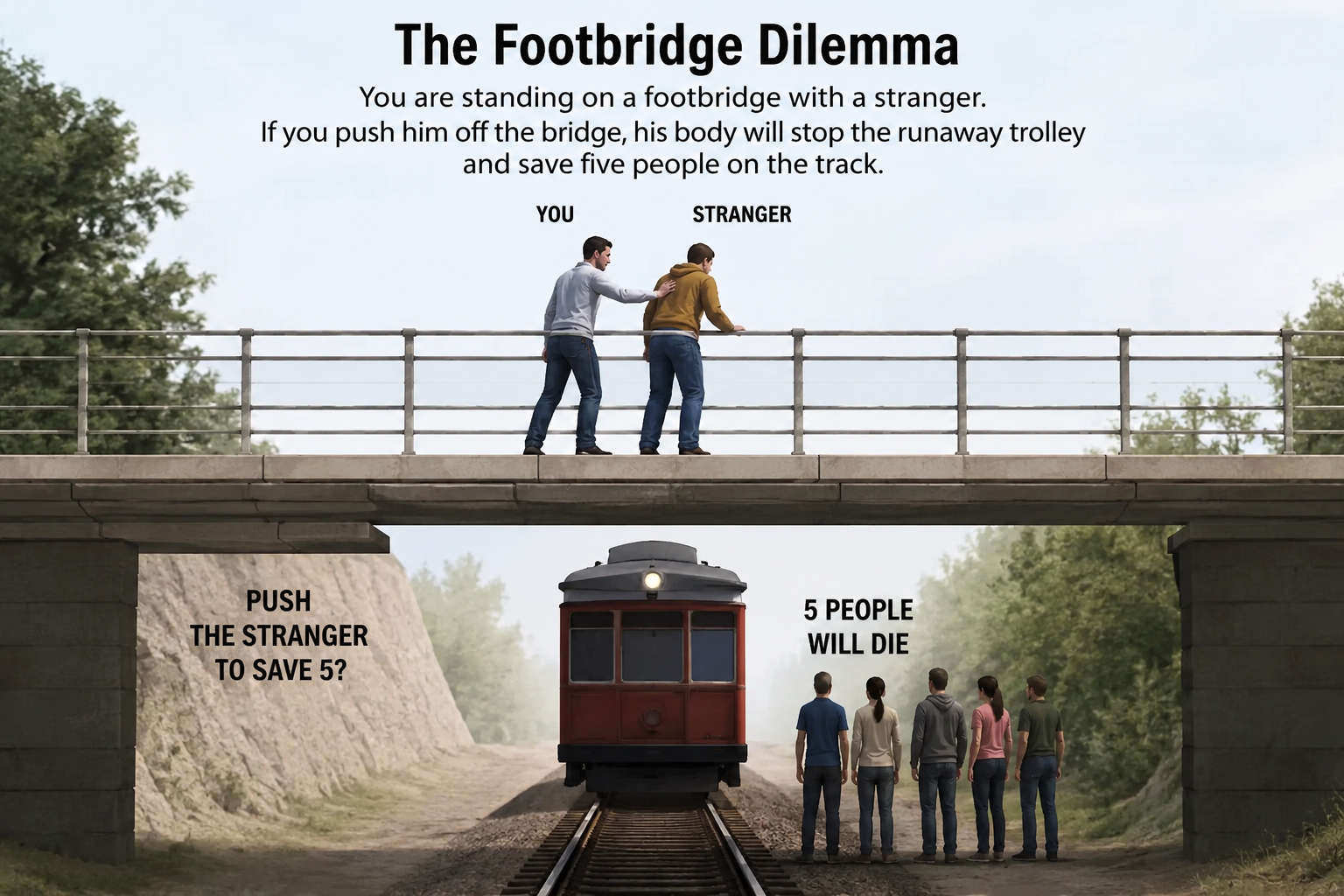
The footbridge case is a variation of the trolley problem, but it changes the moral weight. Instead of pulling a lever to redirect a trolley, you stand on a bridge next to a large stranger. If you push him off the bridge, his body will stop the trolley and save five people. Should you do it?

TST Ethics starts with its recipe:

Group ethics guides. Personal morality chooses. Act with good intent. Weigh the result. Adjust.

To answer clearly, skip ahead to a harsher version of the same moral shape: if one healthy person could be killed and their organs harvested to save five dying people, why not? Shouldn’t hospitals be picking up people off the streets every day, killing them to harvest their organs? The numbers are clear!

Here, group ethics shows the light. Few of us want to live in a world where society can kill a healthy person to save others. The rule would be monstrous. It would destroy trust and violate dignity.

That guiding light helps us return to the footbridge case. Pushing the person off the bridge uses an innocent person as the tool to solve a problem. That is different from pulling a lever and redirecting a threat already in motion.

So, from the group ethics layer, the guidance is clearly not to push. Saving five lives is a powerful result, but the act itself violates the kind of world we can safely share. The footbridge case shows why ethics cannot be reduced to numbers alone.

In the end, personal morality still has to choose. In real life, panic, uncertainty, and impossible pressure matter. But in the clean thought experiment, the guidance is clearer than the classic trolley case: do not push.
— map / TST —

The footbridge case shows why better numbers are not always better ethics. Saving five lives matters, but not by turning an innocent person into a tool. TST Ethics uses group ethics to expose the dangerous rule underneath the act: a world that allows forced sacrifice is not safe to share. Personal morality still chooses, but the cleaner guidance is clear: do not push.
Michael Alan Prestwood
Author & Natural Philosopher
Prestwood writes on science-first philosophy, with particular attention to the convergence of disciplines. Drawing on his TST Framework, his work emphasizes rational inquiry grounded in empirical observation while engaging questions at the edges of established knowledge. With TouchstoneTruth positioned as a living touchstone, this work aims to contribute reliable, evolving analysis in an emerging AI era where the credibility of information is increasingly contested.
The Prestwood Column
Menu
July 2026
»COLUMN ARCHIVE
--COLUMN--
Column Research….
1. Timeline Story
The famous Lewis “Truth in Fiction” Paper
2. Linked Quote
“Truth is stranger than fiction…[which] is obliged to stick to possibilities;”
3. Science FAQ »
Why does fiction feel real?
4. Philosophy FAQ »
Can authors create fiction beyond our universe?
5. Critical Thinking FAQ »
How do we know what is true in a fictional world?
6. History FAQ!
What is the history of philosophy of fiction?
Bonus Deep-Dive Article
TST Philosophy of Fiction: Imaginative Realism

Comments

Join the Conversation! Currently logged out.
NEW BOOK! NOW AVAILABLE!!

30 Philosophers: A New Look at Timeless Ideas

by Michael Alan Prestwood
The story of the history of our best ideas!
Scroll to Top