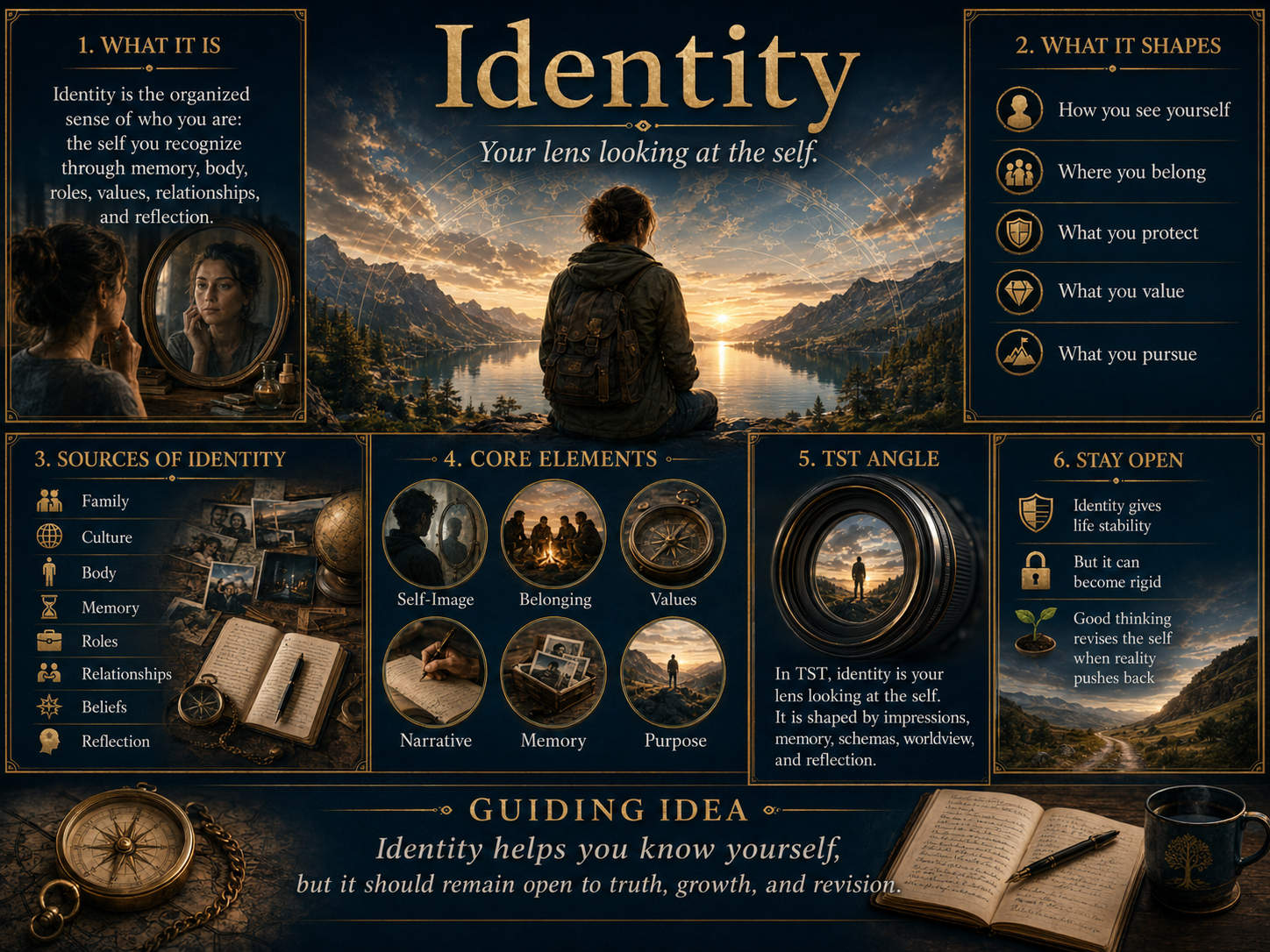
Identity is how you see yourself in life. Your sense of self. It is shaped by your birth, past, and current circumstances. Your birth circumstances are the traits you inherited. Things like your sex at birth, inherited language, culture, and spacetime. Someone born in ancient China has a very different set of birth circumstances than someone born in the 1960s in California. Your past circumstances are the things that have impacted your life up to this point of your journey. Things like your education, injuries, what happened to you, the people you care about, and the things you’ve seen. Your current circumstances include things like where you live, how much you make, your sexual identity, and the people, things, and events around you now.
These personal mosaic of attributes set you apart as an individual. But it also includes your choices: affiliations, accumulated knowledge, habits, values, work, place, and preferences.
In 30 Philosophers, identity is tied closely to worldview. Your identity is shaped by the worldview you embrace and mold. At the same time, your identity influences how you perceive the world. Two people can experience the same event and interpret it differently because they bring different identities and worldviews to the moment.
Identity is not perfectly fixed. It evolves with your journey. Your age changes. Your body changes. Your relationships change. Your work, home, beliefs, and priorities may change. Sartre’s idea that “existence precedes essence” fits here: we are not born with a fully finished identity. We define it through living.
Identity is real, but dynamic. It is not an eternal stone statue hidden inside you. It is a living pattern, shaped by birth, culture, choice, memory, action, and impermanence. You are partly given, partly formed, and partly self-created.