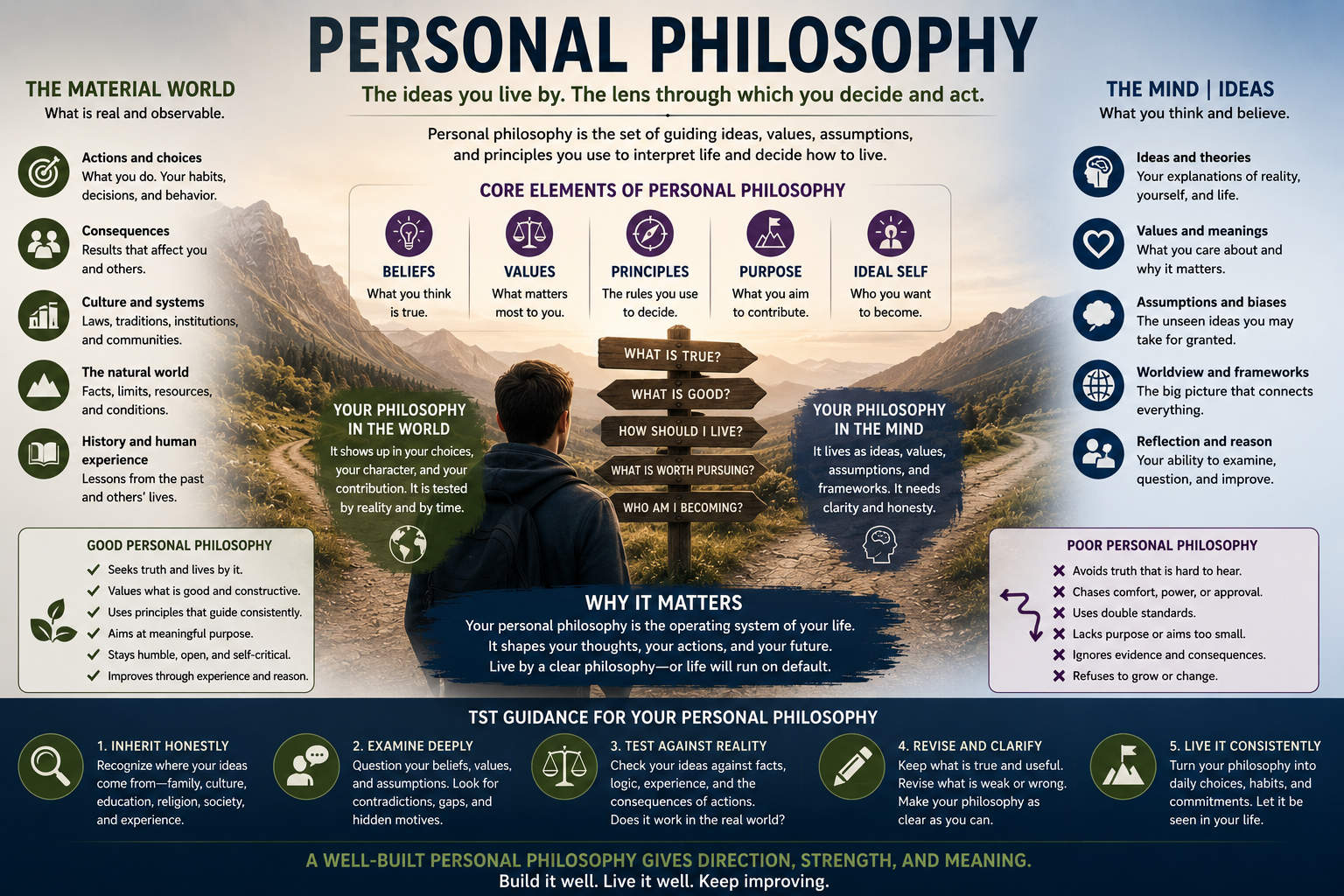
Personal philosophy is the set of ideas you use to interpret life and decide how to live.
Chapter 7 of 30 Philosophers says this:
Philosophy helps us make sense of the world. It’s a harmonious dance between belief and science intertwining the known, unknown, and unknowable.
Personal philosophy is your set of guiding ideas, values, assumptions, and principles. It’s how you interpret life and decide how to live. It includes what beliefs matter to you, what you think is true, how you handle uncertainty, what you pursue, and what you think a good life requires.
Within your worldview, your personal philosophy is the more conscious layer of the lens. It includes the ideas you know you live by, but it also points toward hidden assumptions that may need evaluation. Your personal philosophy inherited language, religion, culture, family rules, political beliefs, and moral schemas. To think well and become your authentic self, you must examine them.
Personal philosophy belongs on the ideas side of the TST metaphysical split. In the material world, your philosophy shows up through your actions, intent, and results. In your mind, it exists as ideas in the form of frameworks with overlapping schemas. Do not let your personal philosophy float free from reality. Test it as you experience life, use reason when you reflect, and evaluate public belief from your view in this world.