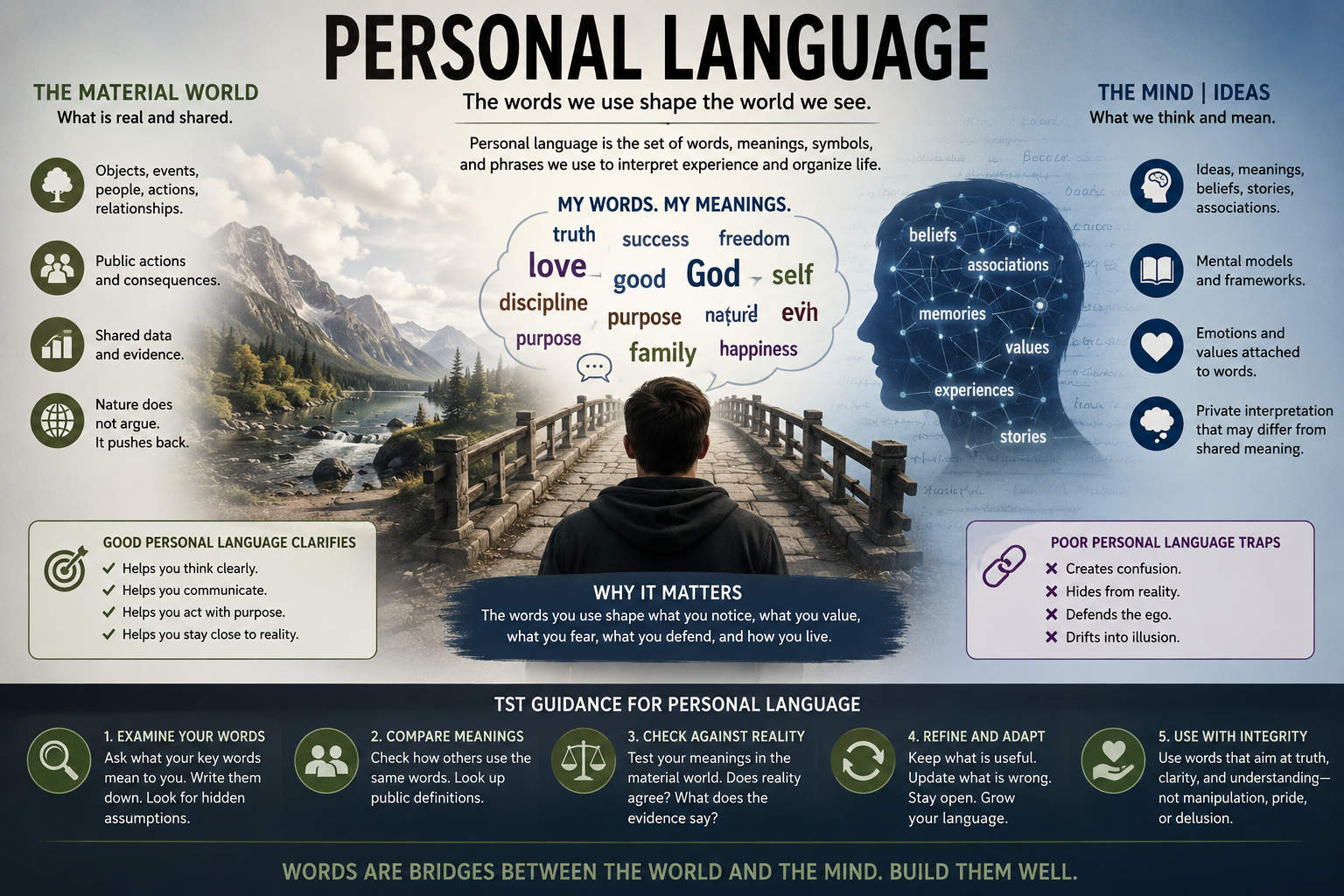
Personal language is the private meaning-world you carry inside words.
Chapter 7 of 30 Philosophers puts it this way:
Within each language, there are countless variations that make each person’s use of language unique. Your version of language was influenced by more than where you grew up. It was also shaped by your experiences, and the beliefs and cultures you embraced. Your personal language asserts your identity, your group, your subculture. The way you speak reflects who you have chosen to be as an individual. You are the author of your own narrative, crafting your voice to reflect who you are.
Two people can use the same word and mean slightly different things because each person brings a different history to it. Words are never just dictionary entries. They carry personal context.
Words like “freedom,” “God,” or “justice” do not land the same way in every mind. They arrive with memory, culture, and emotion already attached. That is why disagreements are often not just about facts.
In TST, personal language is one of the three major abstractions of worldview, alongside personal religion and personal philosophy. Your language shapes the categories you use to divide reality. It shapes what you can name, what you can compare, and what you can question.
This is why definitions matter so much.
When you clarify language, you clarify thought.
When you understand another person’s language from the inside, dialogue becomes easier.