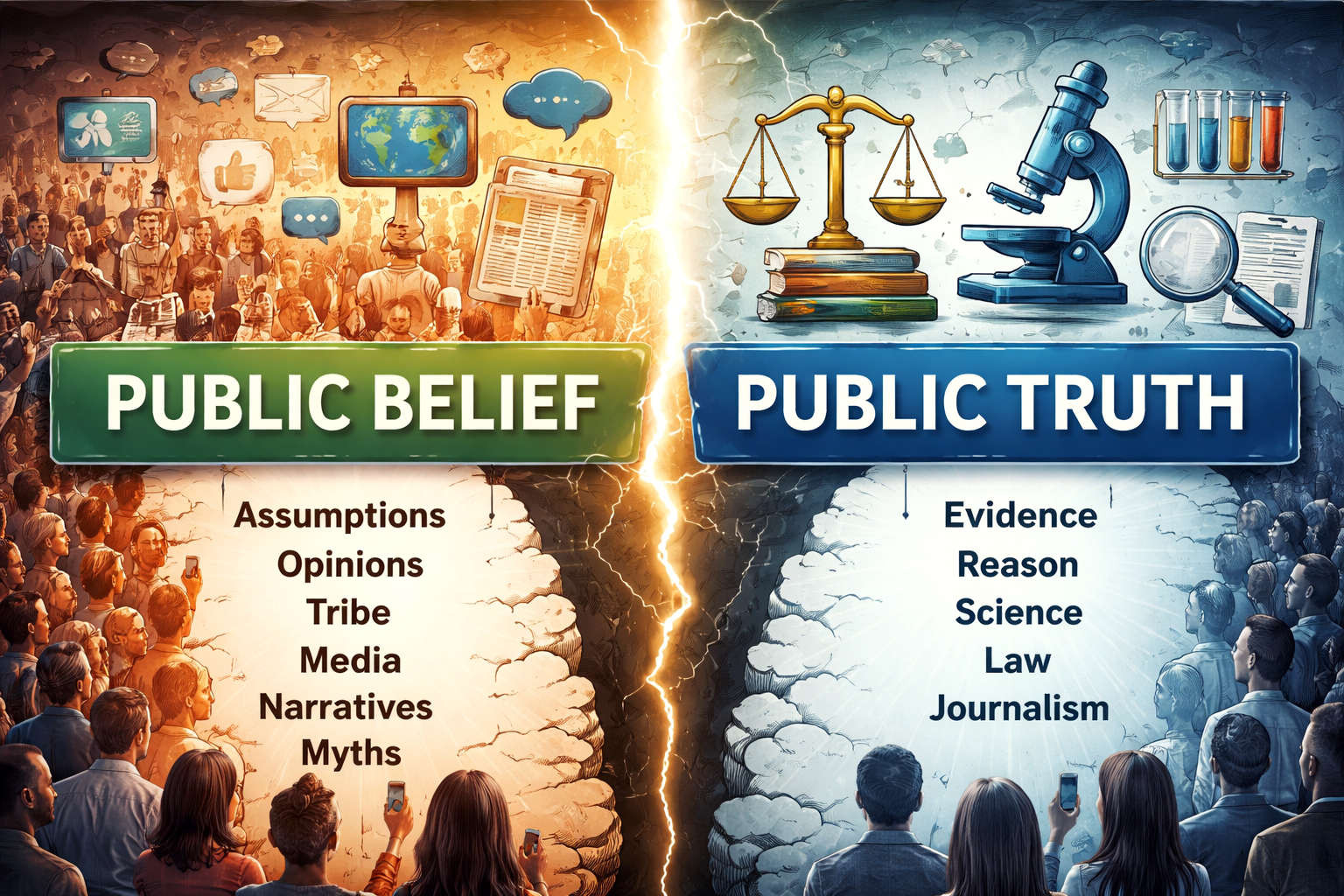
In philosophy generally, public belief is the collection of claims, assumptions, and accepted ideas circulating in a society. Public truth is narrower. It points to what actually deserves to stand as true in public discussion. The two often overlap, but they are not the same. A society can widely believe something and still be wrong. It can also resist a truth for centuries before finally admitting it. Public belief is what people carry together. Public truth is what survives serious challenge.
In TST, that distinction matters a great deal because truth and belief are not the same kind of thing. Truth belongs to reality in the form of three truth hammers: science, law, and journalism. Belief belongs to minds trying to track reality. That means public belief names the broader social layer of inherited and shared claims, while public truth names the narrower class of claims that can justify themselves in the open through evidence, criticism, and staying power. In short, public belief is the social starting point. Public truth is the stronger destination.
In TST, public belief is the wider cultural pool we are born into. It includes what we are taught in school, hear in conversation, absorb from institutions, repeat through media, and inherit from the people around us. It is one of civilization’s great strengths because none of us can rebuild societal knowledge from scratch. But it is mixed. It carries some of our best common knowledge, but it also carries half-truths, simplifications, prestige opinions, social myths, and inherited mistakes. So public belief is necessary, powerful, and unavoidable, but it is never the final court of truth.
In TST, public truth is the stronger target, and it is tested with the Three Truth Hammers: Science, Law, and Journalism. Science tests claims against the material world through observation, evidence, and repeatable results. Law tests claims through structured argument, standards of proof, and the disciplined weighing of competing evidence. Journalism tests claims in public life by gathering facts, checking sources, and bringing contested events into the open. None are perfect, but together they form three of our strongest public methods for separating what merely circulates from what earns the right to stand as public truth. A belief may be comforting, identity-shaping, and deeply meaningful, yet still fail under these tests. That is part of the discipline of TST: respect the person, but do not lower the truth standard.
So the short version is this: public belief is what society carries; public truth is what earns the right to endure.