

The Three Truth Hammers, like the Four Mind Traps, employ the Five Thought Tools. The Three Truth Hammers are Science, Law, and Journalism, which serve as reliable authorities within the Appeal to Authority fallacy — one of the many Logical Fallacies.
Good authorities are part of the Mainstream Media, and it’s not hard to find them!
While these Truth Hammers generally provide dependable results, it is essential to remember that each scientific conclusion, legal trial, and journalistic article is still subject to ongoing peer review. The level of rigor required in peer review increases with the number of questions and doubts raised. As critical thinkers, it is our responsibility to learn how to review and evaluate the outcomes provided by the Truth Hammers, ensuring that we make informed decisions, solve complex problems, and communicate effectively with others.
For the purpose of this work:
A truth hammer is a process that aims to uncover a specific truth using empirical data, logic, reason, and facts.
I use the term truth hammers to describe three useful processes in society aimed at uncovering truth: science, law, and journalism. Within these broad topics are processes aimed at uncovering a specific truth: namely, the scientific process, a legal trial, and the publishing of reporting, journalism, and opinion articles. Science uncovers empirical evidence and furthers our understanding of the natural world. Law establishes frameworks for justice and fairness, promoting ethical conduct and accountability. Finally, journalism fosters transparency and informs the public, empowering citizens with knowledge to make informed decisions. There are arguably more truth hammers, but the focus of my work is on these three.
Other useful tools within these truth hammers and tangent to them include education, philosophy, history, art and literature, peer review, open and transparent government, and public debate and discourse. Education equips individuals with knowledge, critical thinking skills, and the ability to discern truth from falsehood. Philosophy, through critical examination of beliefs and logical reasoning, refines our understanding of truth and guides our quest for wisdom and meaning. History, art, and literature reveal profound truths about human nature, emotions, and experiences, while peer review in academia ensures reliable and credible knowledge dissemination. Open and transparent government and public debate promote a shared understanding of truth in various domains. These tools, in conjunction with the original three truth hammers, contribute to the ongoing quest for truth.
Levels: Each of the Three Truth Hammers operates at different levels of cognitive processing, from basic understanding and application to higher-order analysis, synthesis, and evaluation. By engaging with these Truth Hammers, individuals can develop their critical thinking skills and gain a deeper understanding of the world around them. Additionally, applying intellectual standards such as clarity, precision, accuracy, relevance, depth, breadth, and logical consistency can help individuals harness the power of the Truth Hammers to enhance their critical thinking abilities.
I. Science
Science represents the rules of the material world. Science is a systematic approach to understanding the natural world through observation, experimentation, and the development of testable hypotheses. By employing the scientific method, we can build a reliable and consistent body of knowledge that helps us make sense of the world around us. Science plays a vital role in critical thinking by providing a robust framework for questioning assumptions, testing ideas, and refining our understanding of reality.
The Scientific Method
In science, you put forth a theory. Construct experiments to prove or disprove it. You publish your findings. Other scientists try to prove you wrong so they can make a name. If they agree, they support you and get “a little” glory but not as much as if they struck you down. Also, they try to add to the theory if warranted. If a scientist gets it wrong, the theory is dropped.
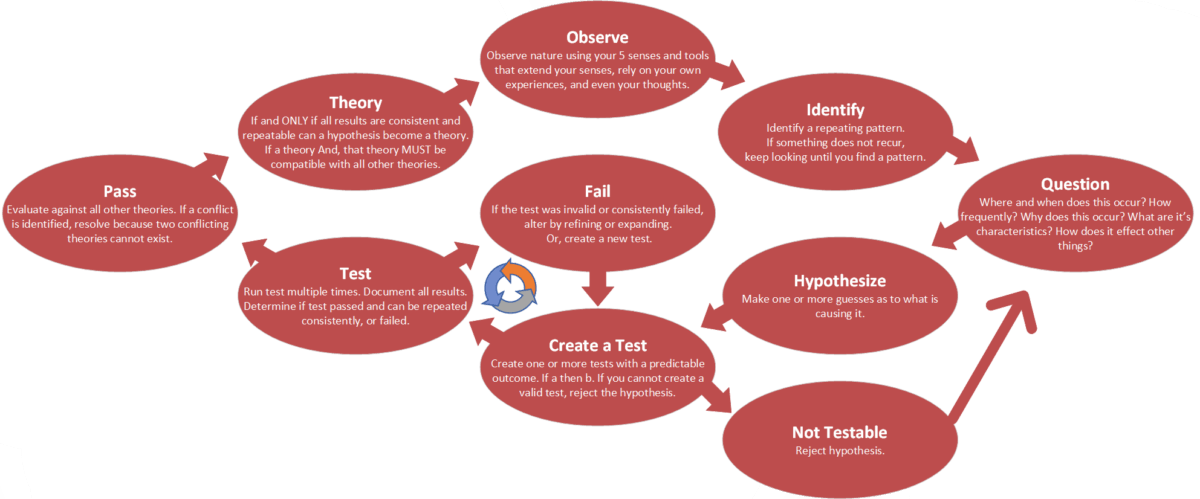
U.S. Constitution: Government Shall Promote Science!
Science is a fundamental need identified by our Founding Fathers.
“Section 8 – Powers of Congress
The Congress shall have power…
To promote the Progress of Science and useful Arts, by securing for limited Times to Authors and Inventors the exclusive Right to their respective Writings and Discoveries;”
Science Around the World
The scientific process is nearly exactly the same in every country, all over Earth.
II. Law
Law represents the rules of society. Law is a system of rules and principles designed to govern human behavior and ensure justice, fairness, and order in society. Legal reasoning and argumentation are crucial components of critical thinking, as they involve the careful analysis and evaluation of evidence, interpretation of statutes and case law, and the application of legal principles to specific situations. By understanding the foundations of law and legal reasoning, individuals can develop their critical thinking skills and make more informed decisions about their actions and the consequences they may have.
The Rule of Law
In law, cops catch criminals, gather evidence. Prosecutors present that evidence to a jury. The American legal system is geared toward the innocent. You are presumed innocent until proven guilty. The jury has to decide 12-0 for guilty, or the person walks. If you are found not guilty, you cannot be retried for the same crime. If you are found guilty, but new evidence is presented that clears you, you are set free. If cops fake evidence or testimony, or prosecutors abuse the system they are penalized.
America’s Constitutional-Based Law and Checks and Balances
Laws, rules, and regulations have jurisdiction, a boundary. In America, Federal laws apply within the boundaries of America. State laws within the boundaries of a state, and similarly for County, and City laws. When Federal laws conflict with state laws, the Federal law takes precedent. This was established by our Founding Fathers in the Supremacy Clause of Article 4 of the U.S. Constitution.
Article 2, The Articles of the Confederation:
“Article 2. Each state retains its sovereignty, freedom, and independence, and every Power, Jurisdiction, and right, which is not by this confederation expressly delegated to the United States, in Congress assembled.” –1777
The 10th amendment clearly completes the same meaning as Article 2 of the Articles of the Confederation.
10th Amendment:
“The powers not delegated to the United States by the Constitution, nor prohibited by it to the States, are reserved to the States respectively, or to the people.”
Finally, this law was held up in the Supreme Court case of McCulloch v. Maryland (1819). It’s clear. Congress, which represents the states, can pass any constitutional federal law they wish including laws that give powers to or take powers from the Federal Government.
Law Around the World
America’s bottom-up Democracy with constitutional checks and balances has lead the world’s efforts for bottom-up Democracy for several centuries now, but there is no reason to expect it will last forever. At least not without proper attention by the people. Other countries have had tremendous difficulty duplicating America’s unique balance of powers. Our rule of the people, by the people, and for the people is still relatively unique in the world. Democracy in other countries tends to come and go depending on the strength of the leader.
The great debate of top-down (trickle-down) versus bottom-up democracy continues around the world and centers around who should lead? Is a society with a strong leader run top-down better than a bottom-up democracy? Is a leader like a King above the rule of law? Who decides? Decisions are much easier with a King, but you are also at the whims of a King. A Democracy up society based on law and a Constitution and a balance of powers is messy, slow, and, at times, ugly, but you avoid the whims of an individual leader.
III. Journalism
Journalism serves as a vital source of information, providing the public with accurate, timely, and relevant news and analysis. Journalistic principles, such as objectivity, fairness, and ethical reporting, are essential components of critical thinking. By evaluating the credibility and reliability of journalistic sources, individuals can discern between fact and fiction and make better-informed decisions about the issues that matter most to them.
The Process of Journalism
In journalism, you compare reporting to reality and come up with “the truth”. You put forth an article including your evidence, reason, and logic. Other journalists try to prove you wrong so they can make a name. If they agree, they try to find additional details to extend the story. If reporters get reporting wrong, they can no longer be a reporter. If journalists publish bad conclusions, their reputation goes down and they cannot work for the mainstream media (MSM).
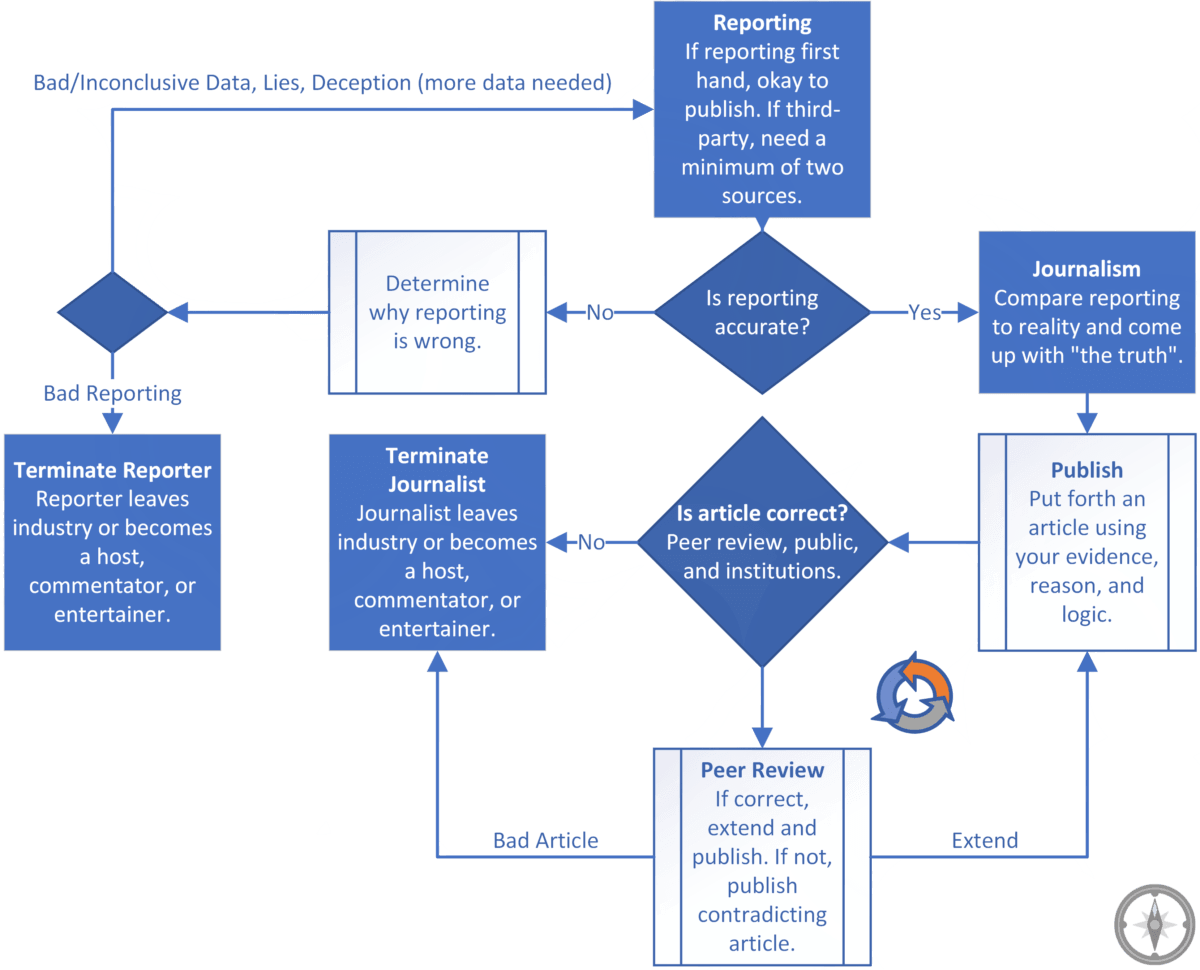
Our Founding Fathers thought of journalism, the press, as the fourth estate for a reason. Journalism is one of the checks and balances they set up.
The First Amendment specifically names only one industry, “the press”:
Congress shall make no law respecting an establishment of religion, or prohibiting the free exercise thereof; or abridging the freedom of speech, or of the press; or the right of the people peaceably to assemble, and to petition the Government for a redress of grievances.
The term “Fourth Estate” makes implicit reference to the earlier historical division of the Three Estates of the Realm:
- First Estate: the clergy,
- Second Estate: the nobility,
- Third Estate: the commoners.
These terms were used to define society. Our Founding Fathers needed to redefine the estates and they chose three equal branches of government.
- legislative,
- executive,
- judicial.
They also established the press, true journalism, as the fourth estate when they explicitly named that industry in the very First Amendment.
What does it mean to be a journalist?
Usually, it means two things, you have a journalism degree, and a major news outlet with a good reputation will hire you and allow you to use the title reporter, journalist, correspondent, investigative journalist, or anchor.
Mainstream Media Sucks!
It is clearly difficult for many to identify true journalism within the MSM. Here’s an easy two-step process for identifying true journalism from all the crap. For each piece you watch or listen to, use this simple two-step process.
Two-Step BS Checker Process:
- First check to see if the piece says OPED, opinion, or commentary. If it does, well, it’s not true journalism so take it as just what it is, opinion not based on journalism. In fact, when searching for truth, avoid opinion pieces altogether.
- Second, find out who the author is and Google them. If their “current” title is reporter, journalist, correspondent, investigative journalist, or anchor, you know they are trying to do journalism. Proceed. If they have another title such as Host, Commentator, Entertainer, or Blogger then they are not practicing journalism. Many partisans are paid and are not even trying to find and tell truth. Avoid them when you are searching for truth.
Notice this process does not take into account the media source. This is because true journalism can come from anywhere. It is true that national media outlets like ABC, NBC, CBS, Fox News, CNN, and MSNBC will abide by the titles and OPED rules extremely strictly, but that does not mean you should discount local affiliates, independents, nor partisans.
Even Breitbart.com?
Yes, as of October 2019 even Breitbart.com obeys these journalism rules. You’ll notice almost none of the writers for Breitbart call themselves journalists, reporters, correspondents, or anchors. They simply list out some educational degree and state what they write on. For example, when you click on Edwin Mora, he is listed as follows:
Edwin Mora primarily covers national security and politics. He has a Communication degree (Journalism concentration) from George Mason University.
Notice he has NO TITLE. Yes, he does mention he has a journalism concentration, but he is not a journalist. He is not practicing a process aimed at finding and conveying truth. Anyone who reads stuff at Breitbart.com needs to understand it’s crap by design and intent. You can read it, sure, but if your goal is truth, you need to verify each fact and conclusion. Or, better yet, just avoid media outlets like this altogether.
Now what?
Once you find a non-opinion piece by a reporter, journalist, correspondent, investigative journalist, or anchor you can put weight into the article and know that if anything is found to be wrong about it, it is corrected. Every time. No exceptions. That doesn’t mean what’s in the piece is perfect now, but it’s believed to be perfect now. Evaluate and weigh each fact and conclusion using logic, reason, and other facts and conclusions by other journalists.
Should I always ignore opinion pieces?
Yes, if your current goal is discovering truth. If you do read an opinion piece and weigh each fact and conclusion against the truth hammers of journalism, science, and law, you’re good. Proceed. But, for most of us most of the time, that’s too much work.
Note: I am not a journalist, but I am trying to follow logic and reason and rely heavily on the truth hammers. I want to be a trusted good authority. If you find a mistake, a bad fact, or illogical argument on this site, contact me so that I can update the page. My goal is to increase the amount of useful information in the world.
What about investigative journalism?
An “investigative journalist” is someone researching and pushing for truth. But, they are still journalists, practicing journalism. They will correct their mistakes, but they will make more mistakes than a journalist.
When Journalism Goes Wrong
If reporters get reporting wrong, they can no longer be a reporter. If journalists publish bad conclusions, their reputation goes down and they cannot work for the MSM as a reporter or journalist. If they made a small mistake, they sometimes try to be an investigative journalist. If they screw that up, they become a host, entertainer, commentator, or blogger.
Some 2018/19 Examples
Sean Hannity was a reporter, now a host and entertainer. Geraldo Rivera was a reporter, then journalist, then investigative journalist, now he’s back as a reporter (the bottom), but mostly a talk show host and commentator. No one will hire him as a journalist. Brian Williams was an anchor (the top), but is now a journalist. He was fired, and no one would hire him for 5 months because he exaggerated ONE set of facts and repeated it, and took years to correct it. Now he’s back to being a journalist and hosting an 11PM late night spot in an effort to rebuild his reputation, and has earned the title “anchor” again, but he still has a way to go to rebuilding his reputation.
FoxNews.com, Faux News
FoxNews.com is an interesting use case. Most are entertainers on there. They have very few reporters and journalists.
Shep Smith is an anchor. Listen and watch him, he is a journalist. He tells the truth with a right-wing slant. Most Trump supporters hate him for that. He’s just about the only truth teller on Fox News.
Chris Wallace is also an anchor, but he is also a political commentator. That’s what gives him the permission to spin, and stretch the truth. So, you can listen to him, at times. But not always. Just depends on if he is anchoring, or commenting. Chris Wallace while interviewing Trump about Trump’s enemy of the people said directly to Trump, “[You, Trump, are] a beacon for repression around the world.” He explained to Trump how dictators around the world are using Trump to justify suppressing media.
Neil Cavuto calls himself an anchor, commentator, and business journalist. Meaning, for business, he wants you to take him seriously, but for politics and the rest he is either reporting as an anchor, or commenting. His commenting is all over the place.
Anyway, it works. Try it! The industry does NOT let people call themselves a reporter if they do journalism, and you fail as a reporter if you report something wrong. Do it too many times, you’re out! Finally, journalist have to get their conclusions right, correct themselves immediately when wrong; otherwise, they become hosts, entertainers, or commentators.
Journalism Around the World
Although journalism is practiced all around the world, it is alive and well only in specific locations and at specific times in history. Right now journalism is alive and well in many places in the world including Canada, the U.K., etc. In America, journalism is under attack for the first time in a very long time by the bad leader Donald Trump. His attack on journalism is one of the reasons Trump will go down as one of the worst Presidents in American history.
Conclusion
Science, journalism, and law are processes that can help one get closer to the truth. They are quests to define our reality, truth hammers. They represent the best estimate of truth based on current evidence. Although they are a quest for truth, they do not represent truth itself. They are tools at our ready for analyzing various subjects. Their conclusions represent the best estimate of truth based on current evidence. The conclusions they offer may be wrong, but the processes involved with science, journalism, and the law have mechanisms for updating and correcting bad facts, and invalid conclusions. In a confusing world, they represent the truth at least until a fact is proven wrong or an argument is invalidated.