
Explore Science-first Philosophy

QUOTE

“Our statements about the external world face the tribunal of sense experience not individually, but only as a corporate body.”
Worldviews
Related Quotes
“Identity is easy — it’s me, whatever that is.”
“I have a worldview. So do you.”
“Reality is self-creating by definition… our impressions of it are what we use to build knowledge.”
“It is wrong always, everywhere, and for anyone, to believe anything upon insufficient evidence.”
“Nothing is enough for the man to whom enough is too little.”
Share :
Email
Print
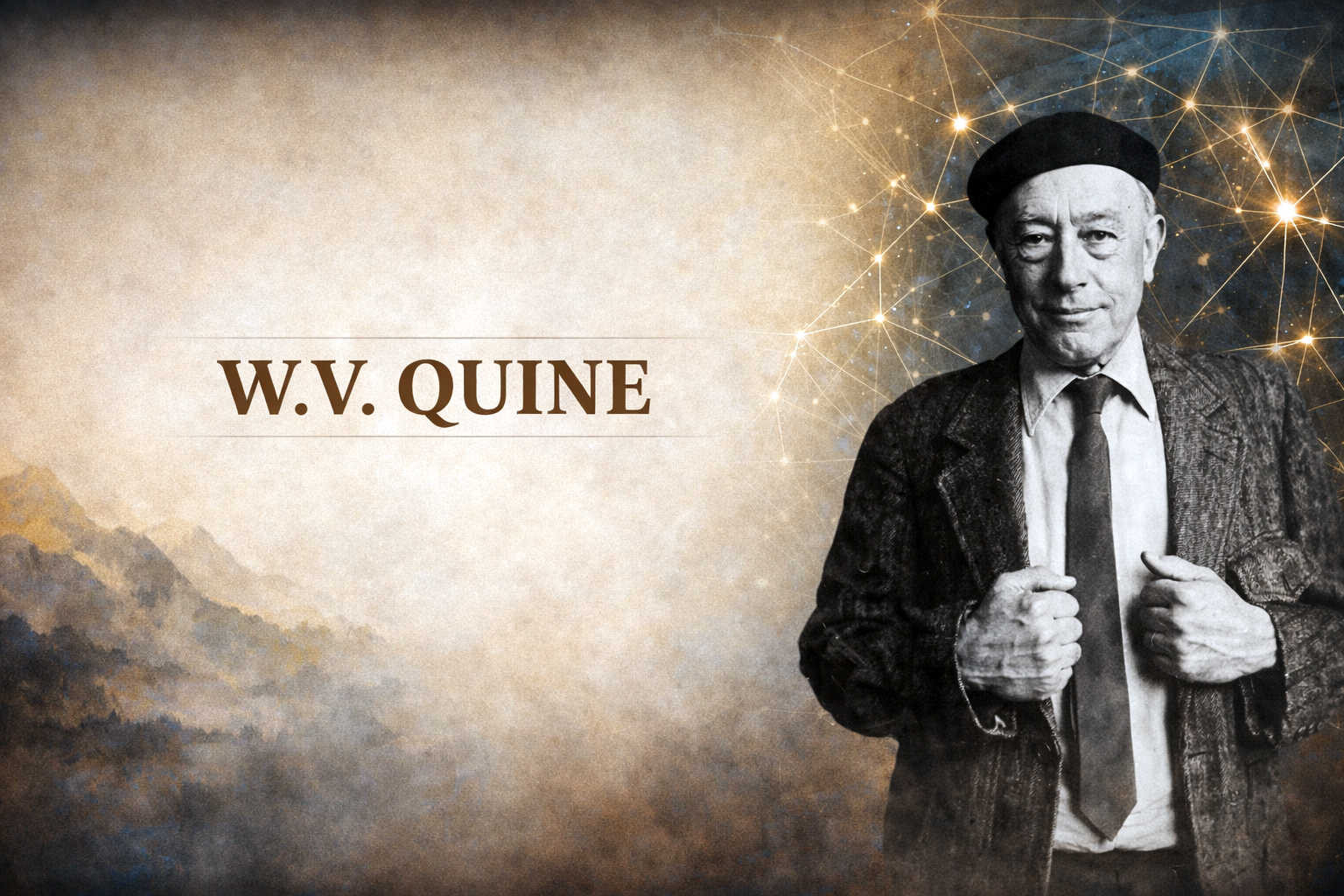
W.V. Quine: Your beliefs do not stand alone. They hang together in a larger web.

Mike's Takeaway:

People do not revise beliefs one at a time in a vacuum. They protect central beliefs, sacrifice peripheral ones, and reinterpret new evidence through a larger web.

Quine’s point here is that beliefs are not usually tested one at a time. They hang together. A single claim about reality rarely walks into experience alone. It arrives with background assumptions, supporting ideas, habits of thought, and a larger structure already in place. That is why this quote connects so naturally to worldview. From Quine’s point of view, what we believe forms more like a web than a stack of separate bricks. Experience presses on the whole structure, and then we adjust different parts of it as needed.

That fits my work because I also reject the idea that people hold beliefs as isolated units. In my writing, worldview is the deeper interpretive structure through which beliefs are sorted, integrated, defended, or revised. Where Quine gives us a web of belief, I push further into the lived human side of that structure by framing worldview around personal language, philosophy, and religion. We do not merely test claims. We test them from within a larger framework that helps decide what even feels believable in the first place.

Willard Van Orman Quine was an American philosopher and logician born in Akron, Ohio, in 1908. He spent his career at Harvard and became one of the major figures in twentieth-century analytic philosophy. He is especially known for his 1951 essay “Two Dogmas of Empiricism,” where this quote appears and where he challenged the sharp divide between truths supposedly true by meaning alone and truths grounded in experience. He died in 2000.

In the broader academic world, Quine matters because he helped reshape how philosophers think about meaning, evidence, and theory. His critique of reductionism and his more holistic picture of belief became part of the backbone of later debates in epistemology, philosophy of science, and analytic philosophy more broadly. Even scholars who reject parts of his view still have to reckon with him, and that is one mark of a major thinker.

Analysis By Michael Alan Prestwood
04 Apr 2026
Published 3 hours ago.
Updated 1 day ago.
Michael Alan Prestwood
Author & Natural Philosopher
Prestwood writes on science-first philosophy, with particular attention to the convergence of disciplines. Drawing on his TST Framework, his work emphasizes rational inquiry grounded in empirical observation while engaging questions at the edges of established knowledge. With TouchstoneTruth positioned as a living touchstone, this work aims to contribute reliable, evolving analysis in an emerging AI era where the credibility of information is increasingly contested.
This Week @ TST
April 8, 2026
»Column Archive
WWB Research….
1. Story of the Week
Pragmatism
2. Quote of the Week
“Our statements about the external world face the tribunal of sense experience not individually, but only as a corporate body.”
3. Science FAQ »
Why do scientific models work if they aren’t literally true?
4. Philosophy FAQ »
Is agnosticism a ludicrous position to occupy?
5. Critical Thinking FAQ »
Do my people and culture help or harm my critical thinking?
6. History FAQ!
Did Berger and Luckmann really say reality is just made up?
Bonus Deep-Dive Article
TST Doxastic Formation: Public Belief, Tribe, and Worldview

Comments

Join the Conversation! Currently logged out.

Leave a Reply

NEW BOOK! NOW AVAILABLE!!

30 Philosophers: A New Look at Timeless Ideas

by Michael Alan Prestwood
The story of the history of our best ideas!
Scroll to Top