


What is confirmation bias, and why does it matter?
Confirmation bias distorts our interpretation of reality by filtering evidence through prior belief.

What is worldview humility?
Most convictions feel universal because they are familiar. Worldview humility begins when we recognize the role of time, place, and culture in shaping what feels ...

Is the Split in the Idea of Ideas the Same as Kant’s?
Kant showed that human experience filters reality; the Idea of Ideas extends that insight by classifying our explanations into empirical, rational, and irrational.

Why do we struggle to recognize the limits of our own thinking?
Good thinking requires recognizing where explanation stops -- where evidence stops.
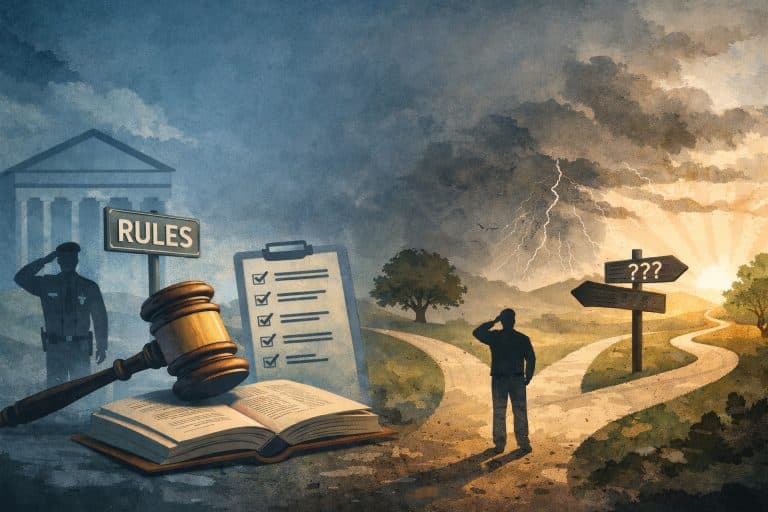
Why do people confuse rule-following with moral reasoning?
Rules can guide behavior, but moral reasoning requires judgment—and judgment cannot be outsourced to authority.

Why do intelligent people defend bad ideas?
Intelligence doesn’t protect us from false beliefs—worldview attachment does the real work.

What’s the difference between intentional change and wishful thinking?
Mistaking intention for causation is a core thinking error that keeps habits, self-stories, and outcomes locked in place.

Why we only remember the good parts of vacations and forget the bad?
Rosy Retrospection, a cognitive bias that filters memory through emotion, preserving highlights. Minds quietly edit experience, shaping memory.

Is Occam’s Razor always right?
In the realm of idea evaluation, Occam’s Razor is a tool that stands out, but it was never meant as a law of truth. It's ...

Was Pythagoras’ thinking flawed?
Yes and no. Pythagoras combined enduring empirical insights with personal beliefs that often overpowered sound reasoning.

Is cause and effect certain?
With the motion of life, cause and effect feel certain. We see stable patterns. But Hume challenged this confidence, reminding us that correlation does not ...

What does the Crinum coal mine teach us about dating methods?
Radiometric dating such as Carbon-14 and Potassium-Argon is scientifically sound, but it's true that scientists need to carefully rule out contaminants.

Does Musk’s Mars vision highlight poor reasoning?
Ambition isn’t the problem — confusing futuristic spectacle with practical priority is.

Does the Fermi paradox lack good thinking?
Good thinking isn’t just about asking big questions like the Fermi Paradox—it’s about recognizing the biases that shape our answers and staying open to possibilities ...

Is the prisoner choosing bread over a key to freedom a critical thinking error?
Choosing bread isn't moral failure; it’s a classic example of "present bias," where immediate needs, present desires, overpower long-term thinking.

What is the preservation bias?
Preservation bias shapes what we think we know by favoring durable evidence over what decays.

What is the Ebbinghaus Illusion?
The Ebbinghaus Illusion reminds us that our senses don’t report reality directly; they interpret it.

What is information theory?
Information theory is the science of information and how it is encoded, transmitted, and preserved.

Was math discovered or invented?
Math is discovered in the universe but invented in our language, a bridge between reality and description.

What is the difference between anthropology and paleontology?
Anthropology uncovers culture, and paleontology uncovers ancient life.