Explore Natural Philosophy

Science • Phil • Cr. Think • Hist •

STORY

Proto-Sinaitic script

By PrestwoodIT

Sun 20 Feb 2022
Published 4 years ago.
Updated 2 months ago.
Related Stories
Heraclitus
Badarayana
Proto-Maya People
Shennong (神农)
The Yellow Emperor (Huangdi)
Augustine of Hippo
Share :
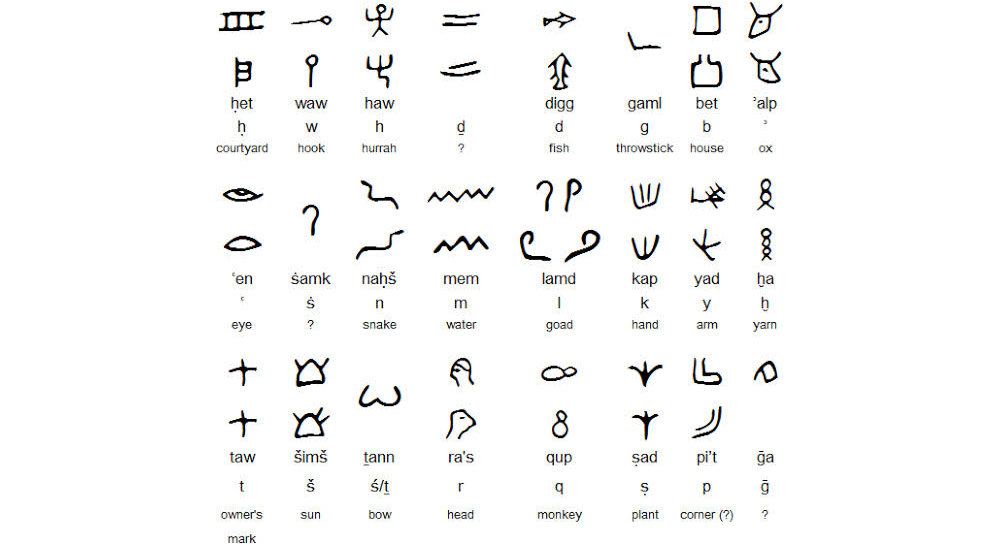
Used roughly between 1900 and 1500 BCE in the Sinai Peninsula by Canaanite-speaking peoples who adapted Egyptian hieroglyphs into the world’s first alphabetic script.

Proto-Sinaitic script

1900 BCE
1900-1500 BCE
155 Generations Ago

The Proto-Sinaitic alphabet is considered the earliest trace of alphabetic writing and the common ancestor of both Ancient South Arabian script and the Phoenician alphabet. The ancient South Arabian script evolved about 1900 BCE which continued to evolve into today’s Modern South Arabian languages. The Phoenician alphabet evolved into the Greek alphabet and all of today’s Western alphabets.

This writing system matured around the Sinai Peninsula from about 1900 to 1700 BCE and remained in common use until roughly 1500 BCE. It likely developed by Canaanite or Semitic workers familiar with Egyptian hieroglyphs. It simplified complex hieroglyphic symbols into a small set of phonetic signs—roughly one symbol per sound—making written language accessible to ordinary people rather than the exclusive domain of scribes and priests.

The innovation of sound-based writing marks one of humanity’s greatest cognitive leaps. It transformed communication from a pictorial and contextual art into a reproducible and teachable code of thought. This democratization of writing enabled the spread of trade, religion, philosophy, and law across cultures, eventually laying the groundwork for literacy as we know it today.

Archaeological finds at Serabit el-Khadim and Wadi el-Hol remain the key evidence for this script, showing inscriptions that bridge the gap between hieroglyphic writing and true alphabets. Though the precise origins are still debated, the Proto-Sinaitic script represents the dawn of phonetic abstraction—the moment humans learned not just to draw what they saw, but to write what they heard.


— map / TST —

Michael Alan Prestwood
Author & Natural Philosopher
Prestwood writes on science-first philosophy, with particular attention to the convergence of disciplines. Drawing on his TST Framework, his work emphasizes rational inquiry grounded in empirical observation while engaging questions at the edges of established knowledge. With TouchstoneTruth positioned as a living touchstone, this work aims to contribute reliable, evolving analysis in an emerging AI era where the credibility of information is increasingly contested.
Email
Print
This month @ TST
Column Menu
June 2026
»COLUMN ARCHIVE
Column Research….
1. Timeline Story
Secular Spirituality Settles
2. Linked Quote
“Extraordinary claims require extraordinary evidence.”
3. Science FAQ »
What is the difference between a spiritual and empirical belief?
4. Philosophy FAQ »
What is secular spirituality?
5. Critical Thinking FAQ »
How does spirituality relate to public belief?
6. History FAQ!
Is secular spirituality supported in history and science?
Bonus Deep-Dive Article
The Material-Spiritual Framework: A Philosophy of Spirituality

Comments

Join the Conversation! Currently logged out.

Leave a Reply

NEW BOOK! NOW AVAILABLE!!

30 Philosophers: A New Look at Timeless Ideas

by Michael Alan Prestwood
The story of the history of our best ideas!
Scroll to Top