

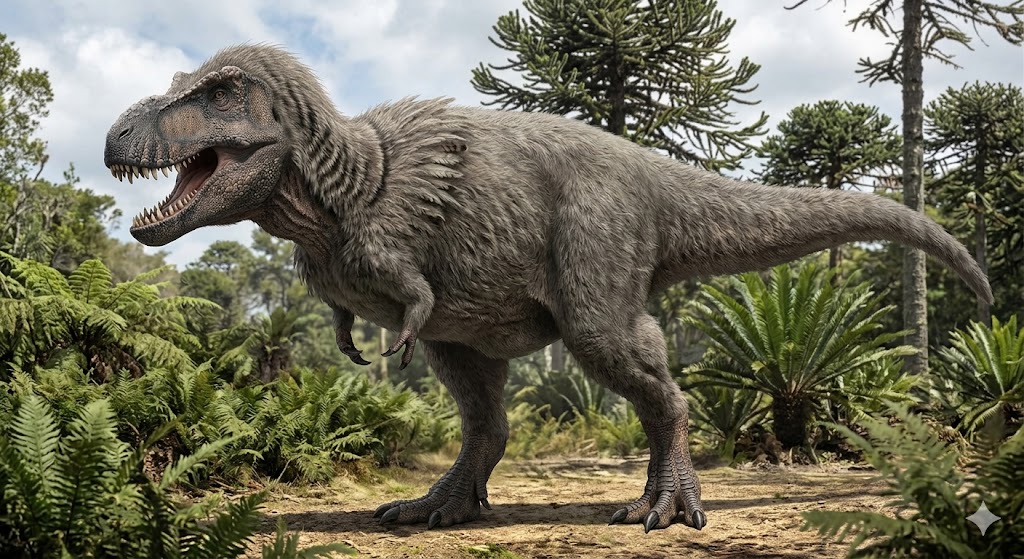
Maybe. But probably not like a giant chicken.
We do not have direct fossil evidence of feathers on T. rex itself. What we do have are fossil skin impressions from T. rex and close relatives showing small patches of pebbly scales. So, the old fully scaly monster is not totally wrong.
But the story gets more interesting.
The tide is turning on dinosaurs in general. For most of my life, dinosaur art showed a world of leathery reptiles. But more and more fossils are telling a different story. Feathers, fuzz, bristles, and quill-like structures were not just bird things. They show up across surprising branches of the dinosaur family tree. That does not mean every dinosaur was feathered head to toe, but it does mean the prehistoric world was likely much more textured than our old museum murals suggested.
And, some earlier tyrannosaur relatives had feathers. The best example is Yutyrannus, a large cousin of T. rex found with shaggy feather-like filaments. That means the tyrannosaur family had the genetic toolkit for feathers. So it is very reasonable to think young T. rex may have been fuzzier, perhaps for warmth.
Adults were different. A full-grown T. rex was huge, and big bodies hold heat well. In a warm Cretaceous world, a heavy feather coat might have been too much. So the best guess is a multi-textured animal: mostly scaly, with possible patches of simple feathers or bristles along the neck, back, or tail.
Not a lizard. Not a bird. Something stranger—and more alive.

