
Phil • Cr. Think • Science • Hist •
TST PRACTICE

The Philosophy Website

STORY

Animal Ancestors Split Off: Cadherin Cell Glue (Holozoa)

☐ Read
☑ Read
You’ve read this 0 times.
You’ve listened to this 0 times.

By Michael Alan Prestwood

Sun 22 Feb 2026
Published 7 months ago.
Updated 4 months ago.
Related Stories
Toothed Birds Go Extinct
The Last Sauropods
Long-Term Memory Evolves: Tiktaalik
Diplodocus
Emergence of the Great Apes (Great Apes LCA)
First Crown Mammals
Share :
This image shows three plausible body plans for early holozoans, ancestors of animals. A loose spherical cluster suggests early cadherin-based adhesion. The pear-shaped flagellated cell reflects choanoflagellate-like forms. The amoeboid shape represents flexible, crawling types.

Animal Ancestors Split Off: Cadherin Cell Glue (Holozoa)

~750 Million Years Ago (+/- 50 million)

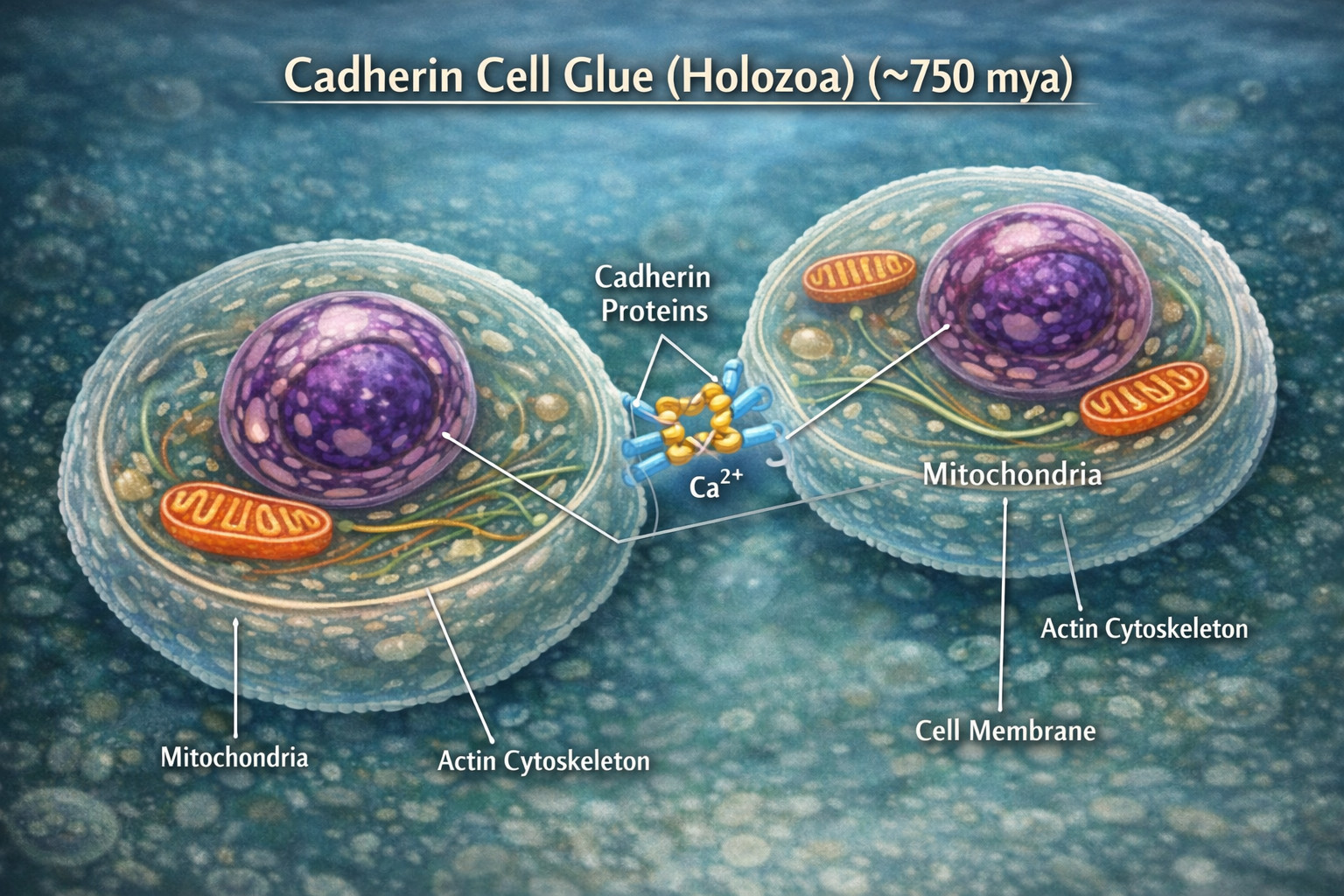
Holozoa is the clade that includes all animals and their closest single‑celled relatives, but excludes fungi.

On the animal side of the split, our ancestors stayed “soft” and flexible to keep moving. They evolved Cadherins: calcium‑dependent adhesion proteins. These specialized proteins acted like Velcro to snap cells together into complex, multicellular bodies. Instead of becoming rigid like a fungus, animal cells used this glue to build muscles and tissues that could contract and expand. While the “body” became a massive, crawling, or swimming machine, they kept the ancient posterior flagellum in a time capsule, the sperm cell, ensuring that the ancestral rear-engine motor would always be what drives the next generation forward.

Possible Snowball Earth Link

Snowball Earth may have favored multicellularity or tighter cell cooperation in some eukaryotes, but we do not currently have clear evidence that the glaciations specifically selected for cadherins themselves. Cadherin-like adhesion machinery appears to predate animals and to have evolved in a unicellular holozoan context before true animals arrived.

— map / TST —

TST Tracker
✓ Reading recorded.
Michael Alan Prestwood
Author & Natural Philosopher
Prestwood writes on science-first philosophy, with particular attention to the convergence of disciplines. Drawing on his TST Framework, his work emphasizes rational inquiry grounded in empirical observation while engaging questions at the edges of established knowledge. With TouchstoneTruth positioned as a living touchstone, this work aims to contribute reliable, evolving analysis in an emerging AI era where the credibility of information is increasingly contested.
Email
Print
The Prestwood Column
Menu
September 2026
Column Research….
1. Timeline Story
Hume’s Is–Ought Problem
2. Linked Quote
“I meet with no proposition that is not connected with an ought, or an ought not.”
3. Science FAQ »
Can science prove flourishing should be our goal?
4. Philosophy FAQ »
What is the difference between a normative aim and a normative directive?
5. Critical Thinking FAQ »
Is flourishing for all just utilitarianism?
6. History FAQ!
What is the history of the idea of flourishing in philosophy?
Bonus Deep-Dive Article
Flourishing for All: The Normative Aim of TST Philosophy

Comments

Join the Conversation! Currently logged out.

Leave a Reply

NEW BOOK! NOW AVAILABLE!!

30 Philosophers: A New Look at Timeless Ideas

by Michael Alan Prestwood
The story of the history of our best ideas!
Scroll to Top