
Explore Natural Philosophy

Phil • Cr. Think • Science • Hist •

STORY

Mold Spores Emerge

By Michael Alan Prestwood

Fri 6 Mar 2026
Published 5 months ago.
Updated 3 months ago.
Related Stories
Ordovician–Silurian Extinction: Ice Strikes the Seas
LECA: Likely Sexual Reproduction
Fungal Giants of the Devonian
Fungal Underground Alliance
Bacterial Endosymbiosis: Origin of Eukaryotes
Mesozoic Era: Age of Dinosaurs
Share :
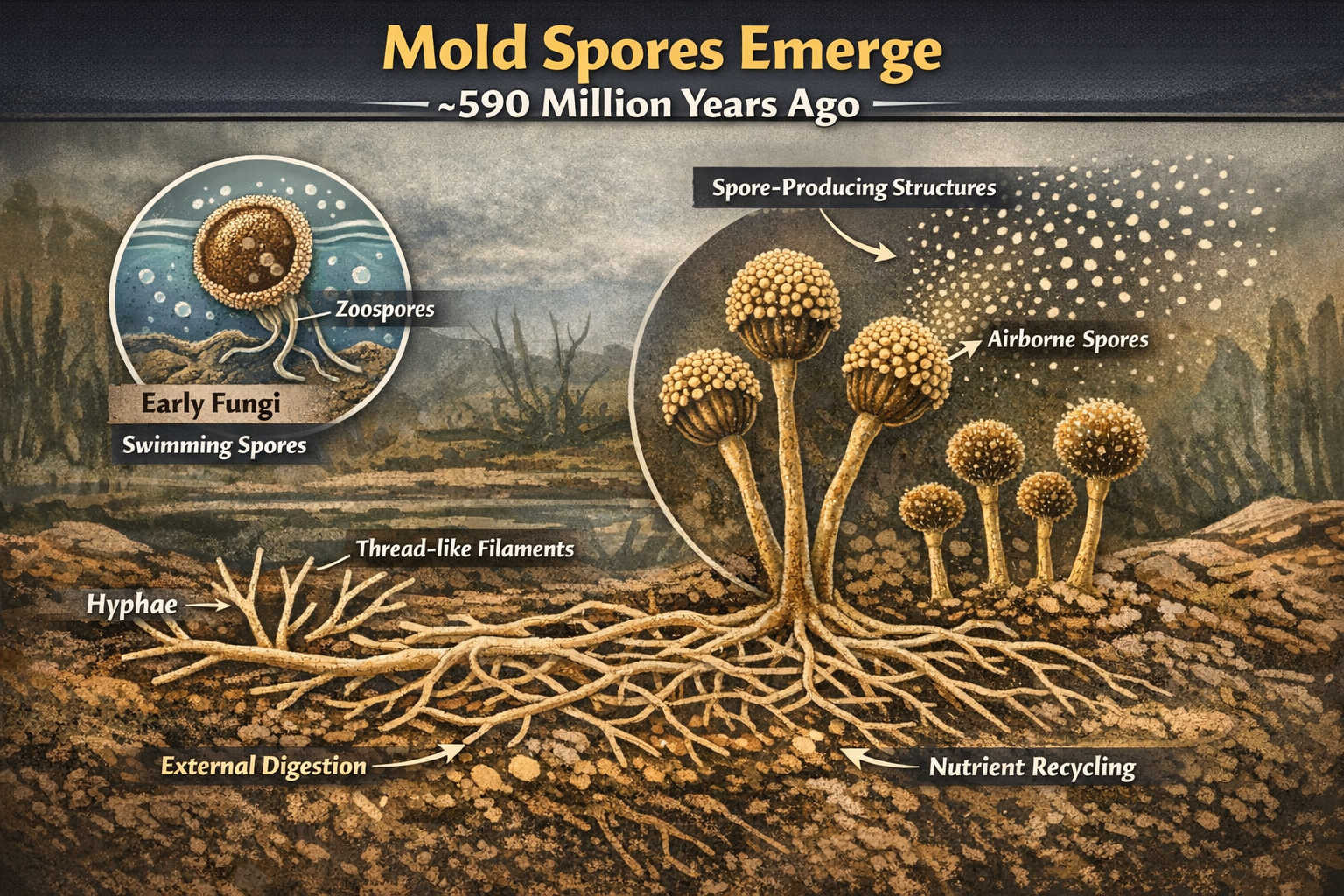
A mold spore is usually just one cell, but it carries the power to begin again. Released into the world, these tiny travelers helped fungi spread across early Earth and become some of nature’s great recyclers.

Mold Spores Emerge

~590 Million years ago (+/- 30 million)

Mold spores are the tiny reproductive particles released by the thread-like fungi we call molds. Unlike chytrids, which likely spread with swimming spores in water, molds seem built for a different world. They grow outward as fine feeding threads, digest food outside their bodies, and then send huge numbers of spores into the air, water, or nearby surfaces. They do not chase food. They spread into it, break it down, and cast their offspring outward like tiny drifting settlers.

The timing here is a bit fuzzy, and that is okay. Early fungi were likely experimenting with different ways of living and reproducing for a long time. So the move from more aquatic, chytrid-like fungi to familiar mold-style fungi was probably not one clean moment. That is why placing mold spores at about 610 million years ago (+/- 30 million) works nicely beside chytrids at about 600 million years ago (+/- 20 million). The overlap tells a more honest evolutionary story. Nature often works in transitions, not neat starting lines.

This was a big step in fungal success. Spores gave molds reach. A fungus no longer had to stay where it began. It could release countless microscopic spores and let wind, water, or plain accident carry them elsewhere. Combined with external digestion, this helped make fungi some of Earth’s great recyclers. They could settle onto dead material, break it down, and return nutrients to the wider environment. Quietly, steadily, molds helped prepare the world beneath larger life.

Not all fungi are molds, and not all fungal spores are mold spores. Yeasts usually live as single cells. Chytrids kept their ancient swimming spores. But molds became one of the fungal kingdom’s great success stories — a multicelled, filamentous way of life built for spreading, feeding, and reproducing with remarkable efficiency. That is why mold spores deserve their own place on the timeline. They do not mark the beginning of fungi, but they do mark the rise of one of fungi’s most successful strategies.


— map / TST —

Annotated References:

Kiss, E., et al. (2019). Comparative genomics reveals the origin of fungal hyphae and multicellularity. Nature Communications, 10, 4080. https://doi.org/10.1038/s41467-019-12085-w

Galindo, L. J., et al. (2021). Phylogenomics of a new fungal phylum reveals multiple waves of reductive evolution across Holomycota. Nature Communications, 12, 4973. https://doi.org/10.1038/s41467-021-25308-w

Naranjo-Ortiz, M. A., & Gabaldón, T. (2019). Fungal evolution: diversity, taxonomy and phylogeny of the Fungi. Biological Reviews, 94(6), 2101–2137. https://doi.org/10.1111/brv.12550

Michael Alan Prestwood
Author & Natural Philosopher
Prestwood writes on science-first philosophy, with particular attention to the convergence of disciplines. Drawing on his TST Framework, his work emphasizes rational inquiry grounded in empirical observation while engaging questions at the edges of established knowledge. With TouchstoneTruth positioned as a living touchstone, this work aims to contribute reliable, evolving analysis in an emerging AI era where the credibility of information is increasingly contested.
Email
Print
The Prestwood Column
Menu
July 2026
»COLUMN ARCHIVE
--COLUMN--
Column Research….
1. Timeline Story
The famous Lewis “Truth in Fiction” Paper
2. Linked Quote
“Truth is stranger than fiction…[which] is obliged to stick to possibilities;”
3. Science FAQ »
Why does fiction feel real?
4. Philosophy FAQ »
Can authors create fiction beyond our universe?
5. Critical Thinking FAQ »
How do we know what is true in a fictional world?
6. History FAQ!
What is the history of philosophy of fiction?
Bonus Deep-Dive Article
TST Philosophy of Fiction: Imaginative Realism

Comments

Join the Conversation! Currently logged out.

Leave a Reply

NEW BOOK! NOW AVAILABLE!!

30 Philosophers: A New Look at Timeless Ideas

by Michael Alan Prestwood
The story of the history of our best ideas!
Scroll to Top