
Weekly Insights for Thinkers

FAQ

Is red an empirical idea?

Tue 10 Mar 2026
Published 6 hours ago.
Updated 5 hours ago.
Metaphysics
Related FAQs
Is religion an uncategorized science?
Was the Roman Empire like the Borg?
What are the six realms of karma?
Does the Fermi paradox lack good thinking?
How did writing first evolve?
Can authors create fiction beyond our universe?
Share :

Is red an empirical idea?

Empirical ideas observe. Rational ideas organize.

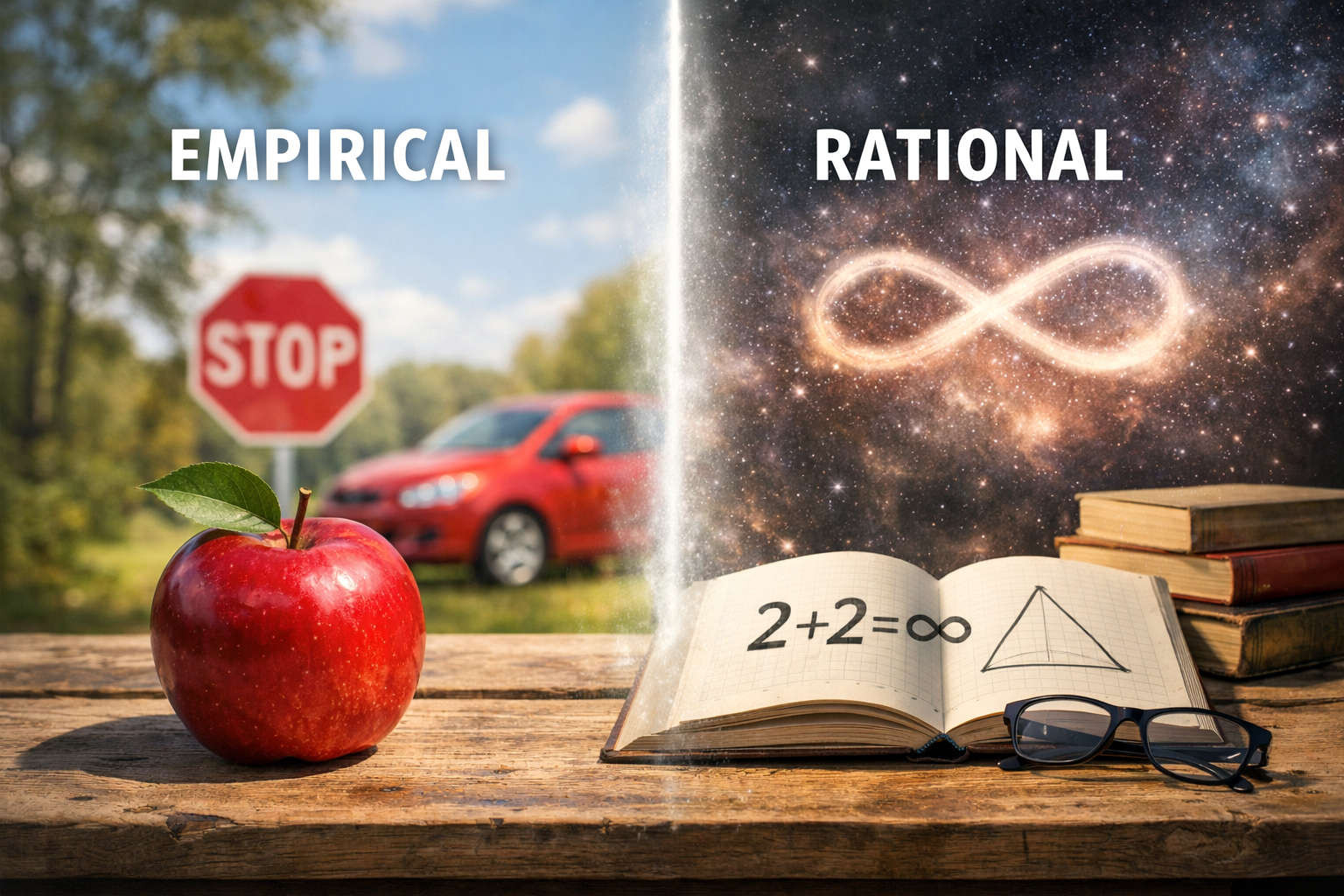
At first glance, the answer seems easy: yes. Red feels empirical because we really do see it. A red apple looks red. A stop sign looks red. Blood looks red. Something is clearly happening in the material world, and our experience is not imaginary. Light interacts with objects, some wavelengths are absorbed, others are reflected, and our eyes receive that reflected light. In that sense, red begins with something real and observable.

But here is where the fine line appears. The band of visible light we call red is part of the material world, while the experience and categorizing of that band into “red” belongs partly to us. The object is not carrying a little bucket of redness inside it. Rather, it reflects certain wavelengths, and our visual system turns that interaction into the color experience we call red. So red feels purely empirical, but it also contains a rational layer. It is an observed pattern structured by a perceiving mind.

In reality, a red apple is red because that is the dominant color the surface rejects. In a real way, one could say red is more accuratly the color a red apple is not.

That makes red a great example in the Idea of Ideas. It starts close to the world, which is why it feels empirical, but analysis reveals that our description is not the thing itself. The light band is real. The object is real. The perception is real. But the concept of “redness” is still a human idea about what is happening. In other words, red is not a free-floating fantasy, but neither is it raw reality untouched by interpretation. It lives near the empirical side while still revealing the role of rational structure.

This is why color is such a useful metaphysical example. It shows how an idea can be deeply anchored in the material world and still not be identical to that world. Red is empirical in contact, but rational in framing. It reminds us that even our most direct-seeming experiences are already partway into the human layer of thought. The world gives us something real. The mind helps turn it into the world as we know it.

“Direct experience gives us red. Indirect experience gives us infinity.”

Empirical ideas describe the material world through direct sensory contact or through tools that extend the senses, though those descriptions remain incomplete. Rational ideas describe the material world indirectly through abstraction, relation, pattern, and inference. The color red and a car are empirical ideas. The number two, equivalence, and infinity are rational ideas. Both are reality-based, but empirical ideas stay closer to direct contact, while rational ideas step back and organize what direct contact reveals.

The statement “Those two are in love” is a rational statement. It is an indirect thought built from observations. It can feel like a direct empirical observation because it describes two people in the material world, but it is not. Love is rationally constructed from patterns we observe. You can support it with specific empirical statements such as: “Those two are married. They have two kids. They say ‘I love you’ to each other frequently.” Those direct empirical ideas support the rational idea of love.

— map / TST —

Michael Alan Prestwood
Author & Natural Philosopher
Prestwood writes on science-first philosophy, with particular attention to the convergence of disciplines. Drawing on his TST Framework, his work emphasizes rational inquiry grounded in empirical observation while engaging questions at the edges of established knowledge. With TouchstoneTruth positioned as a living touchstone, this work aims to contribute reliable, evolving analysis in an emerging AI era where the credibility of information is increasingly contested.
This Week @ TST
March 4, 2026
»Edition Archive
WWB Research….
1. Story of the Week
Marcus Aurelius: An Explorative Agnostic
2. Quote of the Week
“Our knowledge is finite, while our ignorance is infinite.”
3. Science FAQ »
Do we experience reality directly?
4. Philosophy FAQ »
What is TST Ethics?
5. Critical Thinking FAQ »
What is confirmation bias, and why does it matter?
6. History FAQ!
What historical ideas shaped TST Philosophy?
Bonus Deep-Dive Article
1-2-3-4-5: TST Philosophy Overview

Comments

Join the Conversation! Currently logged out.
NEW BOOK! NOW AVAILABLE!!

30 Philosophers: A New Look at Timeless Ideas

by Michael Alan Prestwood
The story of the history of our best ideas!
Scroll to Top