

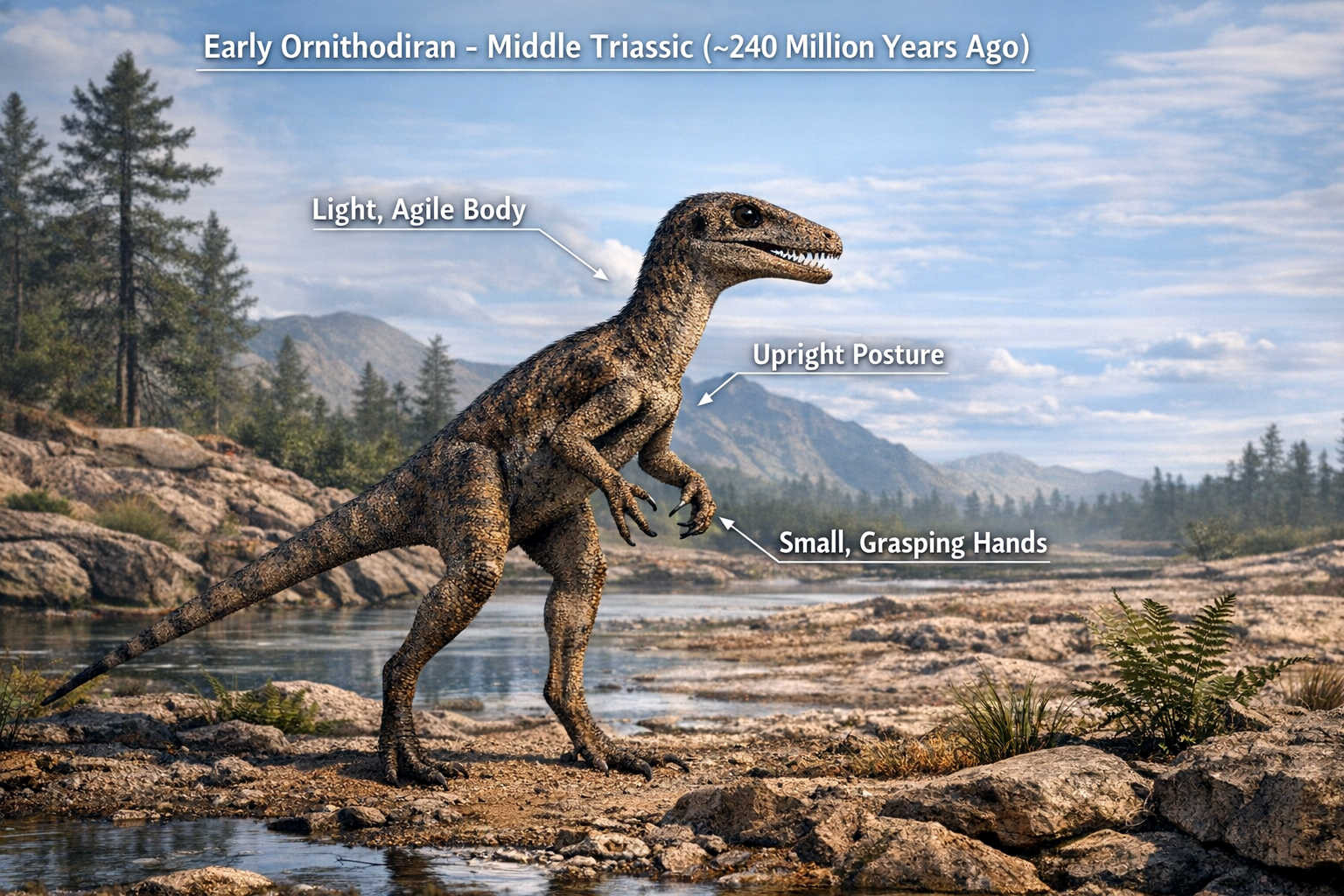
Ornithodirans were early members of the branch that would later include both pterosaurs and dinosaurs, including birds. They appeared in the Triassic and were generally small, lightly built archosaurs with upright-running tendencies that set them apart from many earlier reptile lines. We do not know the exact common ancestor fossil of dinosaurs and pterosaurs, but this is the branch where that story begins. Early ornithodirans already had a more upright, lightweight, runner-type build than many earlier reptile lines, but the classic dinosaur body plan was still taking shape.
From this branch came two of the most famous lineages in prehistory. One line gave rise to pterosaurs, the first vertebrates to achieve powered flight. The other gave rise to dinosaurs, and much later, birds. In that sense, ornithodirans stand near the base of one of evolution’s most remarkable radiations: runners, fliers, giants, predators, plant-eaters, and eventually birds filling the skies.
This branch matters because it helps explain both connection and difference. Pterosaurs and dinosaurs were close relatives, but pterosaurs were not dinosaurs. They split from the same broader ornithodiran stock and then went their own way. So on a “Dinosaurs & Birds” timeline, ornithodirans fit well as an early shared branch point, even though not everything that comes from that point should be called a dinosaur.

