
Phil • Cr. Think • Science • Hist • …
TST PRACTICE

The Philosophy Website

STORY

Argentinosaurus

☐ Read
☑ Read
You’ve read this 0 times.
You’ve listened to this 0 times.

By Michael Alan Prestwood

Sat 21 Mar 2026
Published 6 months ago.
Updated 5 months ago.
Related Stories
Neoaves Birds Emerge (from Neognathae)
Stegosaurus
Neornithes (Crown Birds) emerge
Triceratops
Bird-line Archosaurs: Asilisaurus kongwe (within Ornithodira)
Diplodocid LCA: The Age of Giant Necked Sauropods
Share :
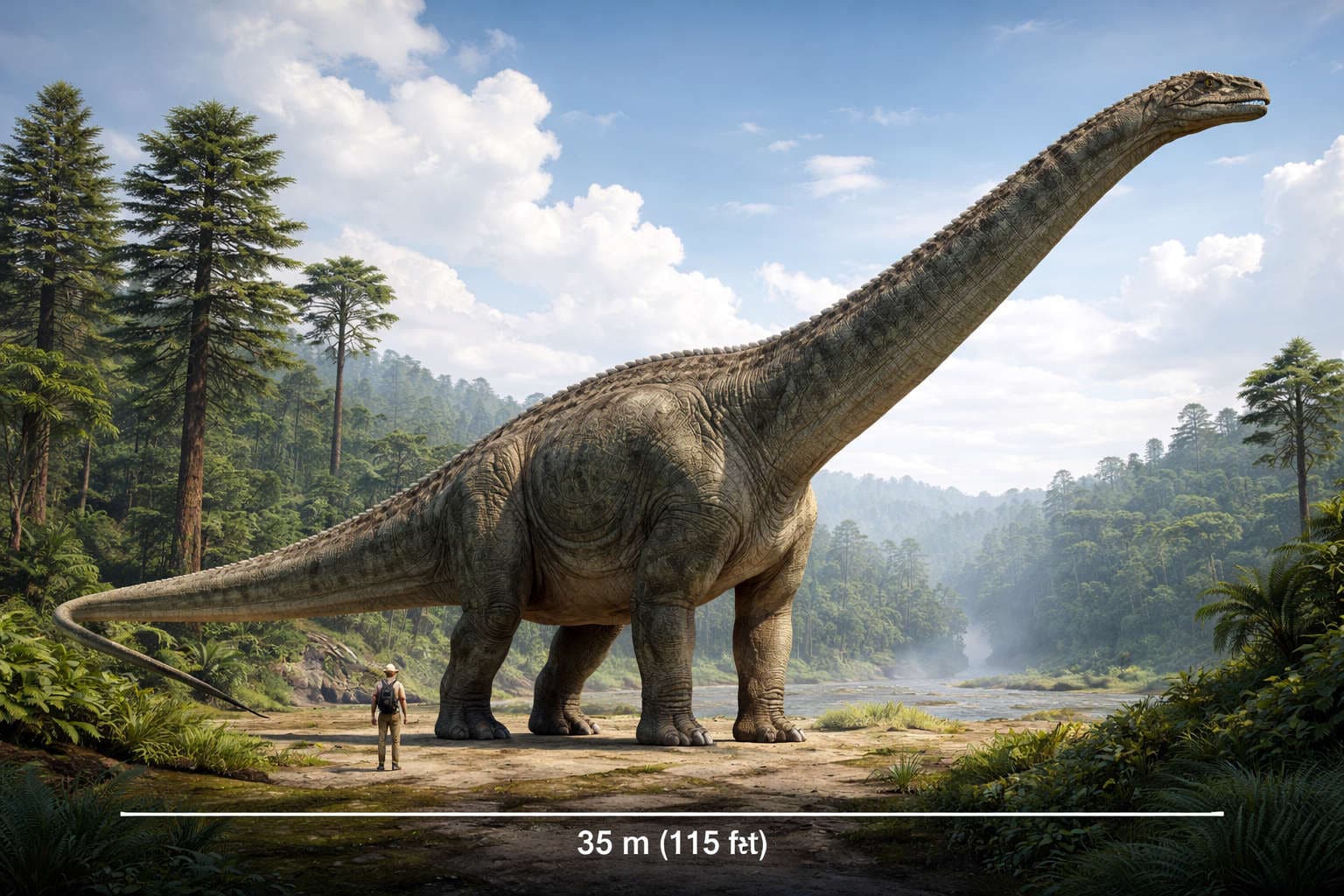
Argentinosaurus shows how far the sauropod body plan could go. By the Late Cretaceous, some titanosaurs had become the largest land animals known, turning the long-necked dinosaur design into one of evolution’s most extreme achievements.

Argentinosaurus

Lived from 97 to 93.5 million years ago.

Argentinosaurus lived in what is now Patagonia, Argentina, during the Late Cretaceous, roughly 97 to 94 million years ago. It was a giant titanosaur sauropod: a long-necked, long-tailed plant-eater with pillar-like legs and a body built on a scale almost beyond imagination. Even from fragmentary remains, paleontologists can tell it was one of the largest land animals ever known, a true giant from a world that still had room for giants.

When people ask about the biggest known dinosaur, Argentinosaurus is still one of the main names at the top of the list. Estimates vary because the fossils are incomplete, but a reasonable working range puts it at about 30 to 35 meters long and roughly 65 to 75 metric tons, with some estimates running even higher. That uncertainty is part of the story. These biggest dinosaurs are often known from frustratingly incomplete material, which means paleontologists are reconstructing greatness from enormous bones, not from perfect skeletons.

And that is where the wonder begins. In any large population, there can be unusually big individuals now and then, the rare outliers that push beyond the norm. Fossils are extraordinarily scarce, so it is possible that one of those exceptional giants fossilized, but it is at least as possible that the bones we have represent something closer to the upper end of normal rather than the absolute maximum. A recent population-modeling study on T. rex suggested the largest individual of a fossil species might be substantially bigger than the biggest specimen we have found. That does not prove the same for Argentinosaurus, and doubling the size would be a very large leap, but it does leave room to wonder whether somewhere in deep time an even more extraordinary sauropod once walked the earth.

— map / TST —

TST Tracker
✓ Reading recorded.
Michael Alan Prestwood
Author & Natural Philosopher
Prestwood writes on science-first philosophy, with particular attention to the convergence of disciplines. Drawing on his TST Framework, his work emphasizes rational inquiry grounded in empirical observation while engaging questions at the edges of established knowledge. With TouchstoneTruth positioned as a living touchstone, this work aims to contribute reliable, evolving analysis in an emerging AI era where the credibility of information is increasingly contested.
Email
Print
The Prestwood Column
Menu
September 2026
Column Research….
1. Timeline Story
Hume’s Is–Ought Problem
2. Linked Quote
“I meet with no proposition that is not connected with an ought, or an ought not.”
3. Science FAQ »
Can science prove flourishing should be our goal?
4. Philosophy FAQ »
What is the difference between a normative aim and a normative directive?
5. Critical Thinking FAQ »
Is flourishing for all just utilitarianism?
6. History FAQ!
What is the history of the idea of flourishing in philosophy?
Bonus Deep-Dive Article
TST Normative Ethics: Flourishing as a Philosophical Goal

Comments

Join the Conversation! Currently logged out.

Leave a Reply

NEW BOOK! NOW AVAILABLE!!

30 Philosophers: A New Look at Timeless Ideas

by Michael Alan Prestwood
The story of the history of our best ideas!
Scroll to Top