
Explore Science-first Philosophy

FAQ

What is secular spirituality?

Sun 24 May 2026
Published 20 hours ago.
Updated 18 hours ago.
Related FAQs
Is agnosticism a ludicrous position to occupy?
What is worldview humility?
What is the difference between ontology and spirituality?
What is Eastern “chee,” or qi?
What is the difference between being philosophical and spiritual?
What is the difference between secular and empirical spirituality?
Share :
Email
Print

What is secular spirituality?

Secular spirituality is the exploration of spirituality minus the supernatural and disproven empirical claims.

Unlike empirical spirituality, secular spirituality does not try to calibrate spiritual ideas as true or false. It simply sets two boundaries: supernatural claims are out, and disproven empirical claims are out. This leaves room for non-disproven metaphysical possibilities, such as higher dimensions, unknown aspects of consciousness, or speculative ideas about reality. Those remain open because you cannot prove a universal negative about the unknown or unknowable. Astrology and crystal healing, by contrast, are out when treated as truth because they make empirical claims that have repeatedly failed.

The word secular means not controlled by religion, religious authority, or supernatural claims. It does not mean anti-religious. It simply means the idea can stand on common ground. A secular person can still feel awe under the stars, gratitude for life, and moral responsibility toward others.

Secular spirituality can explore the metaphysical, the ultimate structure of reality. It can explore the ontological: you are here now—aware, temporary, and responsible. It can include meditation, compassion, and grief. It often includes publicly shared things like art, science, and service. It embraces nature, philosophy, and the quiet mystery of consciousness.

It does not rely on the supernatural or carry disproven claims forward as truth. It can simply say: life is astonishing, consciousness is mysterious, love matters, suffering is real, and how we live matters.
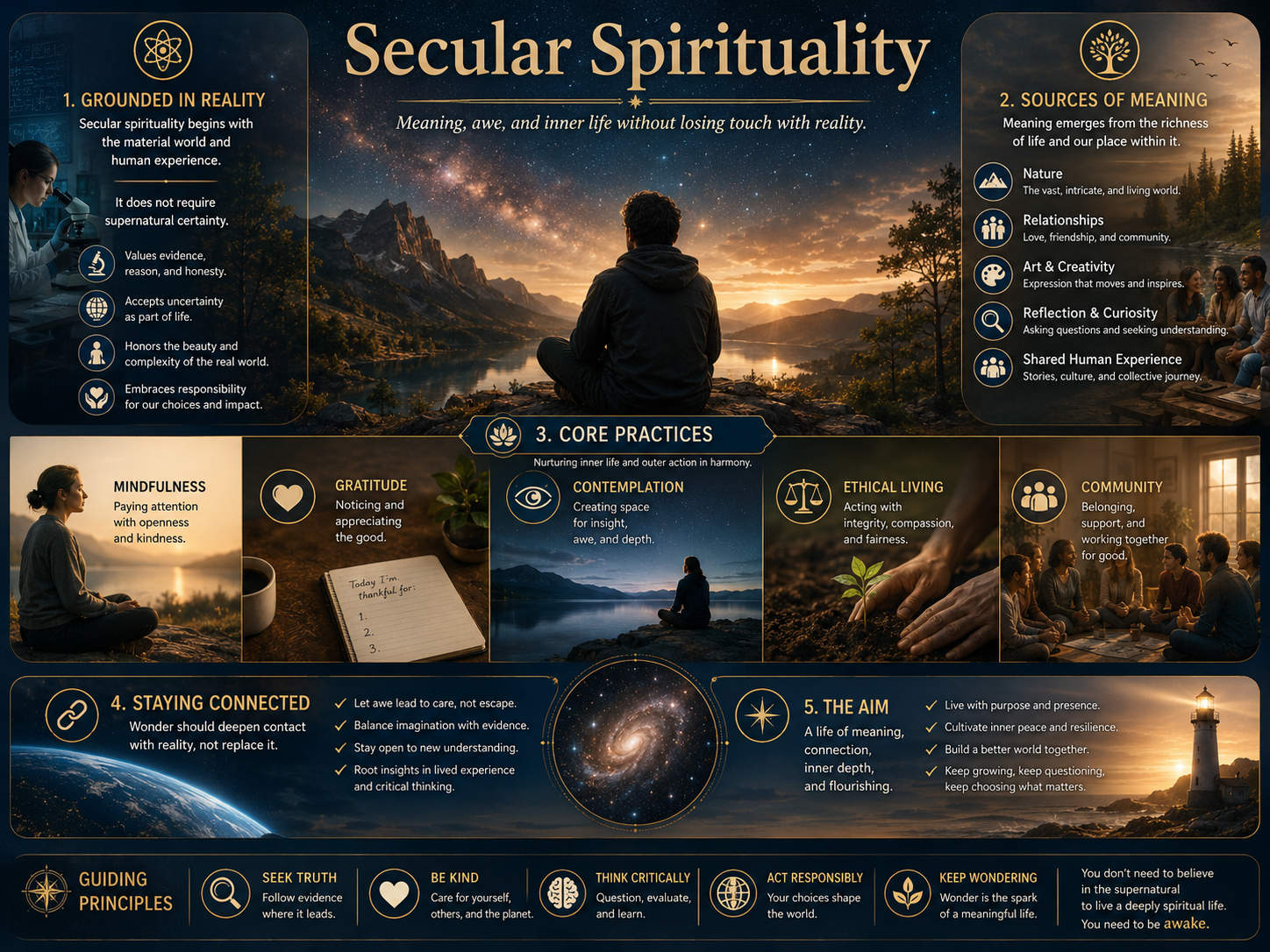
Compared to religious spirituality, secular spirituality does not require gods, revelation, or sacred authority. Compared to mystical spirituality, it is more cautious about hidden realms, supernatural forces, and private revelation. Compared to empirical spirituality, it is freer to speculate beyond and within science.

Secular spirituality explores awe without required supernatural belief or disproven empirical claims.

— map / TST —

Michael Alan Prestwood
Author & Natural Philosopher
Prestwood writes on science-first philosophy, with particular attention to the convergence of disciplines. Drawing on his TST Framework, his work emphasizes rational inquiry grounded in empirical observation while engaging questions at the edges of established knowledge. With TouchstoneTruth positioned as a living touchstone, this work aims to contribute reliable, evolving analysis in an emerging AI era where the credibility of information is increasingly contested.
This month @ TST
Column Menu
May 2026
»COLUMN ARCHIVE
--COLUMN--
Column Research….
1. Timeline Story
Book: The Idea of History
2. Linked Quote
“The historian without his facts is rootless…the facts without their historian are…meaningless.”
3. Science FAQ »
Is science tainted by bias?
4. Philosophy FAQ »
Debating History: Should We Say “Dark Ages” or “Middle Ages?”
5. Critical Thinking FAQ »
What is the preservation bias?
6. History FAQ!
Did Einstein’s driver really give one of his early talks?
Bonus Deep-Dive Article
TST Philosophy of History

Comments

Join the Conversation! Currently logged out.
NEW BOOK! NOW AVAILABLE!!

30 Philosophers: A New Look at Timeless Ideas

by Michael Alan Prestwood
The story of the history of our best ideas!
Scroll to Top