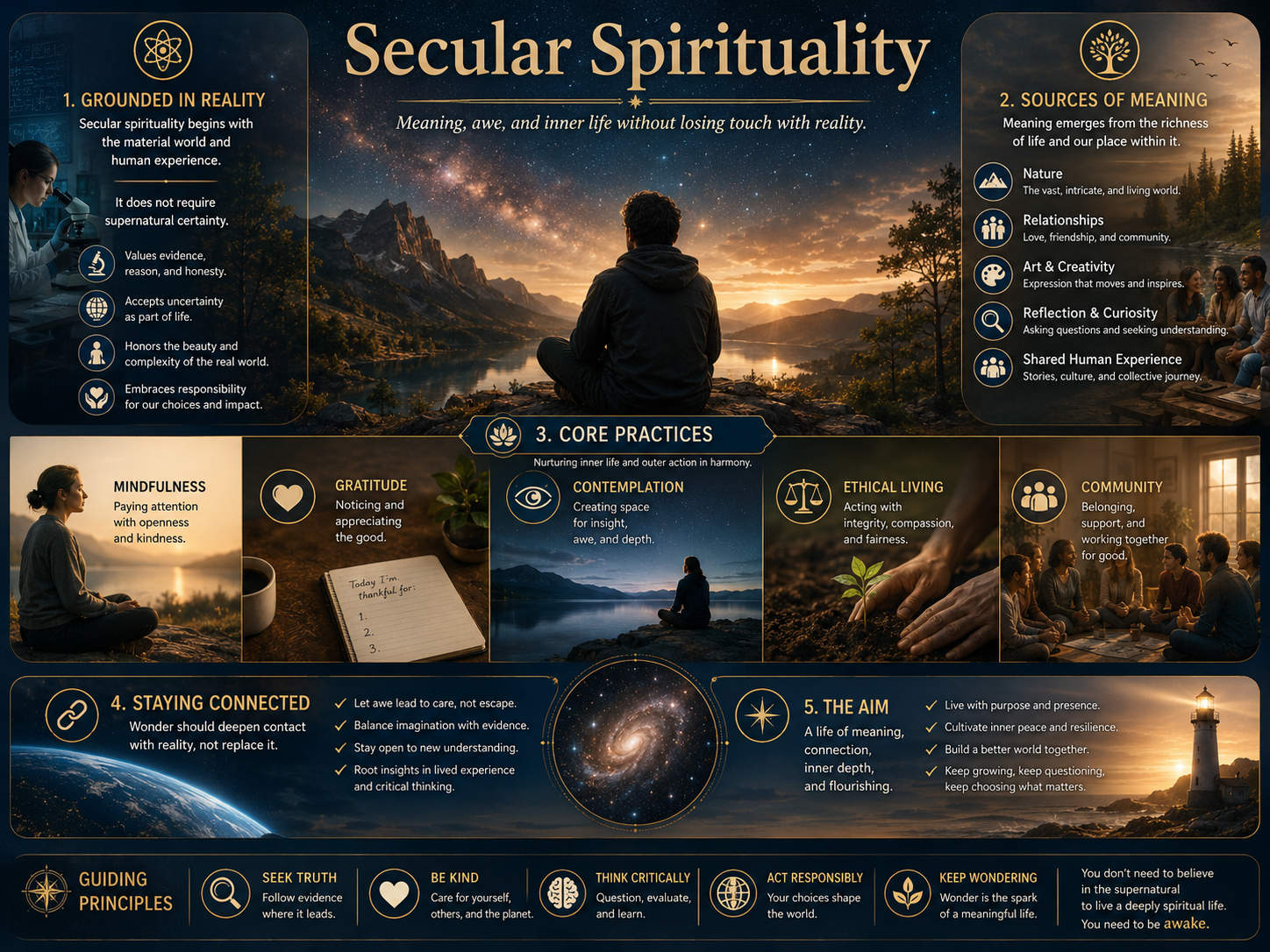
Secular spirituality is the science-first spiritual exploration of the self.
It is the exploration of awe and the transformation of self without relying on supernatural authority or disproven empirical claims.
Secular Spirituality keeps the depth but drops the dogma.
In philosophy, secular is simply a category. It means not governed by religious authority or supernatural claims. In everyday culture, though, the word can sound anti-religious. That is why I often prefer science-first spirituality for general readers. In science-first philosophy, spirituality does not need to attack religion. It simply keeps its feet on common ground we all share in this life.
Secular spirituality still leaves room for careful speculation about the unknown and unknowable, such as higher dimensions, unexplained aspects of consciousness, or possible deeper structures of reality. Those ideas remain open as speculation because we cannot prove a universal negative about the unknown.
A secular person can explore metaphysics: What is reality? What kind of universe are we in? They can explore ontology: you are here now—aware, temporary, embodied, and responsible. This exploration can include meditation, compassion, grief, art, science, service, nature, philosophy, and the quiet mystery of consciousness. A secular person can still feel awe under the stars, gratitude for life, reverence for nature, and moral responsibility toward others.
Compared to religious spirituality, secular spirituality does not require gods or sacred authority. Compared to mystical spirituality, it is more cautious about hidden realms and supernatural forces. Compared to public spirituality, it does not care about what a culture currently accepts.
In general, secular spirituality can simply say: life is astonishing, consciousness is mysterious, love matters, suffering is real, and how we live matters.