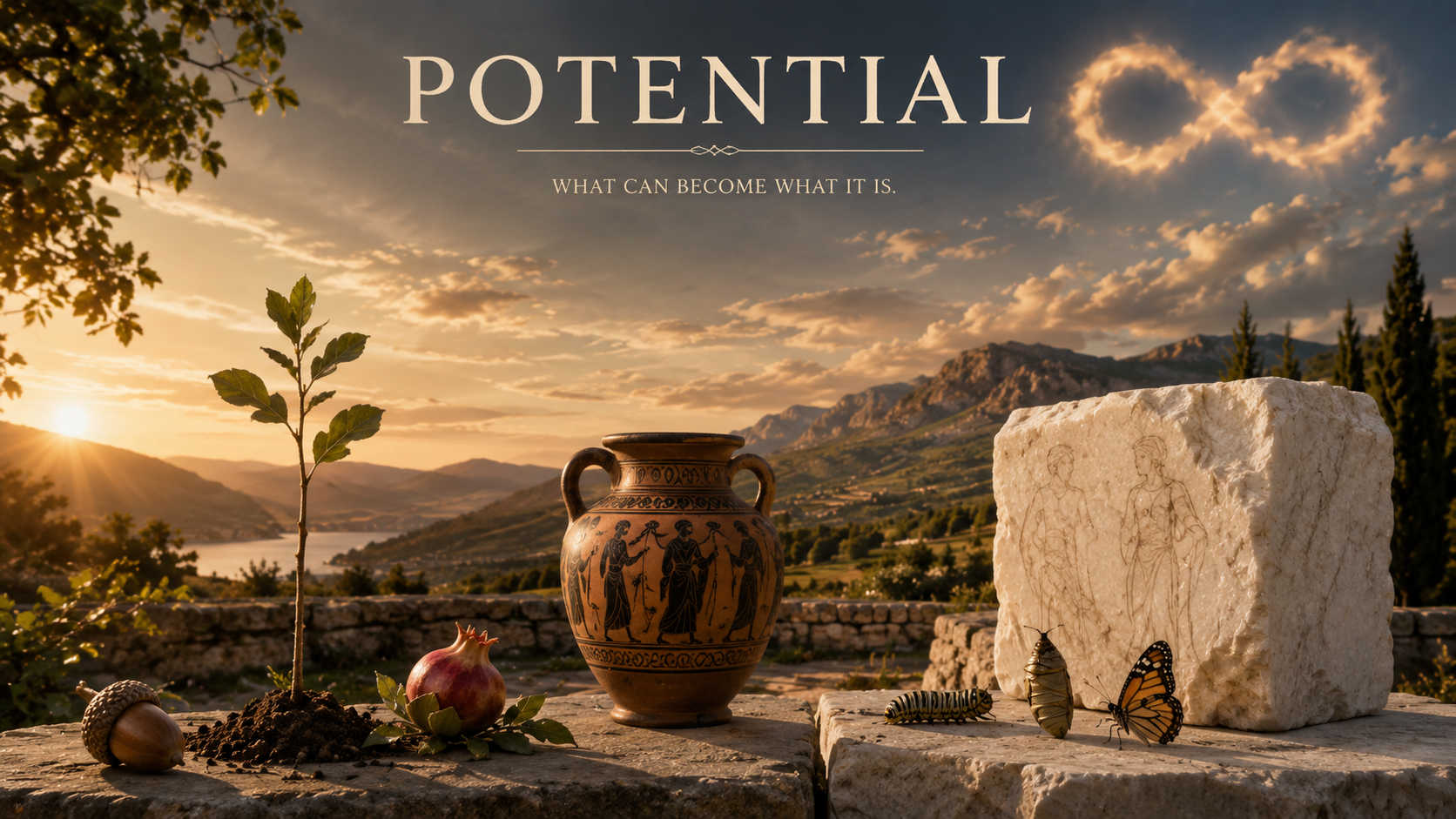
Potential refers to what a thing can become or do within reality’s constraints. It points to possible future states: what something can develop into, gain, lose, express, or accomplish. An acorn has the potential to become an oak tree, but not a horse. A child has the potential to learn language, form memories, build skills, and develop an identity. Potential is about possibility, but not unlimited possibility.
In traditional philosophy, potential is often contrasted with actual. In chapter 9 of 30 Philosopher’s, it says:
“Potentiality & Actuality is the fulfillment of inherent capacities; self-realization; becoming the best version of oneself.”
Aristotle used this distinction to explain change. A thing may have capacities that are not yet realized. The potential is what can become real; the actual is what already is. A block of marble may have the potential to become a statue. A seed may have the potential to become a plant. This distinction helps explain how things change while still remaining connected to what they already are.
In TST Philosophy, potential is used carefully because not every imagined possibility is a real potential. Potential must remain tied to reality’s constraints. A person may have the potential to learn, grow, heal, create, change habits, or develop wisdom, but that potential depends on biology, environment, effort, time, opportunity, and circumstance. TST treats potential as possibility under constraint, not fantasy without limits.
This places potential inside the TST metaphysical split. In the material world, potential is what can become real within reality’s constraints. In the mind, potential is the idea of what is possible. Some ideas about potential are grounded in evidence. Others are hopeful, speculative, or imaginary. TST does not reject hope, but it asks whether a claimed potential can actually cross from idea into reality.