
Phil • Cr. Think • Science • Hist •
TST PRACTICE

The Philosophy Website

QUOTE

“I meet with no proposition that is not connected with an ought, or an ought not.”
☐ Read
☑ Read
You’ve read this 0 times.
You’ve listened to this 0 times.
Related Quotes
“I was not; I was; I am not; I do not mind.”
“Do not speak arrogantly or do hateful things.”
“The greatest weapon against stress is our ability to choose one thought over another.”
Power is the ability to carry out one’s will despite resistance.
“A person is a person through other persons; you can’t be human in isolation; you are human only in relationships.”
Enjoy the journey, with truth and honor, causing no harm.
Share :
Email
Print

Mike's Takeaway:

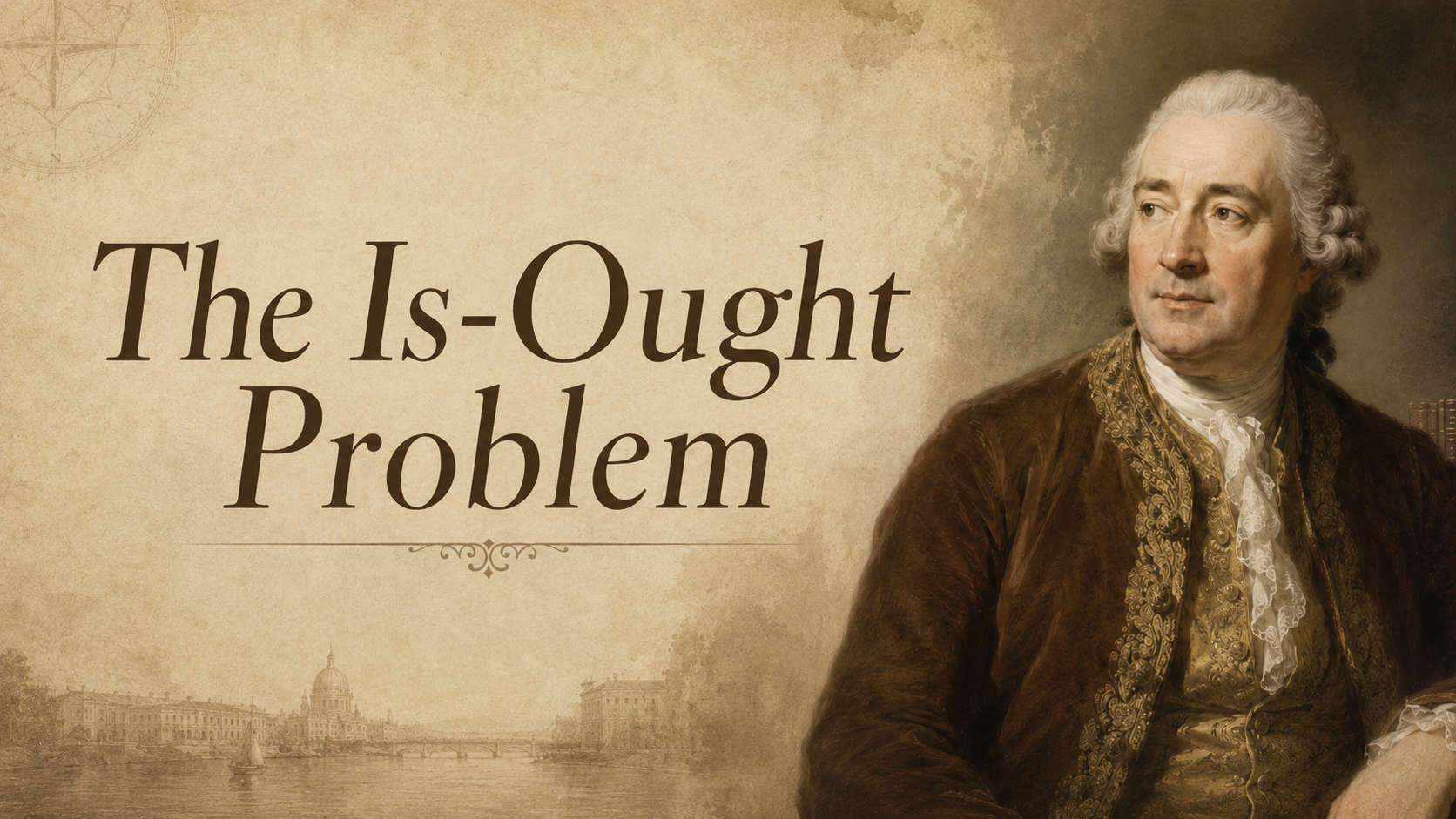
Hume and the is–ought problem is part of the history of critical thinking and philosophy. He observed that thinkers silently jump from factual statements to moral rules. From “is” to “ought”. For example, take the statement: 

“AI is automating our jobs; therefore, governments ought to regulate it.”

Hume objects to the “is-ought” relationship there. He’s really just saying you skipped a step, and if you can’t provide it, it’s invalid. Instead of is-ought, you need more, perhaps is-value-ought. In this case, the value of human jobs over AI jobs. So, the statement might become: 

“AI is automating our jobs; let’s value human jobs over corporate progress, therefore, governments ought to regulate it.”

Hume is simply demanding that we explain the leap. He wants an explanation for how descriptive facts can logically justify moral imperatives.

Here is another passage from Hume’s 1739, A Treatise of Human Nature:

“For as this ought, or ought not, expresses some new relation or affirmation… [a reason must be given for] how this new relation can be a deduction from others, which are entirely different from it.”

That is Hume’s useful lesson for daily thinking. Whenever a statement suddenly moves from what is to what we ought to do, look for the value hiding between them. Facts can inform moral decisions, but they do not carry the moral command alone. Make the value explicit, then decide whether it deserves your agreement. Hume’s guillotine does not stop moral reasoning; it reminds us to show our work.
Analysis By Michael Alan Prestwood
08 Aug 2026
Published 16 minutes ago.
Updated 2 days ago.
TST Tracker
✓ Reading recorded.

Annotated References:

Source: A Treatise of Human Nature, Book III, Part I, Section I
  • Hume, David. A Treatise of Human Nature. Edited by L. A. Selby-Bigge, 2nd ed. revised by P. H. Nidditch, Oxford University Press, 1978, Book III, Part I, Section I, p. 469. Identifies the unexplained transition philosophers often make from statements about what is to conclusions about what ought to be.
  • Searle, John R. How to Derive ‘Ought’ From ‘Is.’ The Philosophical Review 73, no. 1 (1964): 43–58. DOI: 10.2307/2183201: Challenges the strongest interpretation of Hume’s barrier and helped launch a modern debate over whether normative conclusions can ever follow from descriptive facts.
  • Prestwood, Michael Alan. 30 Philosophers. 2024. Chapter 27, “Hume and Skeptical Empiricism”: connects Hume’s ethics to his distinction between reason and the passions—reason informs us about the world, while feelings and values provide motivation and direction.
Hume’s warning against moving directly from “is” to “ought” has a common informal name: Hume’s guillotine.
Michael Alan Prestwood
Author & Natural Philosopher
Prestwood writes on science-first philosophy, with particular attention to the convergence of disciplines. Drawing on his TST Framework, his work emphasizes rational inquiry grounded in empirical observation while engaging questions at the edges of established knowledge. With TouchstoneTruth positioned as a living touchstone, this work aims to contribute reliable, evolving analysis in an emerging AI era where the credibility of information is increasingly contested.
The Prestwood Column
Menu
September 2026
Column Research….
1. Timeline Story
Hume’s Is–Ought Problem
2. Linked Quote
“I meet with no proposition that is not connected with an ought, or an ought not.”
3. Science FAQ »
Can science prove flourishing should be our goal?
4. Philosophy FAQ »
What is the difference between a normative aim and a normative directive?
5. Critical Thinking FAQ »
Is flourishing for all just utilitarianism?
6. History FAQ!
What is the history of the idea of flourishing in philosophy?
Bonus Deep-Dive Article
Flourishing for All: The Normative Aim of TST Philosophy

Comments

Join the Conversation! Currently logged out.

Leave a Reply

NEW BOOK! NOW AVAILABLE!!

30 Philosophers: A New Look at Timeless Ideas

by Michael Alan Prestwood
The story of the history of our best ideas!
Scroll to Top