
Phil • Cr. Think • Science • Hist • …
TST PRACTICE

By Philosopher Michael Alan Prestwood

QUOTE

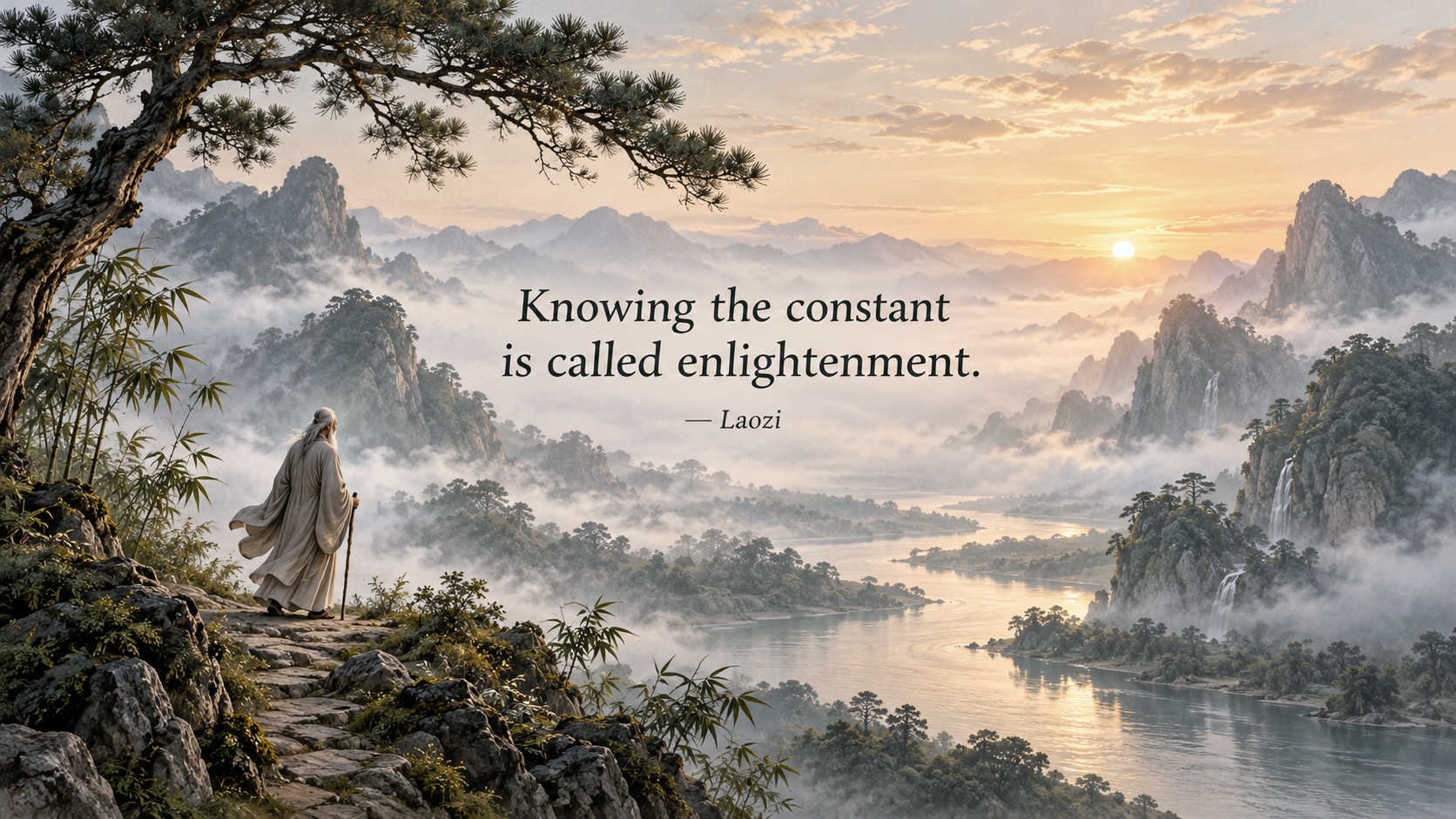
“Knowing the constant is called enlightenment.”
☐ Read
☑ Read
You’ve read this 0 times.
You’ve listened to this 0 times.
Related Quotes
“We are dwarfs on the shoulders of giants.”
“Empty is the argument of the philosopher which does not relieve any human suffering.”
“Nothing is enough for the man to whom enough is too little.”
“We are all connected to each other biologically, to the Earth chemically, and to the rest of the universe atomically.”
“The unexamined life is not worth living.”
“The superior man is modest in his speech but exceeds in his actions.”
Share :
Email
Print

Mike's Takeaway:

In Chapter 16 of the Dao De Jing, Laozi describes how all things in nature emerge, flourish, and eventually return to their roots. He calls this recurring pattern “the constant.” Although individual things are always changing, the natural order continues. As Laozi puts it:

“Knowing the constant is called enlightenment.”

For Laozi, enlightenment represents a deeper form of wisdom. It goes beyond accumulating knowledge to understanding the natural order and our place within it. In the Daoist tradition, this wisdom brings clarity, humility, and an acceptance of change. The enlightened person understands that life is part of something larger, something that cannot be fully controlled or even completely understood.

This brings us to one of Daoism’s central ideas:

wisdom is learning to live in harmony with the natural flow of things.

Rather than constantly struggling against nature, the wise person learns when to act, when to let go, and when to allow things to unfold. This is the spirit of wu wei, often translated as non-action or non-forcing. It is not about doing nothing. It is about acting in harmony with the Dao, the natural Way.
Analysis By Michael Alan Prestwood
10 Oct 2026
Published 22 hours ago.
Updated 5 hours ago.
TST Tracker
✓ Reading recorded.
Laozi teaches that everything in nature emerges, changes, and eventually returns to its roots. The wise person understands these natural patterns and learns to live in harmony with them. Wisdom is not about controlling everything. It is knowing when to act, when to let go, and when to allow life to unfold.
Michael Alan Prestwood
Natural Philosopher & Author
Prestwood explores science-first philosophy, with particular attention to the convergence of disciplines. Drawing on his TST Philosophy, his work emphasizes rational inquiry grounded in empirical observation while engaging questions at the edges of established knowledge. With TouchstoneTruth positioned as a living touchstone, this work aims to contribute reliable, evolving analysis in an emerging AI era where the credibility of information is increasingly contested.
The Prestwood Column
Menu
October 2026
Column Research….
1. Timeline Story
The Great Quaker Debates!
2. Linked Quote
“All men are prone to differ. It is no new thing in all former ages, in all parts. Each party is most right in his own eyes.”
3. Science FAQ »
Do facts actually change minds?
4. Philosophy FAQ »
When does persuasion become manipulation?
5. Critical Thinking FAQ »
How can you tell when a debate has stopped being productive?
6. History FAQ!
What is the history of debate?
Bonus Deep-Dive Article
Roger Williams Biography and Dedication to the Freedom of Conscience

Comments

Join the Conversation! Currently logged out.

Leave a Reply

NEW BOOK! NOW AVAILABLE!!

30 Philosophers: A New Look at Timeless Ideas

by Michael Alan Prestwood
The story of the history of our best ideas!
Scroll to Top