

Right now Polaris is our North Star. In 13,000 years it will be Vega. The Earth spins as it revolves around the Sun, but the North Pole is always pointing toward the North Star, Polaris. The Earth spins and only wobbles a tiny bit over millennia as it revolves around the Sun, and our Sun revolves around a pretty flat Milky Way galaxy. Our solar system, like a thrown frisbee, stays pretty flat in space. The wobble described above is called the axial precession in scientific terms. That’s the North Pole moving in a small circle when compared to the sky. This axial tilt causes the celestial poles to align closely with specific stars, for now, Polaris in the Northern Hemisphere. The Earth’s wobble, or axial precession, is slow, about 26,000 years per wobble cycle. At about 13,000 years through the cycle, the Northern Star will be Vega, not Polaris.
STORY
New North Star
☐ Read
☑ Read
You’ve read this 0 times.
You’ve listened to this 0 times.
By Michael Alan Prestwood
Wed 27 Mar 2024
Published 3 years ago.
Updated 6 months ago.
Share :
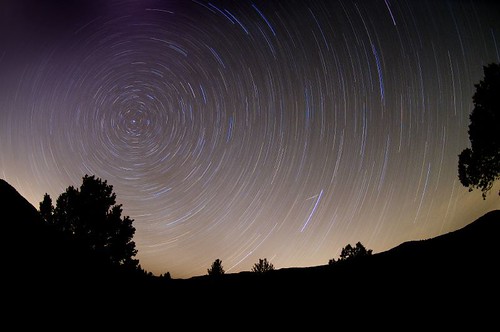
New North Star
13,000 Years From Now
Verified. Empirically supported and rationally deduced.
- < 1 minute read

Michael Alan Prestwood
Natural Philosopher & Author
Natural Philosopher & Author
Prestwood explores science-first philosophy, with particular attention to the convergence of disciplines. Drawing on his TST Philosophy, his work emphasizes rational inquiry grounded in empirical observation while engaging questions at the edges of established knowledge. With TouchstoneTruth positioned as a living touchstone, this work aims to contribute reliable, evolving analysis in an emerging AI era where the credibility of information is increasingly contested.
Email
Print
The Prestwood Column
Menu
October 2026
»COLUMN ARCHIVE
--COLUMN--
Column Research….
NEW BOOK! NOW AVAILABLE!!
30 Philosophers: A New Look at Timeless Ideas
by Michael Alan Prestwood
