
Weekly Insights for Thinkers

Science  Philosophy  Critical Thinking  History  Politics RW  AI  Physics  •  Evolution  Astronomy 30 Phil Book More…
Science  Phil  Cr. Thinking  History 

FAQ

When did we discover stars are mostly made of hydrogen and helium?

By Michael Alan Prestwood

Author and Natural Philosopher

Wed 16 Oct 2024
Published 1 year ago.
Updated 1 month ago.
The Stuff of Stars
Share :

When did we discover stars are mostly made of hydrogen and helium?

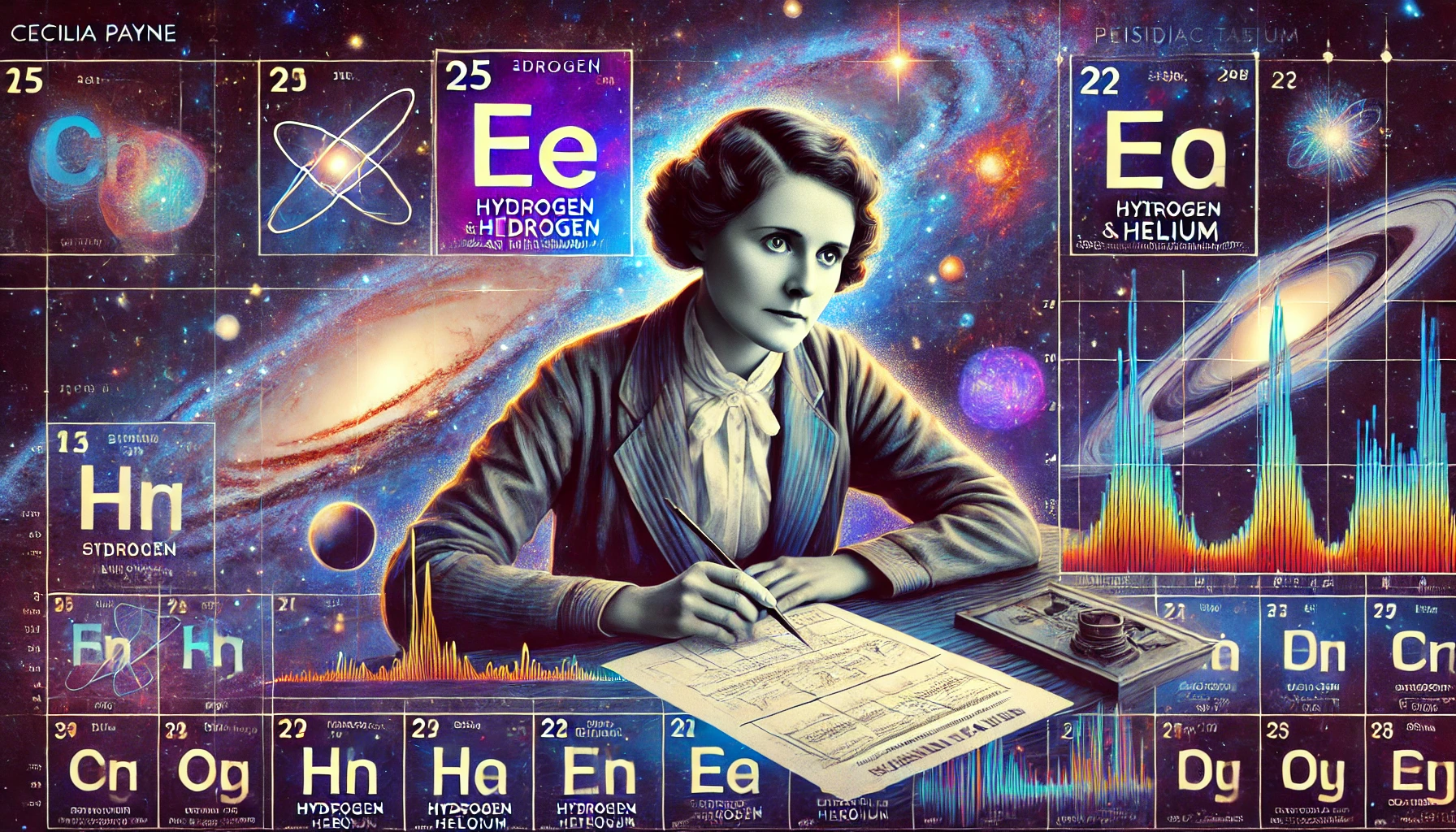
A century ago, in 1925, Cecilia Payne—later Payne-Gaposchkin—discovered that stars are almost entirely made up of the first two elements of the Periodic Table: hydrogen and helium.

She analyzed the spectra of stars using existing data to figure it out. Her key insight was to recognize that the absorption lines in stellar spectra represented the presence of hydrogen and helium. Previously it was thought to be caused by iron and other heavy elements. An idea likely influenced by our anthropomorphic tendencies. We wanted to believe the entire universe was made up of the same stuff as Earth. It’s not. Less than 2% of Type I stars, third generation stars, are made up of heavier elements.

At the time, the scientific community was split. The older prevailing thought was that atoms were neutral. They didn’t emit anything. Some thought they emitted things they called ions. Later we discovered ions were electrons and other sub-atomic particles. So, when someone talks about the ionization of atoms, now you know where that came from!

She used the Saha equation, a new formula developed by Indian astrophysicist Meghnad Saha. She demonstrated that the absorption lines were consistent with the presence of hydrogen and helium in stars. Her work provided strong evidence for the abundance of these elements in stars.

Science is about repeatability and four years later in 1929, Henry Norris Russell, an American astronomer, independently confirmed her findings and provided further evidence for the abundance of hydrogen and helium in stars.

So, back in 1925, Cecilia Payne made a groundbreaking contribution to our understanding of ionization and the composition of stars. By 1930, atom ionization had become the prevailing thought in physics, paving the way for our modern understanding of the cosmos.
Michael Alan Prestwood
Author & Natural Philosopher

Prestwood writes on science-first philosophy, with particular attention to the convergence of disciplines. Drawing on his TST Framework, his work emphasizes rational inquiry grounded in empirical observation while engaging questions at the edges of established knowledge. With TouchstoneTruth positioned as a living touchstone, this work aims to contribute reliable analysis in an emerging AI era where the credibility of information is increasingly contested.

WWB Menu
7 Jan 2026
Essay of the Week
The Architecture of Change: Finding Stability in Flux
Story of the Week
Heraclitus
Quote of the Week
“Everything is in flux.”
Weekly Crossroads!
1. Science »
Will the night sky have stars nearly forever?
2. Philosophy »
What does existence before essence mean?
3. Critical Thinking »
Is cause and effect certain?
4. History!
Who were the Presocratic Philosophers?

Comments

Join the Conversation! Currently logged out.
NEW BOOK! NOW AVAILABLE!!

30 Philosophers: A New Look at Timeless Ideas

by Michael Alan Prestwood
The story of the history of our best ideas!
WWB Menu
7 Jan 2026
Essay of the Week
The Architecture of Change: Finding Stability in Flux
Story of the Week
Heraclitus
Quote of the Week
“Everything is in flux.”
Weekly Crossroads!
1. Science »
Will the night sky have stars nearly forever?
2. Philosophy »
What does existence before essence mean?
3. Critical Thinking »
Is cause and effect certain?
4. History!
Who were the Presocratic Philosophers?
Scroll to Top