
Explore Science-first Philosophy

FAQ

Does sound change pitch in water?

Wed 30 Oct 2024
Published 1 year ago.
Updated 3 weeks ago.
Related FAQs
Does my gravity pull on the Sun?
Is space truly empty? Anywhere?
Can our perception of size and scale be trusted?
What’s the difference between common ions and ionization in physics?
What is the difference between volume and mass?
Was Einstein’s Theory of Relativity ever irrational?
Share :
Email
Print

Does sound change pitch in water?

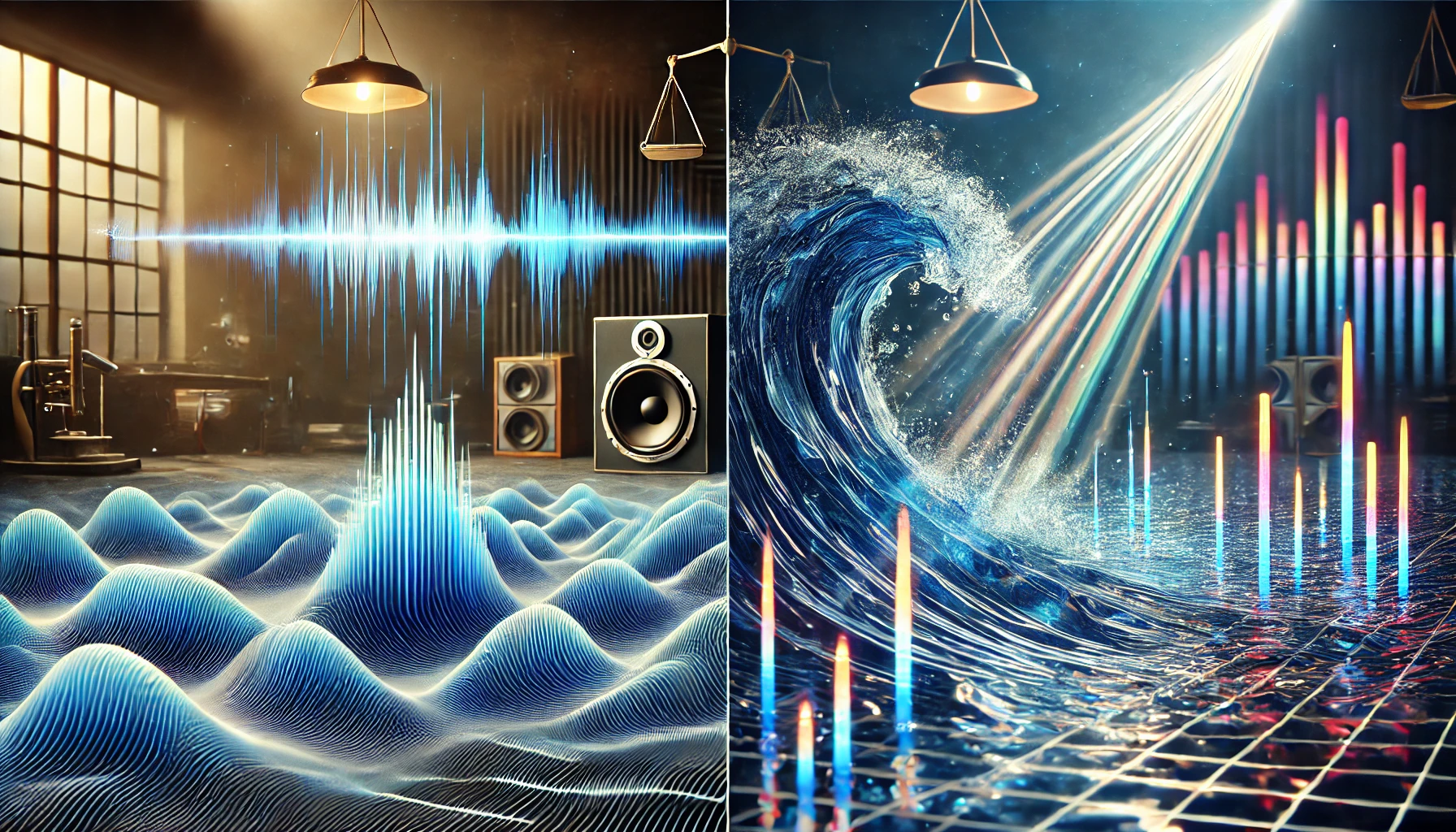
No, sound does not change pitch when it moves from air to water. However, water naturally filters out various waves, especially higher frequencies.

Our universe operates by rules—rules that sometimes feel almost magical. Sound waves are a beautiful example of this. The pitch of a sound is determined by the number of waves per second (its frequency) as it moves through different environments.

Consider the tuning note, A above middle C, with a frequency of 440 Hz—meaning 440 waves per second. This note stays at 440 Hz whether it’s moving through air, water, or even helium. When sound changes mediums, it “magically” adjusts its speed, slowing down or speeding up precisely enough to keep the same frequency. So, even as the wavelength shifts, the frequency—and therefore the pitch—remains consistent across media.

Similarly, light maintains its color, or its frequency, when it transitions between media. When light enters a new medium (like from air to water), its color stays true, even as its speed and wavelength adjust. For example, in denser media like water or glass, the wavelength shortens to preserve the color’s consistency. Magic? Perhaps not in the literal sense, but this universal law certainly gives us something to marvel at.

I’m Michael Alan Prestwood, here to share a bit of physics magic. While sound and light waves can’t travel through all types of media, when they do, they “magically” adjust their speed so that their frequency—and in light’s case, its color—remain constant, no matter the medium and despite the fact that the universe does not have a ticking metronome.
— map / TST —

Michael Alan Prestwood
Author & Natural Philosopher
Prestwood writes on science-first philosophy, with particular attention to the convergence of disciplines. Drawing on his TST Framework, his work emphasizes rational inquiry grounded in empirical observation while engaging questions at the edges of established knowledge. With TouchstoneTruth positioned as a living touchstone, this work aims to contribute reliable, evolving analysis in an emerging AI era where the credibility of information is increasingly contested.
This Week @ TST
April 15, 2026
»Column Archive
WWB Research….
1. Story of the Week
John Snow and the Broad Street Pump
2. Quote of the Week
“A wise man proportions his belief to the evidence.”
3. Science FAQ »
Were dinosaurs Jurassic movie smart?
4. Philosophy FAQ »
How does the idea of Identity in Christ fit within TST?
5. Critical Thinking FAQ »
What is the difference between Public Truth and Public Belief?
6. History FAQ!
Did Einstein’s driver really give one of his early talks?
Bonus Deep-Dive Article
TST Epistemic Calibration: Credence and Degrees of Belief

Comments

Join the Conversation! Currently logged out.
NEW BOOK! NOW AVAILABLE!!

30 Philosophers: A New Look at Timeless Ideas

by Michael Alan Prestwood
The story of the history of our best ideas!
Scroll to Top