

Public Truth Systems
3 Truth Hammers
Public truth = Science + Law + Journalism.
CRITICAL THINKING START
Think Well Path: 5-4-3
Start here if your first question is:
“How do I think more clearly?”
The Think Well Path begins with the tools of judgment. You’ll explore how ideas form, how reasoning works, how thinking goes wrong, and how public truth is tested through science, law, and journalism.
This is the 5-4-3 path: Five Thought Tools, Four Mind Traps, and Three Truth Hammers. It is TST’s practical path for sharpening your mind, testing claims, and building intellectual discipline.
CORE READING
A 5-4-3 structured model for disciplined thinking.
Recent Tidbits:
Stories, Quotes, and FAQs.
The wisdom builder tidbits that feed the columns, articles, and trainer.
Three Truth Hammers
Featured Story
Critical Thinking
Story
Born 1711.
David Hume
Lived from 1711 to 1776. 12 Generations Ago.
- Scottish Enlightenment Philosopher
Skeptical Empiricism
Hume is asking you to calibrate your belief in statements. Even in your spiritual claims. Hold onto all your spiritual beliefs, if you want, but calibrate them against reality. Things like love, compassion and kindness can be measured empirically. Things like Valhalla, Heaven, or Hell cannot. Believe in both types but calibrate. Understand which claims have real evidence. This is how you protect spirituality from false certainty. Awe, meaning, compassion, and transformation are real human experiences. There is no need to pretend every claim is true. Believe carefully. Let confidence rise with empirical evidence.
Featured QUOTE
Critical Thinking
Quote
“The historian without his facts is rootless…the facts without their historian are…meaningless.”
- E. H. Carr
- 1961
Philosophy of History
Carr supports the heart of empirical narrative realism: evidence anchors history, but reason shapes the retelling. The facts keep the historian grounded in reality; the historian gives those facts sequence, context, and meaning. Always ask how much confidence each reconstruction deserves.
Featured FAQ
Updated This Week
Philosophy
FAQ
Debating History: Should We Say “Dark Ages” or “Middle Ages?”
Epistemology
Modern historians prefer “Middle Ages” because “Dark Ages” simplifies a negative time too much. Still, the adjective dark points to something real: a period when tolerance narrowed and knowledge was lost. Language should evolve—but we shouldn’t lose the philosophical insight older labels were trying to express. The same is true in daily life. Categories help us think quickly, but people are always more complex than the labels we give them. Walk a friendlier journey with others by using labels as careful tools, not identities.
Updated Tidbits
Critical Thinking
FAQ
What is the preservation bias?
Preservation Bias
08 Aug 2026
(Updated 1 week ago)
08 Aug 2026
(Updated 2 weeks ago)
Science
FAQ
Is “the speed of light” really the best name for the universe’s maximum speed?
Relativity
08 Aug 2026
(Updated 2 weeks ago)
No more posts to show
Three Truth Hammers
Public Truth Systems
Testing claims against reality.
Truth Hammers are review-based public truth systems that help societies test claims against shared reality. They do not create truth, but they provide structured ways to review claims, challenge error, and move closer to it.
Deep-Dive Articles
TST Philosophy of Fiction: Imaginative Realism
Michael Alan Prestwood
July 1, 2026
Fiction is not created from nothing; it is the recombination of real impressions into imagined things.
Irrational Ideas: The Subtypes
Michael Alan Prestwood
April 6, 2026
When you encounter an irrational idea, first ask whether it is speculative or disproven.
Irrational Ideas: The Subtypes
April 6, 2026
When you encounter an irrational idea, first ask whether it is speculative or disproven.
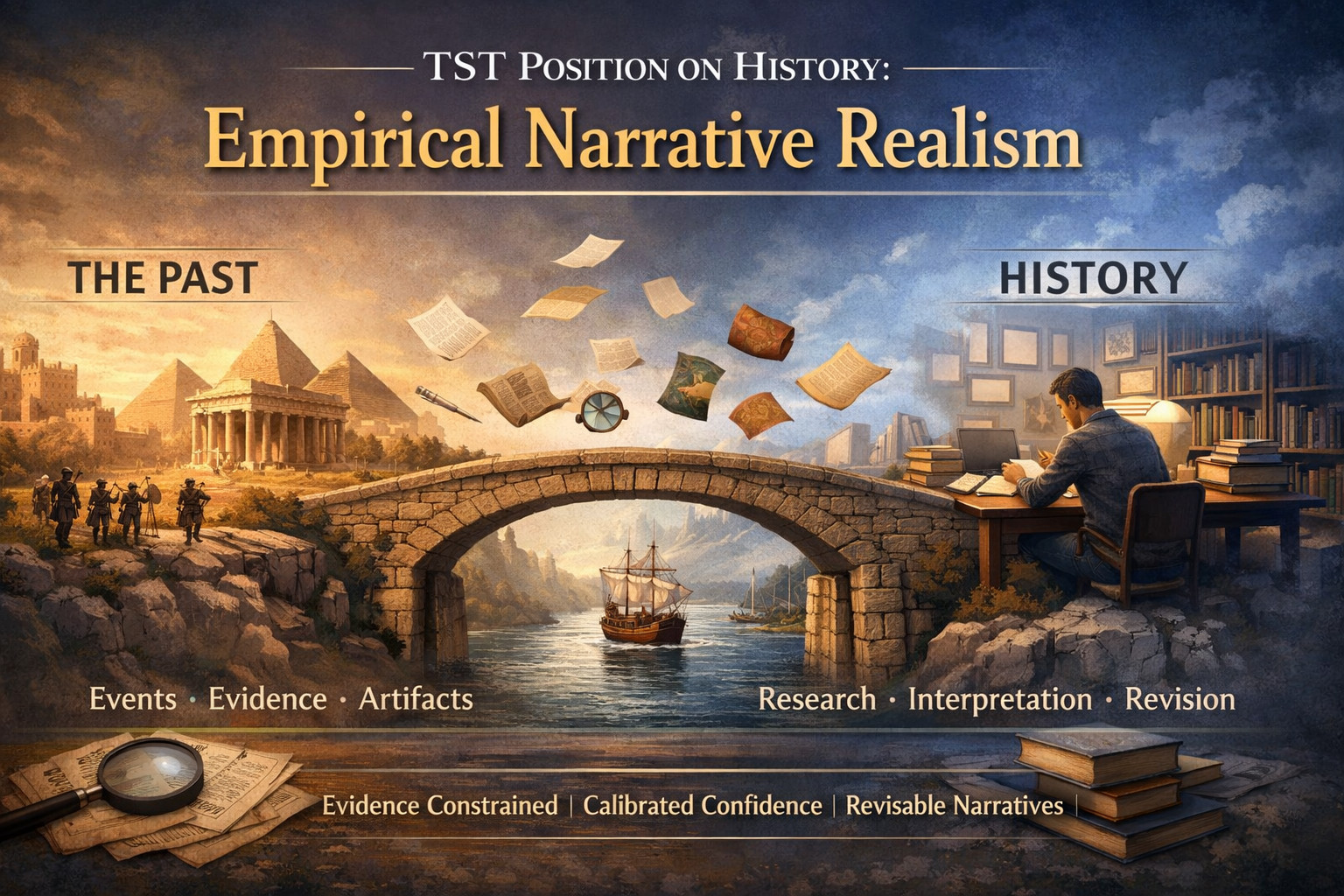
TST Philosophy of History
March 3, 2026
History is the empirical past. Historical writing is rational narrative that aligns with reality.
Idea Theory Framework
February 7, 2026
The Idea Theory Framework within the Idea of Ideas is a promotion ladder for ideas to move from speculation to hypothesis, theory, and law.
Must-Reads
Philosophy of Law
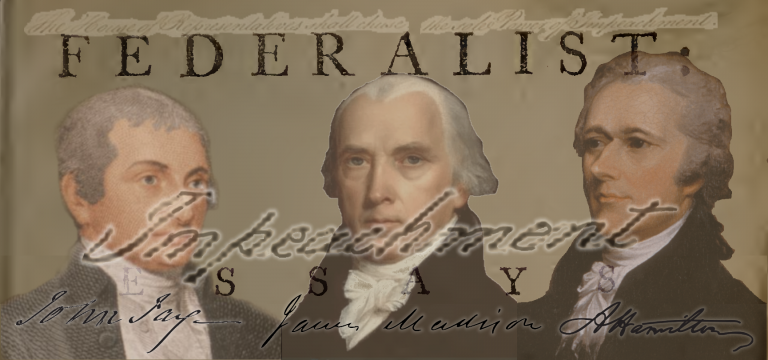
Nonpartisan: The Federalist Papers and Presidential Impeachment
Impeachment is not a normal criminal trial. It is a constitutional political process designed to protect the public trust when federal officials abuse power, show ...
Philosophy of Law
Parable of the Ship by Roger Williams, 1655
Roger Williams’ 1655 Parable of the Ship is used as an illustration of separation of church and state, liberty, and the common good. In this ...

Philosophy of Law
Idea: Comprehensive Gun Control
For those that say we cannot do anything about gun violence, here is a list of items we can implement. This represents some of the ...
New Ideas
Idea of Ideas
Idea Theory Framework
The Idea Theory Framework within the Idea of Ideas is a promotion ladder for ideas to move from speculation to hypothesis, theory, and law.
Ancient Humans
Holistic Paleolithic Framework: A New Look at Prehistory
A new look at dividing up the paleolithic era switches from lower, middle, and upper to Stone, Fire, Cultural, Symbolic, Cognitive, and prehistory ending specifically ...
Philosophy of Journalism
The Living Touchstone
As part of critical thinking, the philosophy of journalism can help us enter the age of AI, where truth and untruth live on equal plain. ...
Updated Articles
TST COLUMN
24 Dec 2019
Debut
Critical Thinking
Article
The Anti-Vaxxer Movement and the Scientific Method
Vaccines
Tue 24 Dec 2019
(7 years ago)
Updated 1 month ago.
TST COLUMN
03 May 2026
Critical Thinking
Paper
TST Philosophy of History
Idea of Ideas
Tue 3 Mar 2026
(6 months ago)
Updated 1 month ago.
TST COLUMN
01 Jul 2026
Critical Thinking
Paper
TST Philosophy of Fiction: Imaginative Realism
Philosophy of Fiction
Wed 1 Jul 2026
(2 months ago)
Updated 1 month ago.
No more posts to show


