
Phil • Cr. Think • Science • Hist • …
TST PRACTICE

By Philosopher Michael Alan Prestwood

FAQ

Do empirical ideas require direct observation?

☐ Read
☑ Read
You’ve read this 0 times.
You’ve listened to this 0 times.
Sun 14 Jun 2026
Published 4 months ago.
Updated 3 months ago.
Related FAQs
Is history a Truth Hammer?
Was Pythagoras’ thinking flawed?
Is there evidence for other dimensions?
Who is famous for questioning cause and effect?
Why do intelligent people defend bad ideas?
Does Agrippa’s Trilemma disprove the Idea of Ideas?
Share :
Email
Print

Do empirical ideas require direct observation?

No. Empirical ideas require confirmation in the material world, not necessarily direct observation. An empirical idea is a direct description of reality. We can confirm it by seeing it, measuring it, detecting its effects, reproducing its behavior, or deducing it from reliable material evidence. Direct observation is one path to empirical truth, but it is not the only path.

The Oort Cloud shows the difference. It is a serious speculative idea because long-period comets seem to point toward a distant reservoir of icy bodies surrounding the solar system. The idea is reasonable, even likely, but the cloud itself has not been confirmed. We have not yet observed, measured, sampled, or otherwise verified the proposed reservoir. So, for now, it remains speculative.

Viruses show the other side. Scientists confirmed viruses before they could see them. In 1892, experiments showed that something smaller than bacteria could pass through filters and still cause disease. That was empirical confirmation by effect, not by sight. Later, electron microscopes allowed us to see viruses directly. The idea became empirical before direct observation because the material world was already pushing back in repeatable, measurable ways.
— map / TST —

TST Tracker
✓ Reading recorded.
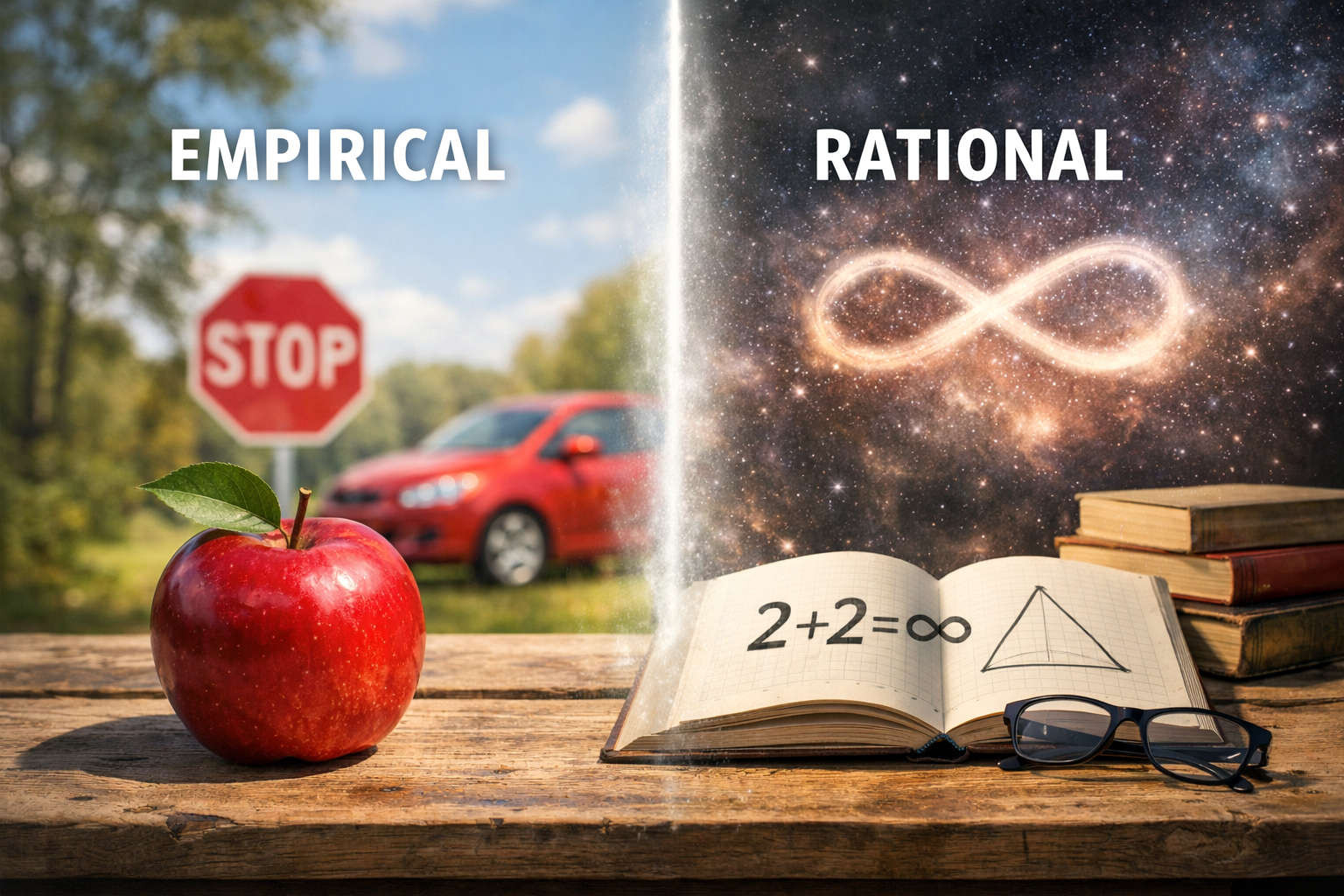
Empirical ideas observe, measure, or detect. Rational ideas organize.
Michael Alan Prestwood
Author & Natural Philosopher
Prestwood writes on science-first philosophy, with particular attention to the convergence of disciplines. Drawing on his TST Framework, his work emphasizes rational inquiry grounded in empirical observation while engaging questions at the edges of established knowledge. With TouchstoneTruth positioned as a living touchstone, this work aims to contribute reliable, evolving analysis in an emerging AI era where the credibility of information is increasingly contested.
The Prestwood Column
Menu
October 2026
Column Research….
1. Timeline Story
The Great Quaker Debates!
2. Linked Quote
“All men are prone to differ. It is no new thing in all former ages, in all parts. Each party is most right in his own eyes.”
3. Science FAQ »
Do facts actually change minds?
4. Philosophy FAQ »
When does persuasion become manipulation?
5. Critical Thinking FAQ »
How can you tell when a debate has stopped being productive?
6. History FAQ!
What is the history of debate?
Bonus Deep-Dive Article
Roger Williams Biography and Dedication to the Freedom of Conscience

Comments

Join the Conversation! Currently logged out.
NEW BOOK! NOW AVAILABLE!!

30 Philosophers: A New Look at Timeless Ideas

by Michael Alan Prestwood
The story of the history of our best ideas!
Scroll to Top