
Explore Natural Philosophy

Phil • Cr. Think • Science • Hist •

STORY

Bacteria Diversify: Major modern phyla

By Michael Alan Prestwood

Sun 22 Feb 2026
Published 5 months ago.
Updated 3 weeks ago.
Related Stories
Bacteria Photosynthesis begins
Ordovician–Silurian Extinction: Ice Strikes the Seas
Mesozoic Era: Age of Dinosaurs
Prokaryotic Life
Triassic–Jurassic Extinction: Volcanoes Open the Age of Dinosaurs
The P-T Extinction
Share :
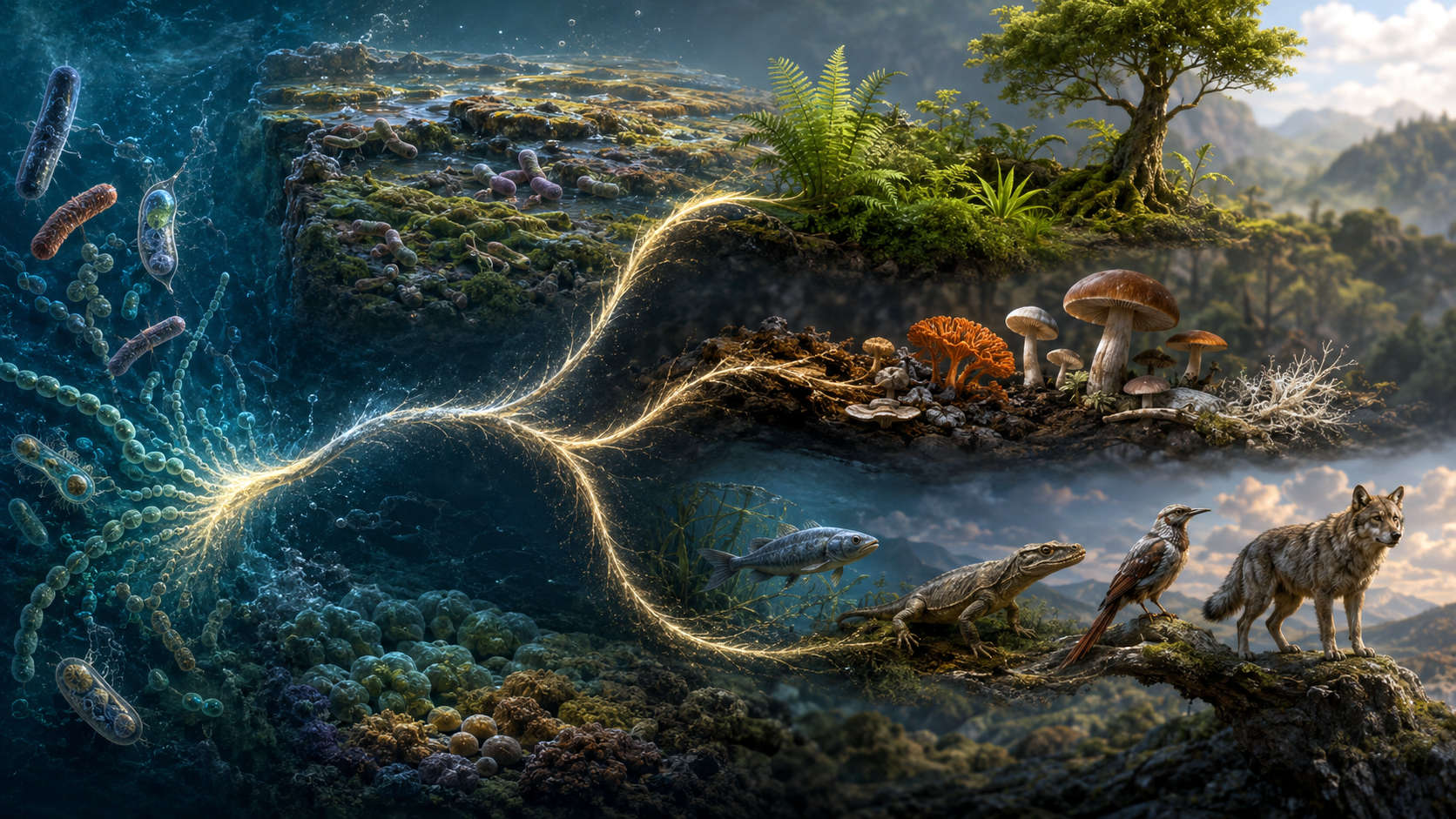
After the "Great Oxidation Event," all life, including the bacterial world settled into modern lineages, the foundational "Ecological Cast" of all major life today.

Bacteria Diversify: Major modern phyla

~1.3 Billion years ago (+/- 200 million)
The ecological cast takes shape.

About 1.3 billion years ago, after oxygen began reshaping Earth, life settled into several major branches. The great ecological cast was taking shape. One branch stayed bacterial and continued running the planet’s chemistry. Another branch became the eukaryotes: larger, more complex cells that eventually gave rise to plants, fungi, animals, algae, and many single-celled protists.

From there, the story becomes familiar. The plant branch became mosses, ferns, trees, grasses, flowers, and crops. The fungal branch became molds, yeasts, mushrooms, and vast underground networks. The animal branch became sponges, worms, fish, insects, reptiles, birds, mammals, and eventually us.

Meanwhile, bacteria kept doing the work almost no one notices. Cyanobacteria made oxygen. Proteobacteria recycled chemicals and helped give rise to mitochondria. Actinobacteria built soils and produced natural compounds. Firmicutes became tough survivors and gut companions. Bacteroidetes became expert decomposers. Other bacterial branches moved through mud, cycled nitrogen, broke down waste, and kept ecosystems alive.

The simple story is this: complex life branched into the visible world of plants, fungi, and animals, while bacteria and archaea remained the invisible workforce beneath it all.

Life did not replace its earliest tricks. It kept them. Bacteria still recycle the world. Archaea still endure strange environments. Cyanobacteria still harvest sunlight. Viruses and mobile genes still reshape evolution from the shadows. The ancient world is not gone; it is under our feet, in our oceans, and inside us.

— map / TST —

Michael Alan Prestwood
Author & Natural Philosopher
Prestwood writes on science-first philosophy, with particular attention to the convergence of disciplines. Drawing on his TST Framework, his work emphasizes rational inquiry grounded in empirical observation while engaging questions at the edges of established knowledge. With TouchstoneTruth positioned as a living touchstone, this work aims to contribute reliable, evolving analysis in an emerging AI era where the credibility of information is increasingly contested.
Email
Print
The Prestwood Column
Menu
July 2026
»COLUMN ARCHIVE
--COLUMN--
Column Research….
1. Timeline Story
The famous Lewis “Truth in Fiction” Paper
2. Linked Quote
“Truth is stranger than fiction…[which] is obliged to stick to possibilities;”
3. Science FAQ »
Why does fiction feel real?
4. Philosophy FAQ »
Can authors create fiction beyond our universe?
5. Critical Thinking FAQ »
How do we know what is true in a fictional world?
6. History FAQ!
What is the history of philosophy of fiction?
Bonus Deep-Dive Article
TST Philosophy of Fiction: Imaginative Realism

Comments

Join the Conversation! Currently logged out.

Leave a Reply

NEW BOOK! NOW AVAILABLE!!

30 Philosophers: A New Look at Timeless Ideas

by Michael Alan Prestwood
The story of the history of our best ideas!
Scroll to Top