
Explore Science-first Philosophy

STORY

Blue-Green Bacteria (Not Algae)

By Michael Alan Prestwood

Fri 6 Mar 2026
Published 1 month ago.
Updated 3 weeks ago.
Related Stories
Bacterial Endosymbiosis: Origin of Eukaryotes
Bacteria Photosynthesis begins
Ordovician–Silurian Extinction: Ice Strikes the Seas
Bacteria Diversify: Major modern phyla
Triassic–Jurassic Extinction: Volcanoes Open the Age of Dinosaurs
Prokaryotic Life
Share :
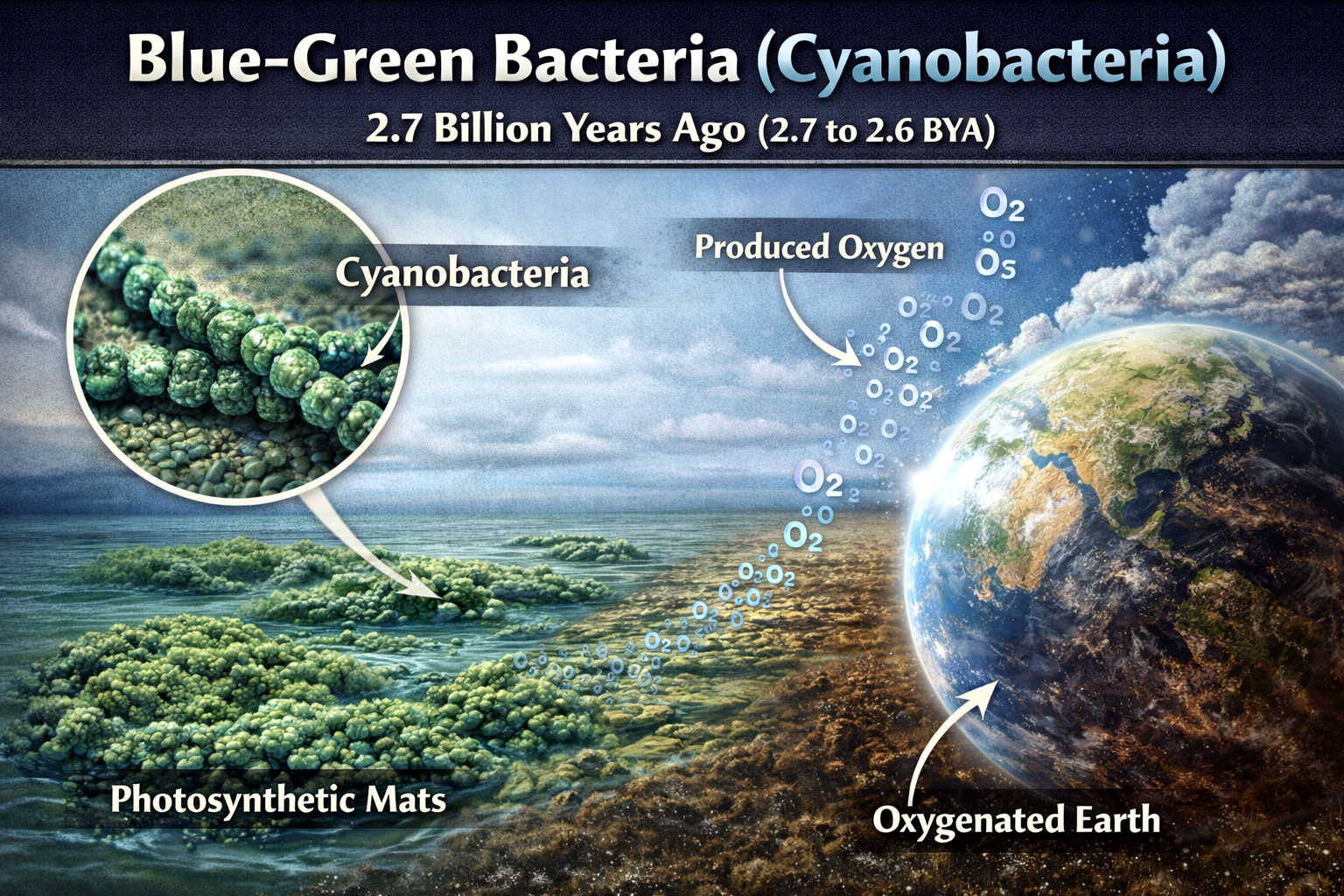
Long before plants covered the land, cyanobacteria were already harvesting sunlight. In doing so, they slowly helped change Earth’s oceans and atmosphere, preparing the way for more complex life.

Blue-Green Bacteria (Not Algae)

2.65 Billion years ago (+/- 50 million years)

Blue-green algae are not true algae at all. They are cyanobacteria — ancient, photosynthetic bacteria. Because they use sunlight and often look algae-like in ponds, lakes, and wet places, the old label stuck. You still see it today on pool supplies and warning signs, even though the scientific term is cyanobacteria. They are not plants, and they are not true algae. They are bacteria.

These tiny organisms were world-changers. Over immense stretches of time, they helped drive the oxygenation of Earth, slowly transforming the oceans and atmosphere. The Great Oxidation Event is usually dated to about 2.4 billion years ago, but cyanobacteria likely appeared earlier. In that sense, they were not just another bacteria. They were among Earth’s earliest great planetary engineers.

They also matter for another reason. Much later, the ancestors of chloroplasts — the structures plants and algae use for photosynthesis — likely came from cyanobacteria through endosymbiosis. So even though blue-green algae are not true algae, they helped make later algae and plants possible. That gives them an even bigger place in the story of life.

— map / TST —

Michael Alan Prestwood
Author & Natural Philosopher
Prestwood writes on science-first philosophy, with particular attention to the convergence of disciplines. Drawing on his TST Framework, his work emphasizes rational inquiry grounded in empirical observation while engaging questions at the edges of established knowledge. With TouchstoneTruth positioned as a living touchstone, this work aims to contribute reliable, evolving analysis in an emerging AI era where the credibility of information is increasingly contested.
Email
Print
This Week @ TST
April 8, 2026
»Column Archive
WWB Research….
1. Story of the Week
Pragmatism
2. Quote of the Week
“Our statements about the external world face the tribunal of sense experience not individually, but only as a corporate body.”
3. Science FAQ »
Why do scientific models work if they aren’t literally true?
4. Philosophy FAQ »
Is agnosticism a ludicrous position to occupy?
5. Critical Thinking FAQ »
Do my people and culture help or harm my critical thinking?
6. History FAQ!
Did Berger and Luckmann really say reality is just made up?
Bonus Deep-Dive Article
TST Doxastic Formation: Public Belief, Tribe, and Worldview
Scroll to Top