
Phil • Cr. Think • Science • Hist •
TST PRACTICE

The Philosophy Website

STORY

First True Bacteria

☐ Read
☑ Read
You’ve read this 0 times.
You’ve listened to this 0 times.

By Michael Alan Prestwood

Sun 22 Feb 2026
Published 7 months ago.
Updated 4 months ago.
Related Stories
Triassic–Jurassic Extinction: Volcanoes Open the Age of Dinosaurs
Bacteria Photosynthesis begins
Blue-Green Bacteria (Not Algae)
Prokaryotic Life
Bacterial Endosymbiosis: Origin of Eukaryotes
Cenozoic Era: Age of Mammals & Birds
Share :
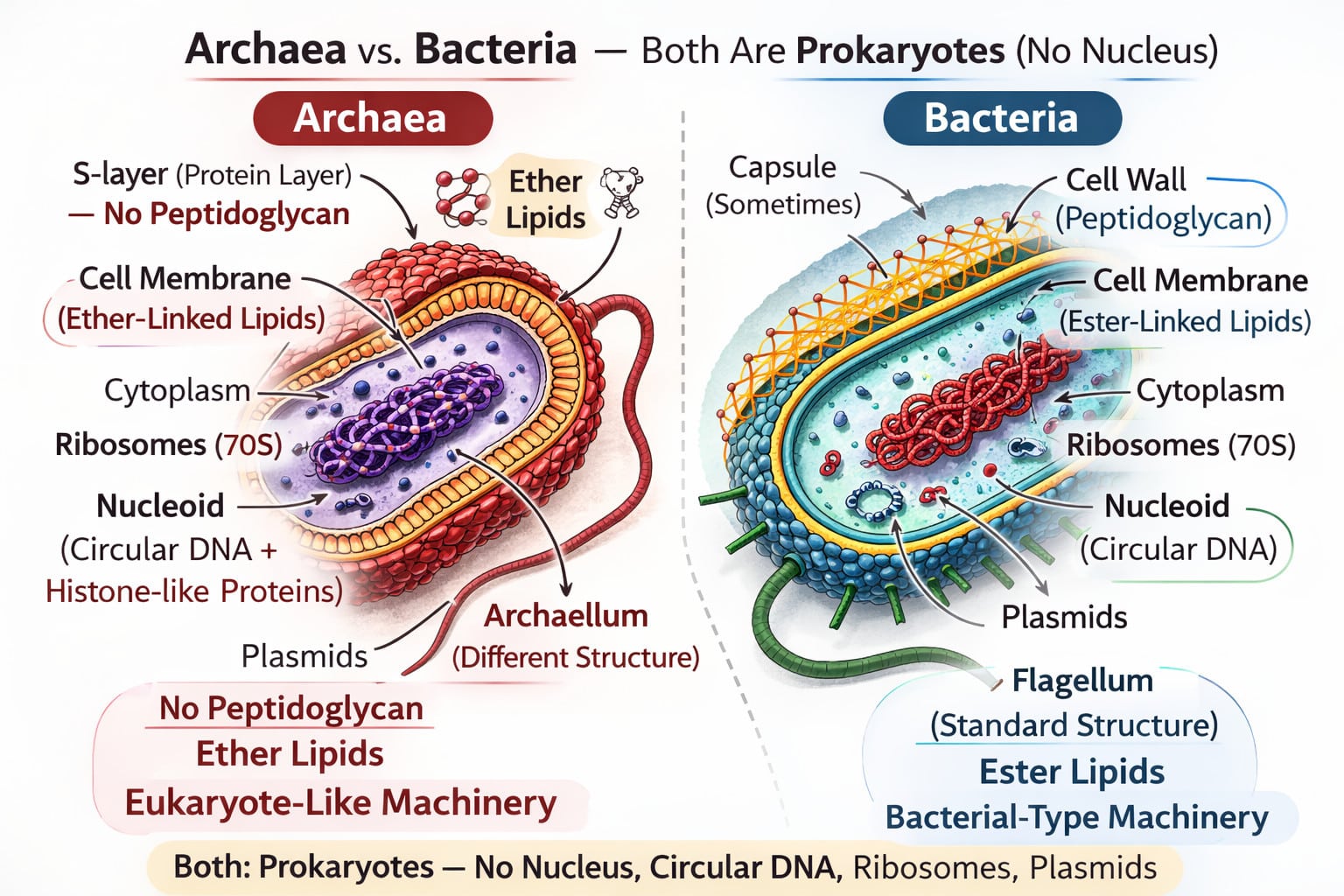
Bacteria and archaea are both prokaryotes, but archaea’s membrane chemistry and genetic machinery are fundamentally different — and archaeal ancestry gave rise to eukaryotic cells.

First True Bacteria

~3.7 Billion years ago (shortly after LUCA)
Peptidoglycan cell wall and Ester-linked lipids

LUCA likely had a very simple, leaky membrane or a rudimentary protein shell. Bacteria developed a cell wall made of peptidoglycan (a mesh of sugars and amino acids). This acts like a reinforced chain-link fence, allowing bacteria to survive in different water pressures without exploding.

The peptidoglycan wall of sugars and amino acids is exactly what penicillin attacks! If a cell has this specific wall, it’s a bacterium.

— map / TST —

TST Tracker
✓ Reading recorded.
Michael Alan Prestwood
Author & Natural Philosopher
Prestwood writes on science-first philosophy, with particular attention to the convergence of disciplines. Drawing on his TST Framework, his work emphasizes rational inquiry grounded in empirical observation while engaging questions at the edges of established knowledge. With TouchstoneTruth positioned as a living touchstone, this work aims to contribute reliable, evolving analysis in an emerging AI era where the credibility of information is increasingly contested.
Email
Print
The Prestwood Column
Menu
September 2026
Column Research….
1. Timeline Story
Hume’s Is–Ought Problem
2. Linked Quote
“I meet with no proposition that is not connected with an ought, or an ought not.”
3. Science FAQ »
Can science prove flourishing should be our goal?
4. Philosophy FAQ »
What is the difference between a normative aim and a normative directive?
5. Critical Thinking FAQ »
Is flourishing for all just utilitarianism?
6. History FAQ!
What is the history of the idea of flourishing in philosophy?
Bonus Deep-Dive Article
Flourishing for All: The Normative Aim of TST Philosophy

Comments

Join the Conversation! Currently logged out.

Leave a Reply

NEW BOOK! NOW AVAILABLE!!

30 Philosophers: A New Look at Timeless Ideas

by Michael Alan Prestwood
The story of the history of our best ideas!
Scroll to Top