
Phil • Cr. Think • Science • Hist •

Explore Natural Philosophy

STORY

Bacteria Aerobic metabolism expands

By Michael Alan Prestwood

Sun 22 Feb 2026
Published 6 months ago.
Updated 1 month ago.
Related Stories
Mesozoic Era: Age of Dinosaurs
Ordovician–Silurian Extinction: Ice Strikes the Seas
Prokaryotic Life
Blue-Green Bacteria (Not Algae)
Great Oxidation Event: Third Atmosphere
The P-T Extinction
Share :
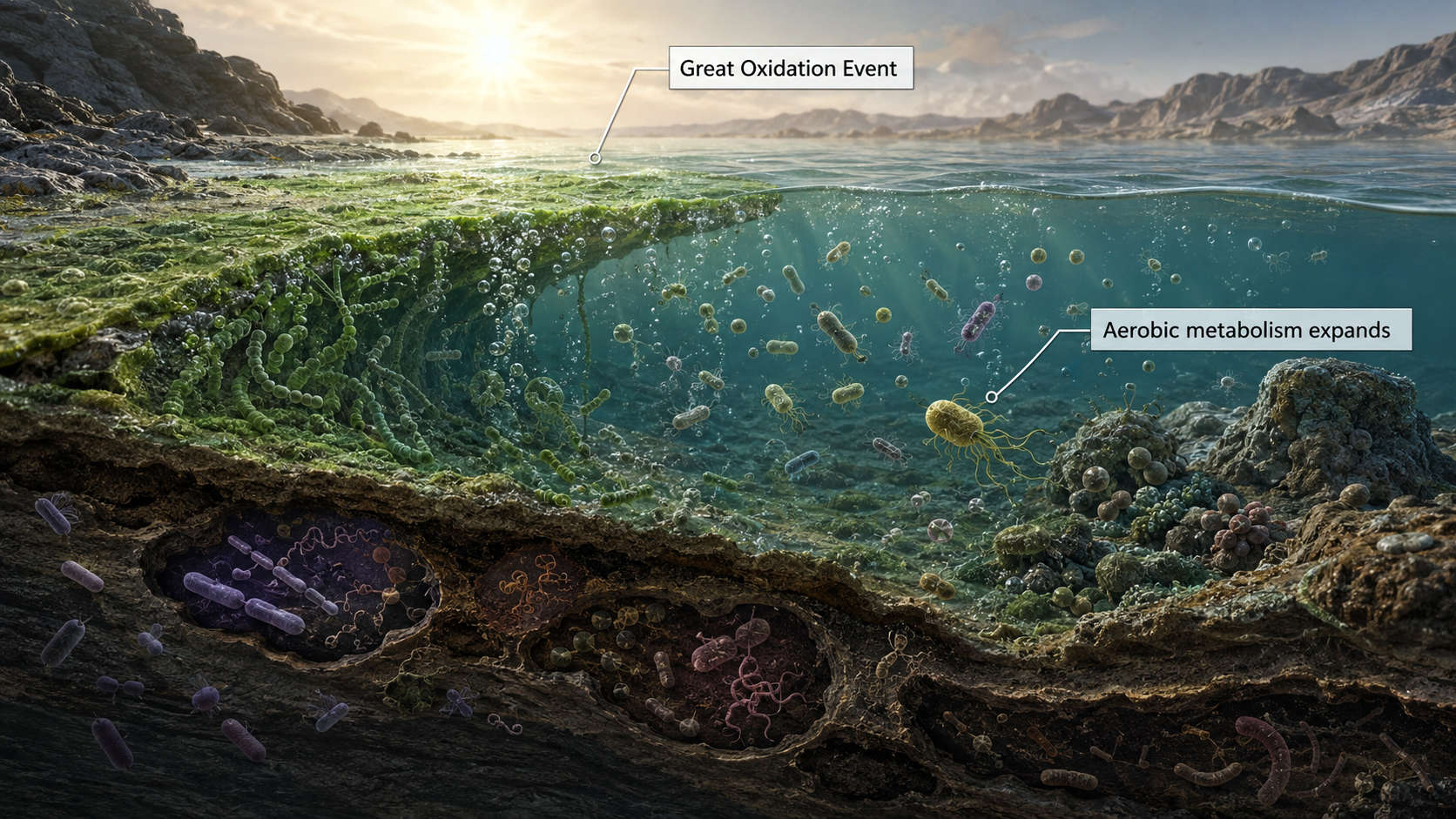
Cyanobacteria caused the oxygen crisis. Aerobic bacteria were among the survivors that learned how to use the poison.

Bacteria Aerobic metabolism expands

~2.2 Billion years ago (+/- 200 million)
Oxygen-respiring bacteria diversify

As cyanobacteria kept releasing oxygen, Earth changed. At first, oxygen did not simply fill the air. It reacted with iron, sulfur, methane, volcanic gases, and other oxygen-hungry materials. But eventually the old chemical buffers filled up. Oxygen began to linger. Then it began to spread.

A catastrophe for life. But evolution is rarely just disaster. It is also opportunity.

Most early microbes lived without oxygen. Many were anaerobes, meaning oxygen was not just unnecessary; it was harmful. When oxygen levels rose, many anaerobic lineages died out, shrank back, or retreated into oxygen-poor refuges: deep mud, sediments, hydrothermal systems, buried mats, and later, animal guts. Others survived by evolving ways to tolerate or use oxygen.

This is where oxygen-respiring bacteria enter the story. The oxygen-makers created the crisis; the oxygen-users learned to live inside it.

Among the bacterial winners were major proteobacterial lineages. Proteobacteria became especially important in oxygen-linked metabolism, chemical cycling, and later evolution. Much later, one alphaproteobacterial lineage would become the ancestor of mitochondria, the energy organelles inside eukaryotic cells. Inside your cells.

The Great Oxidation Event is not just “oxygen appears.” It is deeper. It is the moment life began turning poison into power.

Some bacteria evolved the ability to use oxygen as a terminal electron acceptor in respiration. That sounds technical, but the idea is simple: oxygen is excellent at helping cells extract energy from food. Aerobic metabolism opened a much richer energy pathway. Once oxygen became available, organisms that could use it gained a powerful advantage. Yes, when you think of aerobic exercise, you need to thank the bacteria in each of your cells! Likewise, when you feel the pain of anaerobic exercise, like too many squats, think of the pre-oxygen world.

— map / TST —

Michael Alan Prestwood
Author & Natural Philosopher
Prestwood writes on science-first philosophy, with particular attention to the convergence of disciplines. Drawing on his TST Framework, his work emphasizes rational inquiry grounded in empirical observation while engaging questions at the edges of established knowledge. With TouchstoneTruth positioned as a living touchstone, this work aims to contribute reliable, evolving analysis in an emerging AI era where the credibility of information is increasingly contested.
Email
Print
The Prestwood Column
Menu
August 2026
»COLUMN ARCHIVE
--COLUMN--
Column Research….
1. Timeline Story
Ethical Roadmap
2. Linked Quote
“The greatest weapon against stress is our ability to choose one thought over another.”
3. Science FAQ »
Did morality evolve?
4. Philosophy FAQ »
Is the Me Too movement consistent with TST Ethics?
5. Critical Thinking FAQ »
When should you stop following the crowd?
6. History FAQ!
What did the Nuremberg Trials clarify about moral agents?
Bonus Deep-Dive Article
TST Ethical Roadmap: A Process Model for Ethical Guidance and Moral Choice

Comments

Join the Conversation! Currently logged out.

Leave a Reply

NEW BOOK! NOW AVAILABLE!!

30 Philosophers: A New Look at Timeless Ideas

by Michael Alan Prestwood
The story of the history of our best ideas!
Scroll to Top