

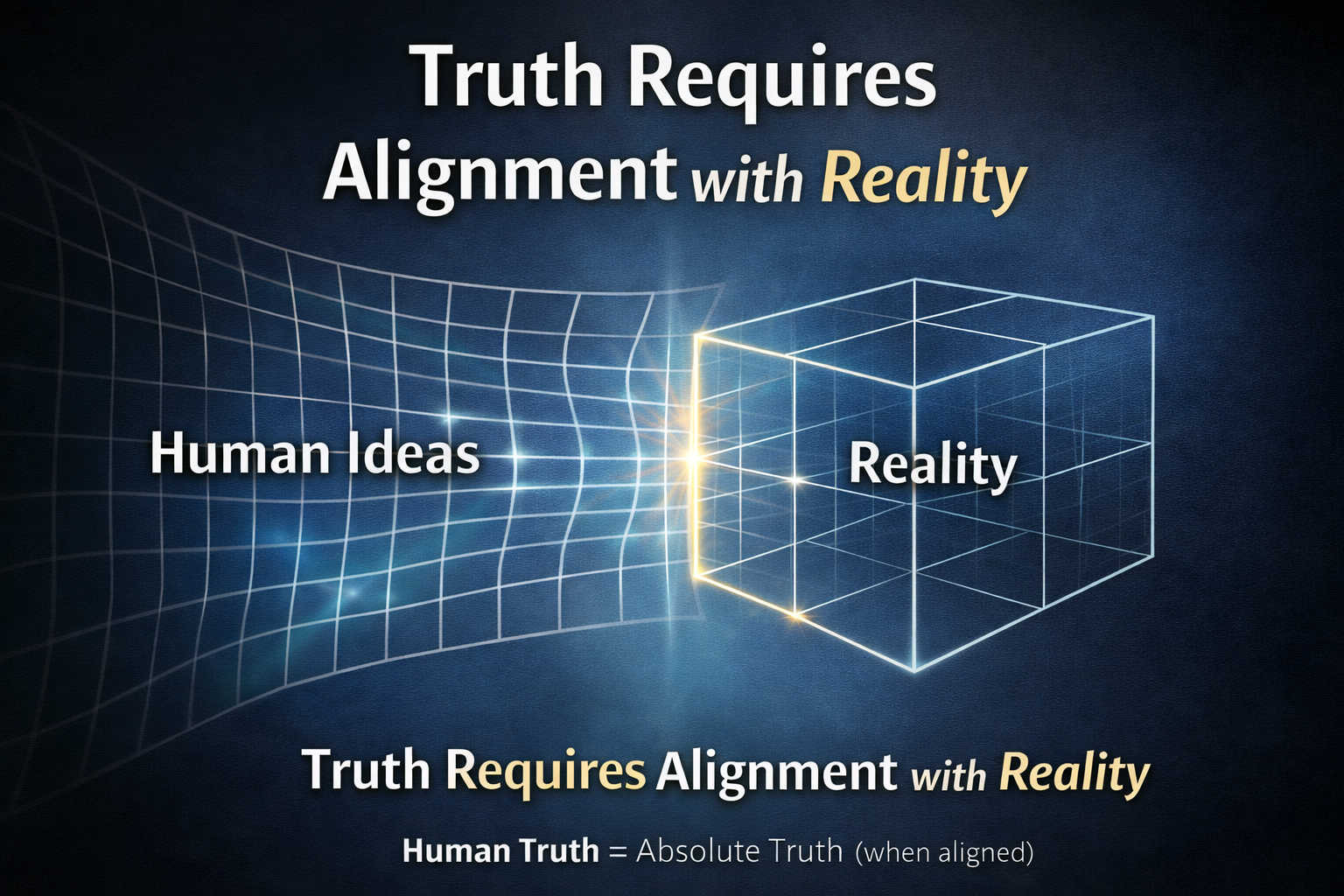
Introduction: Truth Is Not Floating Free.
Truth is not just about words lining up with other words. It is not just about having a clever argument, a useful belief, or a story that feels meaningful. For truth to mean anything strong at all, it has to answer to something beyond our language, beyond our private inner world, beyond our preferences.
In philosophy, the word preferences is used to explore one’s agency — your ability to act, rather than just having things happen to you. Your preferences are your comparative evaluations. Not just “I like coffee,” but more like “I prefer coffee over tea.” Preferences are usually tied to practical reasoning. I’ll say that again because it is important when talking about truth. Your preferences are subjective and are usually, but not always, tied to logic and reason. That right there means, you cannot rely on your preferences alone to determine truth.
Truth cannot be personal, it must be universal. What you “belief,” is covered in the How Truth Relates to Belief column. Truth and belief are related, but they are not the same. Belief is the degree of confidence you hold about something. Your belief alone never makes something publically true.
Unlike belief, truth has to answer, in some meaningful way, to reality. In philosophy, that falls within correspondence and realism. The idea that reality is required to establish truth. Correspondence means that something is true when it matches, or corresponds, with that reality. Realism just menas there is a world out there. In short, this means that truth must answer to the things that actually exist.
That simple point is one of the reasons TST Metaphysics begins with the split between objective reality and our ideas about it. In the Idea of Ideas, there is the material world as it exists, and are descriptions, models, interpretations, and stories built around and within it. The split between reality and our ideas matters because it helps us talk about truth with both confidence and humility.
To frame truth properly, it is important to focus on three things: reality itself, our ideas about reality, and our ideas about everything else.
First up, reality.
The Material World is Reality.
Reality comes first because it cannot change to match our ideas. It does not pause while we debate it, and it does not shift just because a crowd believes something with passion.
To understand truth, you must first accept that objective reality exists and does not change to match your opinion.
Mountains do not shrink to fit a slogan. Gravity does not loosen its grip because a theory is fashionable. Disease does not care about our politics. Death does not wait for consensus. And the age of the Earth is not something we settle by vote, identity, or preference. Reality is what it is, whether we describe it well, badly, or not at all.
That is what makes reality so important to any serious discussion of truth. If truth is cut loose from reality, then it starts to drift. It becomes easier to confuse what is useful with what is true, what is comforting with what is true, or what is popular with what is true. A false idea can be comforting. A bad idea can become fashionable. A useful shortcut can still be an incomplete description of the world. Reality is the anchor that keeps truth from floating away into mere language, group loyalty, or private imagination that surfaces as personal truth.
This is also why the topic of error is so important. We can be wrong only because there is something real to be wrong about. If reality did not stand apart from our ideas, then the idea of a “mistake” would lose meaning. We could still disagree, of course, but disagreement alone is not the same as correction. Correction requires resistance. It requires a world that pushes back. We test a bridge because gravity is real. We test medicine because disease is real. We test historical claims because the past was real, even if our records are incomplete. In each case, reality gets the final say.
So when I say:
Reality precedes thought.
I do not mean that humans are powerless or that ideas do not matter. Ideas matter immensely. They help us describe, predict, organize, and sometimes transform the world around us. But ideas do not become true simply because they are elegant, emotionally satisfying, or widely shared. They become more true when they align with the world they describe.
That is the backbone here: truth depends on something objective enough to resist us, correct us, and outlast us. That means, living with truth means accepting that objective reality exists.
So, with reality set, we move to the second half of the story: thought.
Truthfullness is alignment.
Once reality is placed first, we can then define truth.
Truth is degree of alignment with reality.
Reality and thoughts are not the same thing. They are related, often deeply related, but they are not identical. Human beings do not interact with reality in some pure, perfect, unfiltered way. We see through perception. We think through language. We remember imperfectly. We reason with limits. We build models, stories, categories, and systems to help us navigate the world. A mountain is not the word mountain. Our theory of gravity may someday feel complete, but it is never gravity itself. A tree does not become less real because someone describes it poorly. Reality comes first. Our ideas come after.
That means our ideas can be right, wrong, or partly right. Some ideas fit reality well. Some miss the mark badly. And many land somewhere in between, useful for a time, but incomplete.
That is one of the reasons truth requires humility. We do not simply possess truth like a trophy on a shelf. We move toward it. We test. We revise. We compare. We correct. In that sense, truth for human beings is often less like a thing we hold and more like a process we participate in.
So yes, our ideas can be right, partly right, or wrong. That is the human condition. But it is also a human opportunity. We are not trapped with first impressions and private feelings. We can improve our ideas. We can refine them. We can bring them closer to reality.
To seek truth, is to evaluate. When you evaluate, start by asking yourself what kind of idea you are dealing with. Empirical ideas describe the material world directly. Those can be tested, easily. They deserve weight. Rational ideas describe reality indirectly.
This is why science is one of the three truth hammers.
To measure the truth of an idea, you must first decide if an idea falls within empirical or rational. Empirical ideas describe the material world directly, rational indirectly.
Science is our best disciplined process for forming and refining direct ideas about the material world. These empirical ideas are rooted in observation, measurement, testing, and correction. Science does not give us absolute truth, but it gets a closer. It is powerful not because scientists are magically free from bias, but because the process itself is built to let reality push back.
But not all true ideas need to be direct descriptions of reality. Rational ideas describe reality indirectly. Math, logic, categories, and even ideas like love are not always things we point to as if they were rocks or trees. Yet even these rational ideas must still line up with reality in a meaningful way. They must remain internally consistent, and they cannot clash with the material world they help us describe. A rational idea is strengthened the more it aligns with the material world. Conversely, it is weakened when alignment faulters.
Rational indirect descriptions use logic, structure, relationship, or abstraction. Give them more weight when they are internally consistent. Give them even more weight when their implied empirical implications can be tested. And when those empirical implications are disproven, the idea becomes worthless.
This brings us to the concept of confidence. We can have confidence in our ideas because objective reality is not created by opinion, tribe, or fashion. But we must also practice pragmatic humility toward stories of the unknown and unknowable, because our access to reality is always filtered through perception, memory, and culture. We do not hold reality in our hands as pure certainty. We reach toward it with better and worse ideas. Some of those ideas are highly empirical. Some are indirect rational systems built from what we observe. And some drift so far from the material world that they no longer describe reality in any testable sense. But all ideas are either empirical, rational, or irrational. In TST, empirical, rational, and irrational are not insults or praise words. They are framing categories.
And that leads to the third and final part of this discussion before we conclude: what happens when thought does not align with reality.
Without Reality, “Truth” Collapses.
If truth did not require reality, then truth would have no core. Nothing supporting it. Ideas that ignore objective reality, cannot carry truth. Without truth, ideas just hang together in our minds, we gravitate toward what works for the moment, what comforts us, what our group rewards, or what we feel deeply enough to defend.
If an idea is irrational, it does not describe the material world at all. It is false in a binary logical setting.
All ideas begin as speculative. Some are later proven, some disproven, and some remain speculative. Ideas that are currently unknown stay speculative until we discover a way to test them. Ideas that are unknowable remain speculative because no test is possible. And in some cases, we do not yet know whether an idea is merely unknown or truly unknowable. Ideas that attempt to describe the material world directly are empirically disproven when they fail against observation, evidence, or testing. Ideas that describe things indirectly are rationally disproven when they fail internally through contradiction, incoherence, or invalid structure, or when their implied empirical predictions are shown to be wrong. That is how irrational ideas split over time: from speculative into the proven, the disproven, and the unresolved.
In philosophy, the irrational often shows up in softer substitutes for truth: coherence, usefulness, popularity, or personal conviction. Each of those may have value, but none of them is strong enough by itself to carry truth.
A lie can be useful. A myth can feel meaningful. A tribe can reward falsehood. A slogan can sound coherent inside a closed system. A belief can become popular simply because it flatters the people repeating it. None of that makes it true. Once truth is severed from reality, it becomes much easier for illusion to dress itself up as wisdom. And human history is full of cases where confidence, power, and repetition were mistaken for truth.
This is why reality must stand outside our ideas as something more than our invention. We need a world that can correct us. We need something that does not bend to our preferences. Science needs it. History needs it. Everyday life needs it. We rely on it when we test medicine, when we examine evidence, when we build bridges, when we judge claims, and when we try to separate honest mistakes from comforting nonsense. In all of these cases, truth becomes stronger only when reality is allowed to have the final say.
Untethered speculation is private conviction or social agreement pretending to be more than it is. That does not mean such ideas are always meaningless. Some may inspire, organize, or comfort. But if they do not answer to reality, they cannot carry truth. They are ideas existing without the grounding that truth requires.
To stay honest about truth, recognize when an idea no longer answers to reality. At that point, it is speculation. It might be useful in a pragmatic or meaningful way, but it is not truth.
Let’s wrap this up in a way you can carry with you.
A Summary Recipe for Truth.
Truth is not something we invent out of thin air. It is the ongoing effort to bring our ideas into better alignment with reality. That requires modesty, because we do not know everything perfectly. It requires discipline, because our first impressions, favorite stories, and group loyalties can all mislead us. And it requires honesty, because truth means very little if reality is not allowed to push back.
So the recipe is fairly simple. Three steps that can dramatically improve your life.
- First, accept that objective reality exists and does not bend to your opinion.
- Second, when presented with new information, determine what kind of idea you are dealing with. Is it an empirical idea describing the material world directly, or a rational idea describing it indirectly through logic, structure, or abstraction? Either way, test the empirical of it.
- Third, when reality pushes back on an idea, when it no longer aligns with the material world, have the courage to treat it as speculation rather than truth.
That is the modest but powerful claim at the center of this whole discussion. We may never possess complete truth in some final and perfect sense, but that does not make truth meaningless. It makes truth a disciplined relationship between the mind and the world.
Reality comes first. Our ideas come after. And the more honestly we align them, the closer we come to truth.

