
Weekly Insights for Thinkers

STORY

Theropod Line Diverges Within Dinosaria (from Saurischia)

By Michael Alan Prestwood

Sat 14 Mar 2026
Published 2 hours ago.
Updated 20 minutes ago.
Dinosaur Evolution
Related Stories
First True Bird: Archaeopteryx
Pterosaurs Diverge Within Dinosauria (from Ornithodira)
Pterosaurs Emerge
Archosauria Diverge Within Reptiles
Sauropodomorph Line Diverges Within Dinosaria (from Saurischia)
Ornithischians Diverge Within Dinosauria “Bird Hipped”
Share :
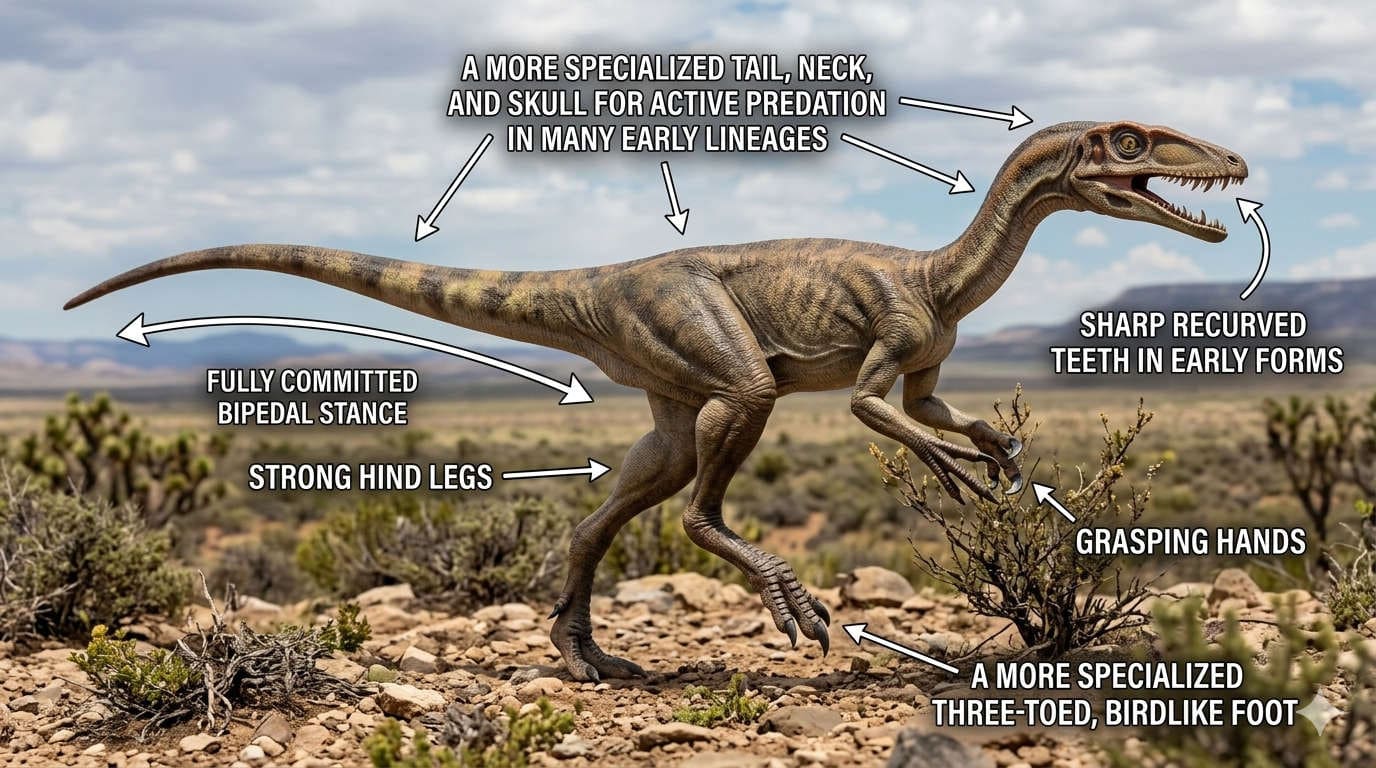
Theropods were the agile, sharp-toothed dinosaur branch that refined the classic predator body plan. They stood fully upright on two legs, balanced with long tails, used grasping hands, and carried specialized skulls and recurved teeth built for active hunting. Over time, this branch produced everything from small early predators to giant hunters—and eventually birds.

Theropod Line Diverges Within Dinosaria (from Saurischia)

~233 million years ago (±2 million years)

While other dinosaur lines committed to armor or massive size, the Theropods perfected the mechanics of the hunt. They emerged in the Late Triassic as high-performance predators, defined by a hollow-boned skeleton that maximized strength while minimizing weight. This was a lineage of athletes. By committing fully to a bipedal stance, they freed their forelimbs to become specialized tools for grasping and slashing. This evolutionary “split” within the saurischian group created a blueprint so successful that it survived the greatest cataclysms in Earth’s history, eventually yielding the only dinosaurs still walking—and flying—among us today.

The anatomy of an early theropod was built for active predation. Their hind legs were elongated and powered by massive muscles, ending in a specialized three-toed, birdlike foot designed for balance and bursts of speed. In the skull, sharp, recurved teeth—often serrated like steak knives—were set into jaws capable of devastating bite forces. A rigid yet flexible tail acted as a dynamic counterweight, allowing for the quick, agile pivoting necessary to track escaping prey. Every feature, from the S-curved neck to the enlarged brain cavity, pointed toward a singular biological goal: the efficient pursuit and capture of other living things.

The legacy of the theropods is one of incredible endurance and radical transformation. Over 165 million years, they diversified into everything from the multi-ton Tyrannosaurus rex to the feathered, bird-like Deinonychus. When the Mesozoic ended, it was the smallest, most specialized members of this clade—the birds—that carried the theropod torch into the modern age. They traded teeth for beaks and scales for plumage, but the core architecture remains. Every modern eagle and hawk is a living testament to the predatory efficiency that first emerged in the Triassic dust.

— map / TST —

Michael Alan Prestwood
Author & Natural Philosopher
Prestwood writes on science-first philosophy, with particular attention to the convergence of disciplines. Drawing on his TST Framework, his work emphasizes rational inquiry grounded in empirical observation while engaging questions at the edges of established knowledge. With TouchstoneTruth positioned as a living touchstone, this work aims to contribute reliable, evolving analysis in an emerging AI era where the credibility of information is increasingly contested.
This Week @ TST
March 11, 2026
»Edition Archive
WWB Research….
1. Story of the Week
Galileo: Observation Corrects the Map
2. Quote of the Week
“The Dao that can be told is not the eternal Dao; The name that can be named is not the eternal name.”
3. Science FAQ »
Is red an empirical idea?
4. Philosophy FAQ »
Does infinity exist?
5. Critical Thinking FAQ »
Was math discovered or invented?
6. History FAQ!
Is Philo’s interpretation related to the split in the Idea of Ideas?
Bonus Deep-Dive Article
TST Metaphysical Position: The Split
Scroll to Top