
Weekly Insights for Thinkers

STORY

The Last Theropods

By Michael Alan Prestwood

Mon 16 Mar 2026
Published 18 hours ago.
Updated 18 hours ago.
Dinosaur Evolution
Related Stories
Bashanosaurus primitivus
Avialae: The Bird Line Diverges (Theropoda)
Galloanserae Birds Emerge (from Neognathae)
Stegosaurus
Dinosauria Emerge: True Dinosaurs!
Hesperornithiformes Birds Emerge (Now Extinct)
Share :
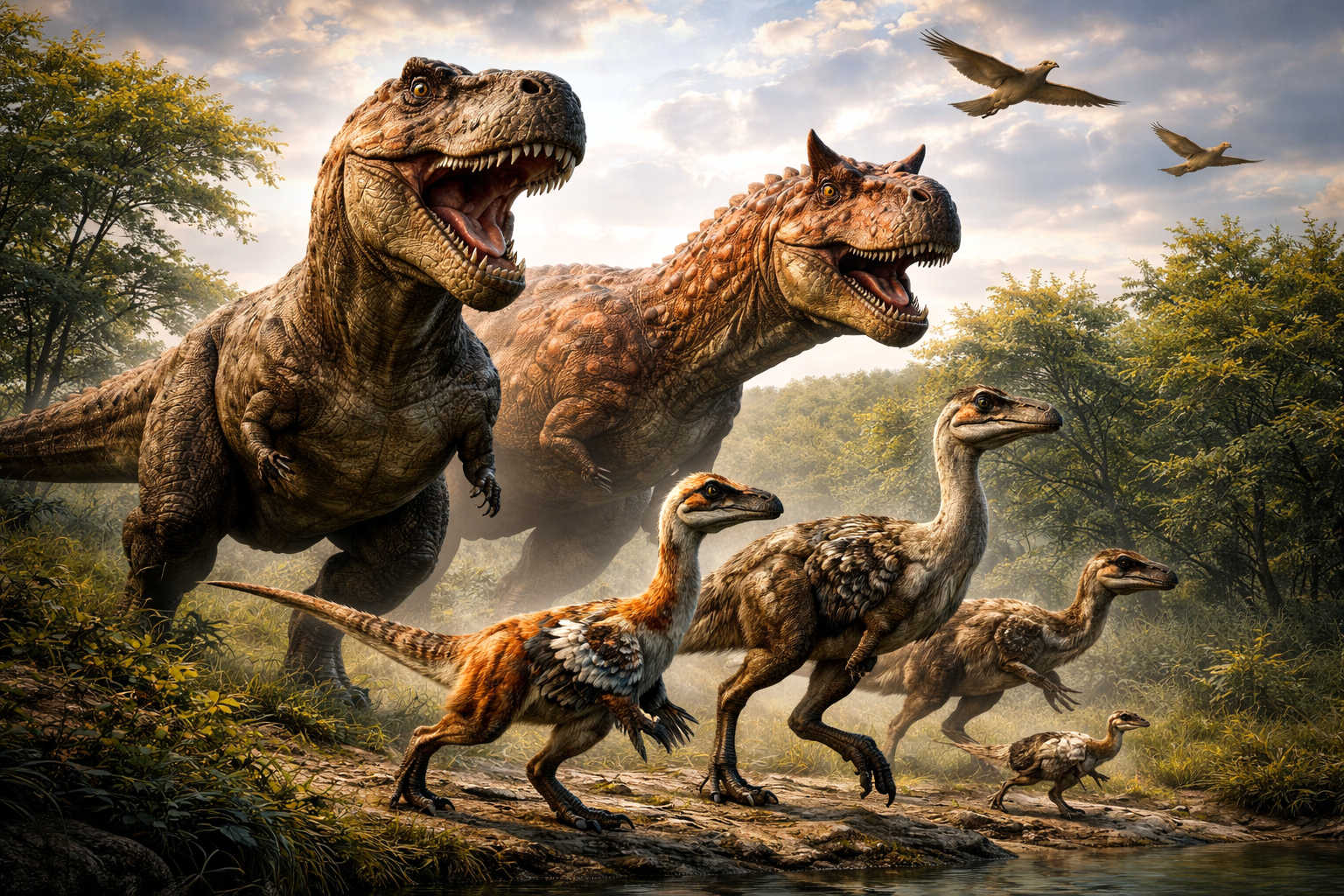
The last theropods still ranged from giant apex predators to smaller runners and hunters, while birds overhead carried the theropod branch beyond the extinction event.

The Last Theropods

66 Million years ago (K–Pg extinction)

By the end of the Cretaceous, the last theropods still ranged from giant bone-crushing hunters to smaller, lighter, faster forms, with birds overhead carrying the branch into the future. In North America and Asia, tyrannosaurids dominated the role of giant apex predator, while in southern continents abelisaurids filled a similar large-bodied role. Around them lived smaller theropods with very different builds and habits—sickle-clawed dromaeosaurids, long-legged ornithomimosaurs, and other small coelurosaurs—showing that the branch had not narrowed to one final shape. Late Maastrichtian sites in Europe also suggest a diverse mix of small theropods and avialans right near the end.

Their lifestyles reflected that variety. Some were giant ambush or pursuit predators with massive skulls and powerful bites. Others were built for speed, agility, or smaller prey. Some likely chased, some scavenged, some snapped up little animals, and some had begun leaning fully into the avian way of life. Even near the end, theropods were still experimenting within their winning blueprint: strong hind legs, balancing tails, grasping forelimbs or winged descendants, sharp senses, and body plans tuned for active lives. The latest European record in particular points to several small-bodied theropod niches existing side by side rather than one generic “last raptor” type.

Their broader journey is one of the great stories in evolution. Theropods began in the Late Triassic and, including birds, have lasted roughly 170 million years. Over that immense stretch of time, they produced towering predators, strange beaked forms, feathered runners, and finally the only dinosaurs still alive today: birds. So the last theropods were not just the closing scene of a dying branch. They were the final non-avian chapter of a lineage still full of variety, while one winged part of that same branch crossed the K–Pg boundary and kept going.

— map / TST —

Michael Alan Prestwood
Author & Natural Philosopher
Prestwood writes on science-first philosophy, with particular attention to the convergence of disciplines. Drawing on his TST Framework, his work emphasizes rational inquiry grounded in empirical observation while engaging questions at the edges of established knowledge. With TouchstoneTruth positioned as a living touchstone, this work aims to contribute reliable, evolving analysis in an emerging AI era where the credibility of information is increasingly contested.
This Week @ TST
March 11, 2026
»Edition Archive
WWB Research….
1. Story of the Week
Galileo: Observation Corrects the Map
2. Quote of the Week
“The Dao that can be told is not the eternal Dao; The name that can be named is not the eternal name.”
3. Science FAQ »
Is red an empirical idea?
4. Philosophy FAQ »
Does infinity exist?
5. Critical Thinking FAQ »
Was math discovered or invented?
6. History FAQ!
Is Philo’s interpretation related to the split in the Idea of Ideas?
Bonus Deep-Dive Article
TST Metaphysical Position: The Split
Scroll to Top