
--Idea System--
5 Tools + 4 Traps + 3 Hammers
TST FRAMEWORK
Applied Epistemology.
CRITICAL THINKING START
Think Well Path: 5-4-3
Start here if your first question is:
“How do I think more clearly?”
The Think Well Path begins with the tools of judgment. You’ll explore how ideas form, how reasoning works, how thinking goes wrong, and how public truth is tested through science, law, and journalism.
This is the 5-4-3 path: Five Thought Tools, Four Mind Traps, and Three Truth Hammers. It is TST’s practical path for sharpening your mind, testing claims, and building intellectual discipline.
CORE READING
A 5-4-3 structured model for disciplined thinking.
Recent Tidbits:
Stories, Quotes, and FAQs.
The wisdom builder tidbits that feed the columns, articles, and trainer.
TST FRAMEWORK
Featured Story
Updated This Week
Philosophy
Story
Absolute Truth
Remember absolute truth belongs to the material world as it is. Humans never hold it absolutely. You construct empirical and rational descriptions that align with reality or not, and then you believe each one with a degree of confidence. Each of your claims remains open to testing and revision. Even your strongest conclusions are provisional: true until disproven, not true beyond challenge.
Featured QUOTE
Critical Thinking
Quote
“It is wrong always, everywhere, and for anyone, to believe anything upon insufficient evidence.”
- William Kingdon Clifford
- 1877
Belief
Belief is not just private. What you believe shapes you and the world around you. Although his suggestion is stricter than most like, I think he wants you to treat belief as a responsibility: seek evidence where you can, stay humble where you cannot, and do not let wishful thinking do the work of truth.
Featured FAQ
Critical Thinking
FAQ
Why do people confuse rule-following with moral reasoning?
Personal Judgement
Authority figures create rules that make obedience feel moral, even when the result is harmful. Their power grows when people stop judging for themselves. Take control of your own moral center. Use rules as guides, but never as a replacement for your own conscience. When authority asks you to surrender moral responsibility, hold the line. Weigh intent, evaluate results. Then grow from bad results.
TST Framework
Applied Epistemology
The Think Well path into TST Philosophy.
The TST Framework is the thinking doorway into TST Philosophy. It directly supports the Think Well with a practical system for evaluating ideas:
- Five Thought Tools,
- Four Mind Traps,
- Three Truth Hammers.
It does not ask you to believe quickly or doubt forever. It asks you to slow down, sort the claim, test the support, and calibrate your confidence to reality.
Deep-Dive Articles
Why Flourishing for All Helps You Flourish
Michael Alan Prestwood
September 1, 2026
Your flourishing is tied to the flourishing of others. Living well means treating others as agents with lives, needs, and struggles as real as your own.
TST Normative Ethics: Flourishing as a Philosophical Goal
Michael Alan Prestwood
September 1, 2026
Ethics is fundamentally relational: human flourishing is not merely individual achievement, but a shared moral condition grounded in the recognition of other persons as agents.
Archived Epistemic Calibration
March 1, 2026
TST Calibration Theory asks: How strong should our confidence be? Answer: Confidence is the quality of alignment to reality.
TST Theory of Truth: Reality-First Correspondence
March 1, 2026
What makes an idea true? Truth is successful alignment between our representations and a determinate, mind-independent reality.
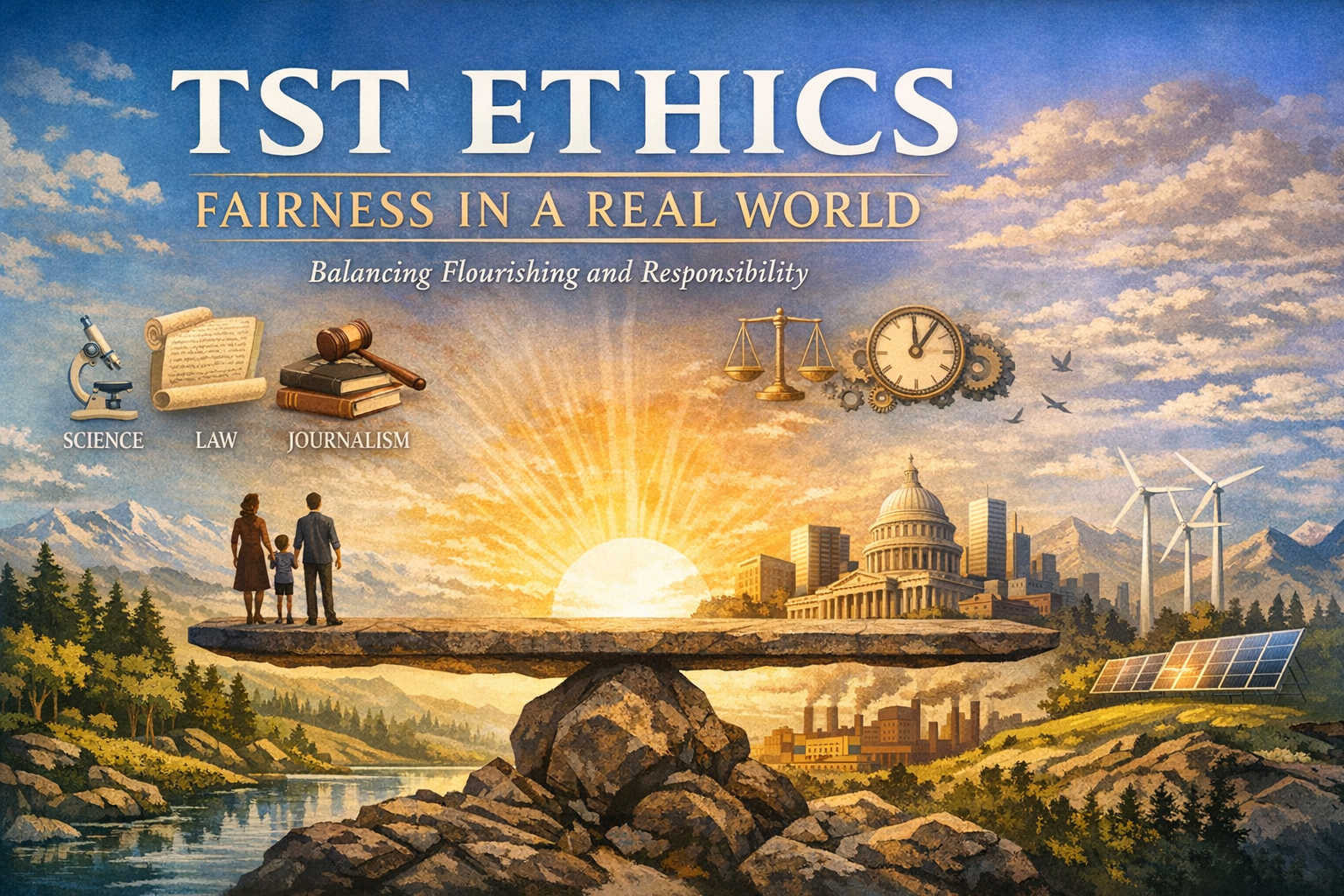
TST Moral Calibration: Legal, Moral, and Fair
February 27, 2026
Law gives order, morality gives conscience, and fairness gives balance. None is enough alone. A legal action can still be wrong. A good decision asks ...
Updated Articles
No more posts to show


