
Phil • Cr. Think • Science • Hist •
TST PRACTICE

The Philosophy Website

STORY

Simple Sentience Settles: Haikouichthys

☐ Read
☑ Read
You’ve read this 0 times.
You’ve listened to this 0 times.

By Michael Alan Prestwood

Tue 2 Apr 2024
Published 2 years ago.
Updated 4 months ago.
Related Stories
Full Emotional Intelligence Emerges
Touch: Life Learns to Feel Force
Early Intelligence Emerges: Aegyptopithecus zeuxis
Higher Play Evolves in Social Mammals
Complex Sentience Settles: Eomaia scansoria
Neanderthal-Denisovan Split
Share :

Simple Sentience Settles: Haikouichthys

520 Million BCE
Simple Brains; Proto-Short-Term Memory; Simple Sentience.

From no sentience or presentience to solidly “Simple Sentience,” early fish during this time represent our ancestral beings that started to suffer and feel the dichotomy of pleasure and pain.

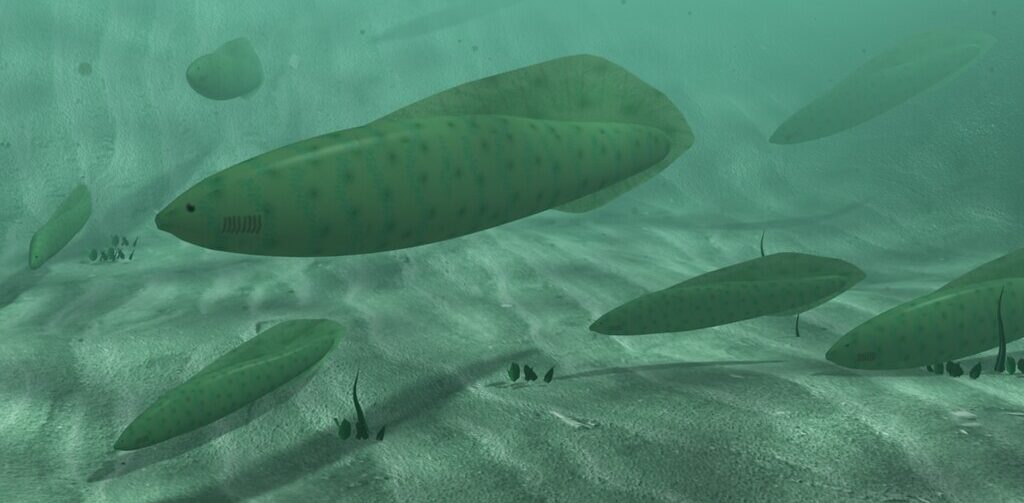
Haikouichthys (circa 520 Million Years Ago): Dwelling in the ancient seas of the Cambrian period, Haikouichthys is among the earliest forms of vertebrate life, showcasing fundamental advancements in the complexity of the nervous system. Unlike its precursors in the Ediacaran period, which exhibited only the most rudimentary forms of interaction with their environment, Haikouichthys possessed a more developed nervous system, allowing for more nuanced responses to stimuli. This development marks a significant evolutionary leap towards the ability to experience basic forms of what we might consider suffering and pleasure. Its existence underscores a pivotal transition in the evolution of life, bridging the gap between the simplicity of early multicellular organisms and the complexity required for the nuanced experiences of sentience.

  • Phylum: Chordata > Class: Agnatha (jawless fish)
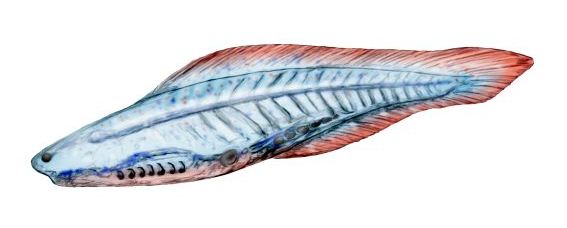
"<a href="https://commons.wikimedia.org/w/index.php?curid=19461018" target="_blank" rel="noopener noreferrer">Haikouichthys NT</a>" by <a href="https://commons.wikimedia.org/w/index.php?title=User:ArthurWeasley&amp;action=edit&amp;redlink=1" target="_blank" rel="noopener noreferrer">Nobu Tamura email:nobu.tamura@yahoo.com www.palaeocritti.com</a> is licensed under <a href="https://creativecommons.org/licenses/by-sa/3.0/" target="_blank" rel="noopener noreferrer">CC BY-SA 3.0</a>

— map / TST —

TST Tracker
✓ Reading recorded.
Michael Alan Prestwood
Author & Natural Philosopher
Prestwood writes on science-first philosophy, with particular attention to the convergence of disciplines. Drawing on his TST Framework, his work emphasizes rational inquiry grounded in empirical observation while engaging questions at the edges of established knowledge. With TouchstoneTruth positioned as a living touchstone, this work aims to contribute reliable, evolving analysis in an emerging AI era where the credibility of information is increasingly contested.
Email
Print
The Prestwood Column
Menu
September 2026
Column Research….
1. Timeline Story
Hume’s Is–Ought Problem
2. Linked Quote
“I meet with no proposition that is not connected with an ought, or an ought not.”
3. Science FAQ »
Can science prove flourishing should be our goal?
4. Philosophy FAQ »
What is the difference between a normative aim and a normative directive?
5. Critical Thinking FAQ »
Is flourishing for all just utilitarianism?
6. History FAQ!
What is the history of the idea of flourishing in philosophy?
Bonus Deep-Dive Article
Flourishing for All: The Normative Aim of TST Philosophy

Comments

Join the Conversation! Currently logged out.

Leave a Reply

NEW BOOK! NOW AVAILABLE!!

30 Philosophers: A New Look at Timeless Ideas

by Michael Alan Prestwood
The story of the history of our best ideas!
Scroll to Top