
Explore Natural Philosophy

Science • Phil • Cr. Think • Hist •

FAQ

When was punctuation invented?

Sun 30 Jun 2024
Published 2 years ago.
Updated 6 months ago.
Related FAQs
How important was the printing press to cultural transmission?
What is the history of ethical war?
Was Copernicus famous during his life?
Debating History: Should We Say “Dark Ages” or “Middle Ages?”
Who was William of Ockham, and what principle is named after him?
Was the richest person in history an African just before colonial slavery?
Share :
Email
Print

When was punctuation invented?

Did it start with the space?

Yes. Punctuation as we know it began to develop in the Middle Ages. Monks copying manuscripts in the 7th to 9th centuries started using spaces between words to improve readability and speed up their work. By the time the Magna Carta was written in 1215, punctuation was still mostly just spaces, with limited use of other marks. However, by the time Copernicus published his famous book in the 16th century, we had modern writing with periods, commas, paragraphs, and even chapters.
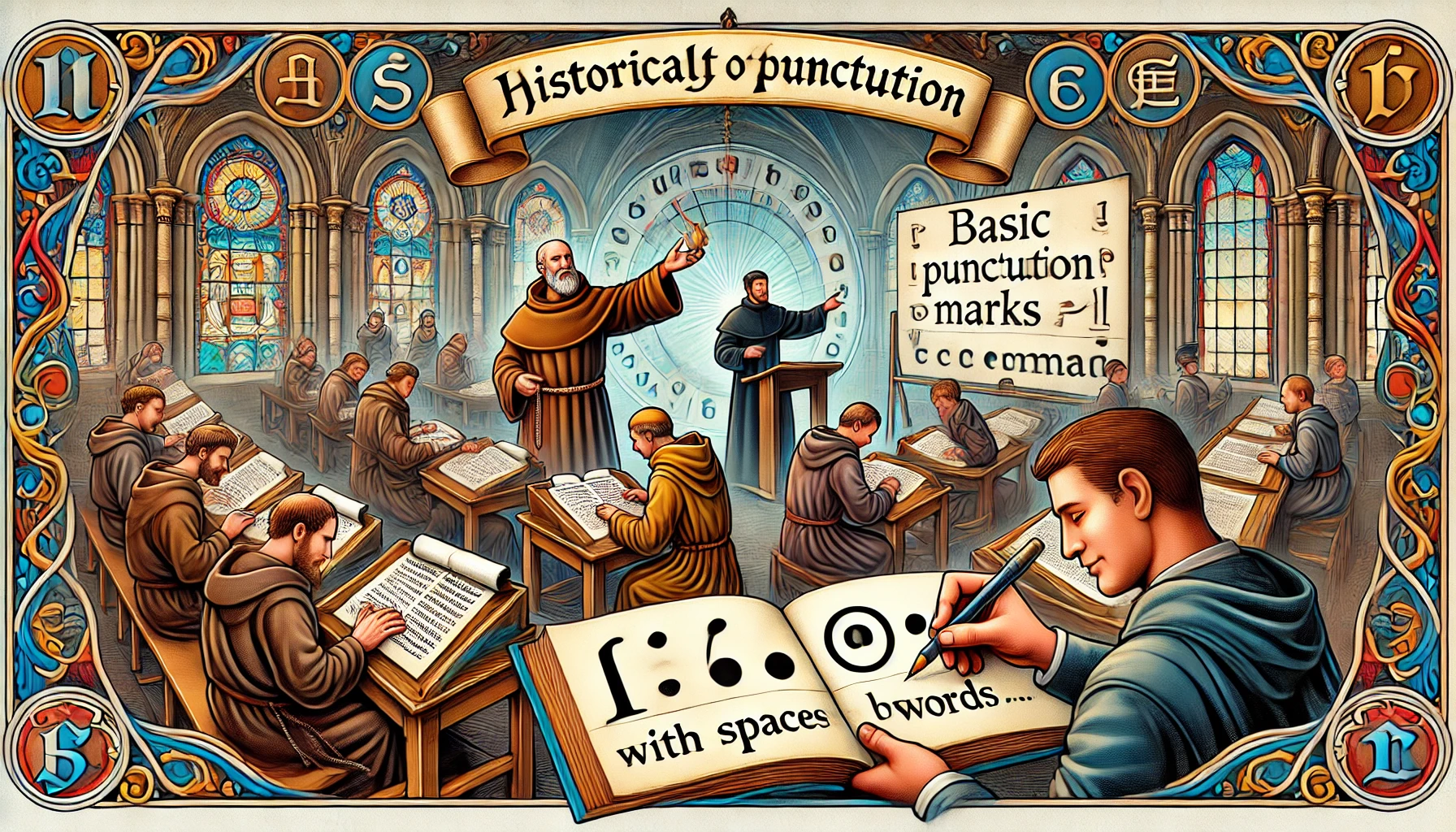
As part of telling the story of the printing press in 30 Philosophers, the narrative is shared like this:

“Prior to 900 CE, [writing] had no case—it was all uppercase or lowercase. It had no punctuation at all: no spaces, no commas, no periods, no paragraphs. It was just letters strung together. For example, most historical documents written before 900 CE in the West, particularly Latin and Greek texts, employed scriptio continua, featuring all uppercase letters, with no spaces between words, no punctuation, no paragraphs.

Before around 900 CE, reading was an experience most of us would not recognize. Instead of having grammar guide the reader’s interpretation, they had to interpret the text. Sure, they grew up seeing patterns of words in a string of letters, but a reader of the time would read and interpret the text much more than we accept today. The aim was to convey meaning through the arrangement of words alone. Sometimes the process required rereading the text several times. In fact, there was the profession of a professional reader—someone who would stand in the town square and read announcements the way the authors wanted them read.” 

The simple innovation of word spacing brings you needed context to our ancient spiritual texts, showing you the primitive format that forged our story and captured our thoughts. For more, take the deep dive, take a few minutes and explore the timeline: Medieval History Timeline.

— map / TST —

Michael Alan Prestwood
Author & Natural Philosopher
Prestwood writes on science-first philosophy, with particular attention to the convergence of disciplines. Drawing on his TST Framework, his work emphasizes rational inquiry grounded in empirical observation while engaging questions at the edges of established knowledge. With TouchstoneTruth positioned as a living touchstone, this work aims to contribute reliable, evolving analysis in an emerging AI era where the credibility of information is increasingly contested.
This month @ TST
Column Menu
June 2026
»COLUMN ARCHIVE
Column Research….
1. Timeline Story
Secular Spirituality Settles
2. Linked Quote
“Extraordinary claims require extraordinary evidence.”
3. Science FAQ »
What is the difference between a spiritual and empirical belief?
4. Philosophy FAQ »
What is secular spirituality?
5. Critical Thinking FAQ »
How does spirituality relate to public belief?
6. History FAQ!
Is secular spirituality supported in history and science?
Bonus Deep-Dive Article
The Material-Spiritual Framework: A Philosophy of Spirituality

Comments

Join the Conversation! Currently logged out.
NEW BOOK! NOW AVAILABLE!!

30 Philosophers: A New Look at Timeless Ideas

by Michael Alan Prestwood
The story of the history of our best ideas!
Scroll to Top