
Explore Natural Philosophy

Phil • Cr. Think • Science • Hist •

FAQ

Can you explain the quantum measurement problem simply?

Tue 2 Jun 2026
Published 2 months ago.
Updated 2 months ago.
Related FAQs
What is Schrödinger’s Cat and why is it important?
What is the classic double‐slit experiment?
Has Planck’s Constant been updated?
Is space truly empty? Anywhere?
Does wave-particle duality imply a multiverse?
What does quantum tunneling imply about metaphysics?
Share :
Email
Print

Can you explain the quantum measurement problem simply?

In quantum mechanics, tiny things like electrons are described as a range of possible states before measurement. This is called superposition. But when we measure the system, we get one definite result.

That raises the big question: What exactly happens during measurement?

Does the particle settle into one state because the physical system changes? Or does the wavefunction simply update because our knowledge has changed? In other words, is the wavefunction describing reality itself, or is it describing what we can know about reality?

That is the measurement problem.

Some interpretations say measurement physically collapses the wavefunction into one outcome. Others say there is no collapse at all; the math simply tells us how to update our expectations. Still others, like many-worlds, say every possible outcome happens, but in different branches of reality.

Entanglement adds to the mystery. When two particles are entangled, measuring one is linked with what we can say about the other, even across great distances. That does not mean we can send messages faster than light, but it does challenge our everyday picture of separateness.

The quantum measurement problem is not the mystery of whether quantum results are real. They are. The mystery is what the results mean. Quantum behavior is empirical. The wavefunction is rational. The deeper meaning is metaphysical.

We know how to predict the outcomes. We are still debating what reality is doing underneath the prediction.
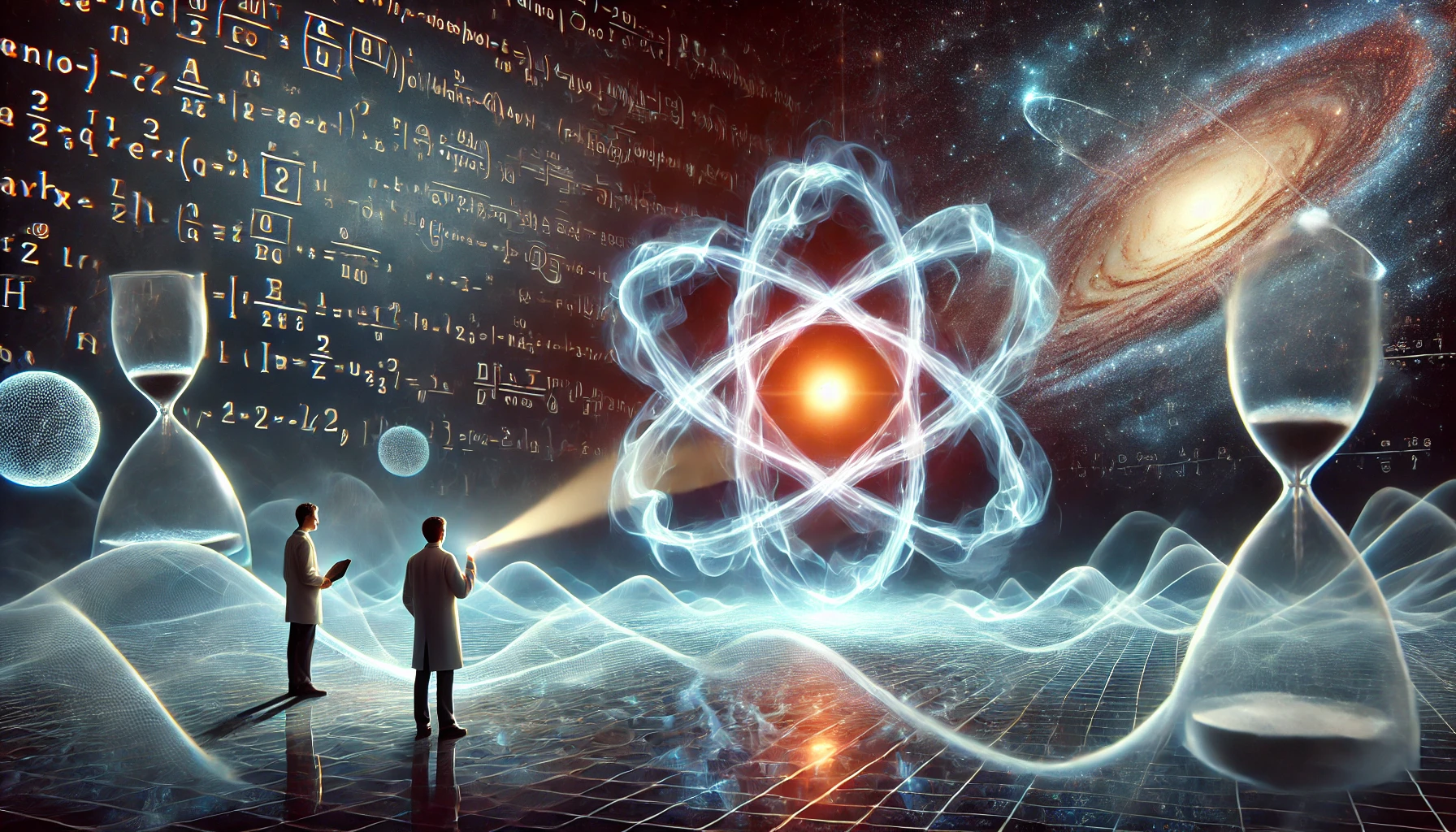
— map / TST —

Quantum mechanics predicts the answer. The mystery is what reality is doing.
Michael Alan Prestwood
Author & Natural Philosopher
Prestwood writes on science-first philosophy, with particular attention to the convergence of disciplines. Drawing on his TST Framework, his work emphasizes rational inquiry grounded in empirical observation while engaging questions at the edges of established knowledge. With TouchstoneTruth positioned as a living touchstone, this work aims to contribute reliable, evolving analysis in an emerging AI era where the credibility of information is increasingly contested.
The Prestwood Column
Menu
July 2026
»COLUMN ARCHIVE
--COLUMN--
Column Research….
1. Timeline Story
The famous Lewis “Truth in Fiction” Paper
2. Linked Quote
“Truth is stranger than fiction…[which] is obliged to stick to possibilities;”
3. Science FAQ »
Why does fiction feel real?
4. Philosophy FAQ »
Can authors create fiction beyond our universe?
5. Critical Thinking FAQ »
How do we know what is true in a fictional world?
6. History FAQ!
What is the history of philosophy of fiction?
Bonus Deep-Dive Article
TST Philosophy of Fiction: Imaginative Realism

Comments

Join the Conversation! Currently logged out.
NEW BOOK! NOW AVAILABLE!!

30 Philosophers: A New Look at Timeless Ideas

by Michael Alan Prestwood
The story of the history of our best ideas!
Scroll to Top