
Explore Science-first Philosophy

FAQ

Do the empirical and rational categories apply to vocabulary words?

Tue 28 Apr 2026
Published 16 minutes ago.
Updated 8 minutes ago.
Related FAQs
Was math discovered or invented?
Is the Big Bang singularity scientific or philosophical?
What is TST Ethics?
Is Philo’s interpretation related to the split in the Idea of Ideas?
Why do people confuse explanations with reality?
Does Agrippa’s Trilemma Disprove the Idea of Ideas?
Share :
Email
Print

Do the empirical and rational categories apply to vocabulary words?

Yes, empirical and rational categories of the Idea of Ideas applies to all words. Not absolute, but in their use.

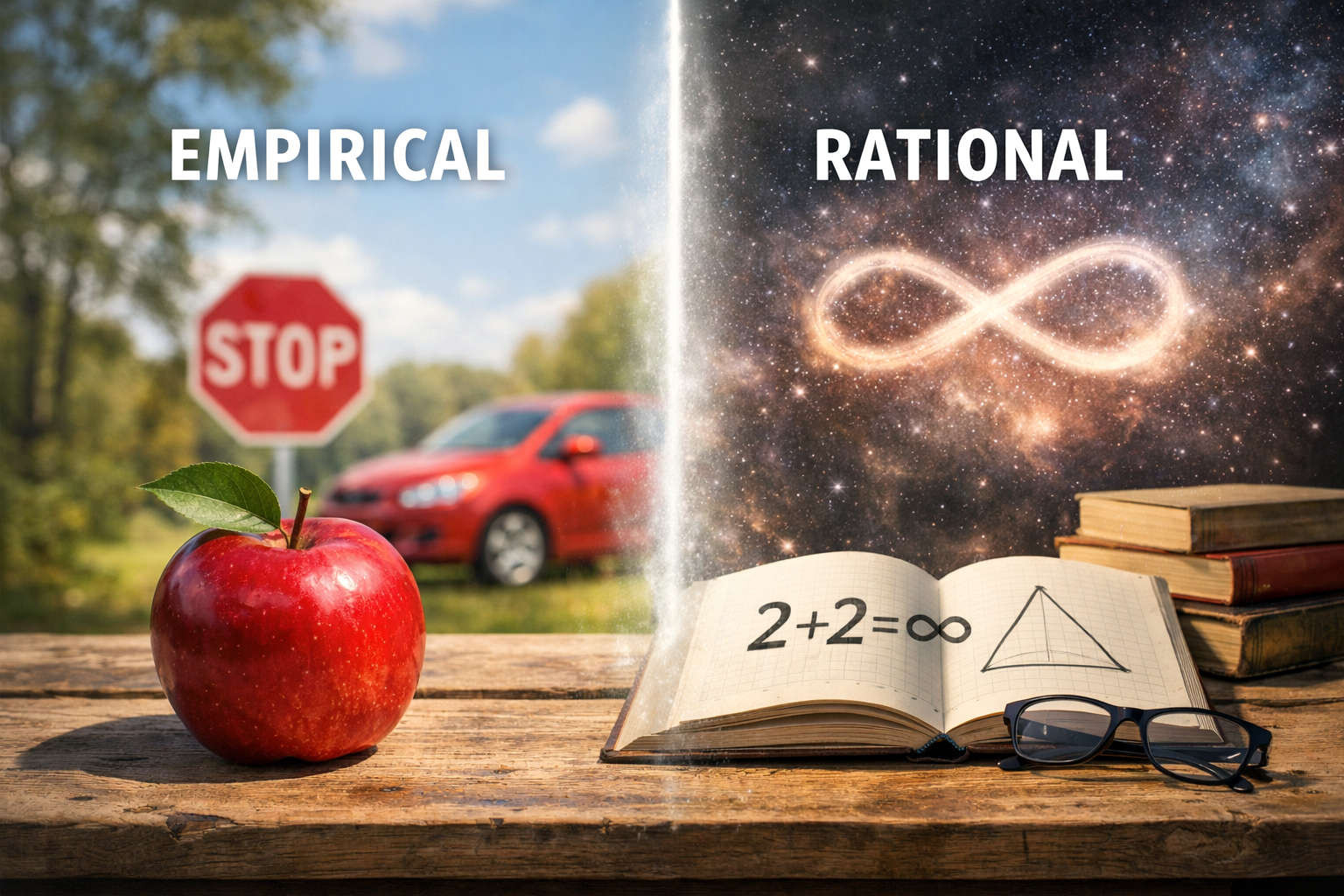
Empirical words observe. Rational words organize.

A word is empirical when it directly describes the material world. A word is rational when it helps the mind structure, compare, group, relate, or organize what is being described. And finally, a word functions irrationally when it points to something asserted as real, but not supported by evidence, reason, or coherent grounding.

Words like cat, tree, roof, smoke, and red are empirical when they point directly to things or properties in the material world. Words like number, category, cause, system, equality, justice, schema, and theory are rational because they describe reality indirectly. They help the mind organize experience.

Some rational words are conceptual, such as number, cause, category, justice, and theory. Others are structural, such as is, are, of, on, if, then, and because. These words do not usually describe material things directly. Instead, they are rational and help connect ideas. For example, “are” binds a subject to an action, identity, category, or state.

This is why an empirical sentence can still use rational words. “Three cats are playing on a tin roof” is an empirical sentence because it directly describes material things and actions: cats, playing, and a tin roof. “Infinite cats are playing on a tin roof” is irrational. 

Some words also shift categories depending on use. Root is empirical when it names the root of a tree, but rational when it names the root of a number. Field is empirical when it names a meadow, but rational when it names a magnetic field or a field of study.
— map / TST —

Empirical ideas observe. Rational ideas organize.
Michael Alan Prestwood
Author & Natural Philosopher
Prestwood writes on science-first philosophy, with particular attention to the convergence of disciplines. Drawing on his TST Framework, his work emphasizes rational inquiry grounded in empirical observation while engaging questions at the edges of established knowledge. With TouchstoneTruth positioned as a living touchstone, this work aims to contribute reliable, evolving analysis in an emerging AI era where the credibility of information is increasingly contested.
TST Column
April 22, 2026
Column Research….
1. Timeline Story
Augustine of Hippo
2. Linked Quote
“In order for a war to be just, three things are necessary.”
3. Science FAQ »
Why do we overreact and escalate?
4. Philosophy FAQ »
How does TST Ethics handle the trolley problem?
5. Critical Thinking FAQ »
How do you prevent yourself from overreacting?
6. History FAQ!
What is the history of ethical war?
Bonus Deep-Dive Article
1 Goal: Flourish (TST Ethics)

Comments

Join the Conversation! Currently logged out.
NEW BOOK! NOW AVAILABLE!!

30 Philosophers: A New Look at Timeless Ideas

by Michael Alan Prestwood
The story of the history of our best ideas!
Scroll to Top