Yes. Absolutely. But he was a science guy.
Here’s that story.
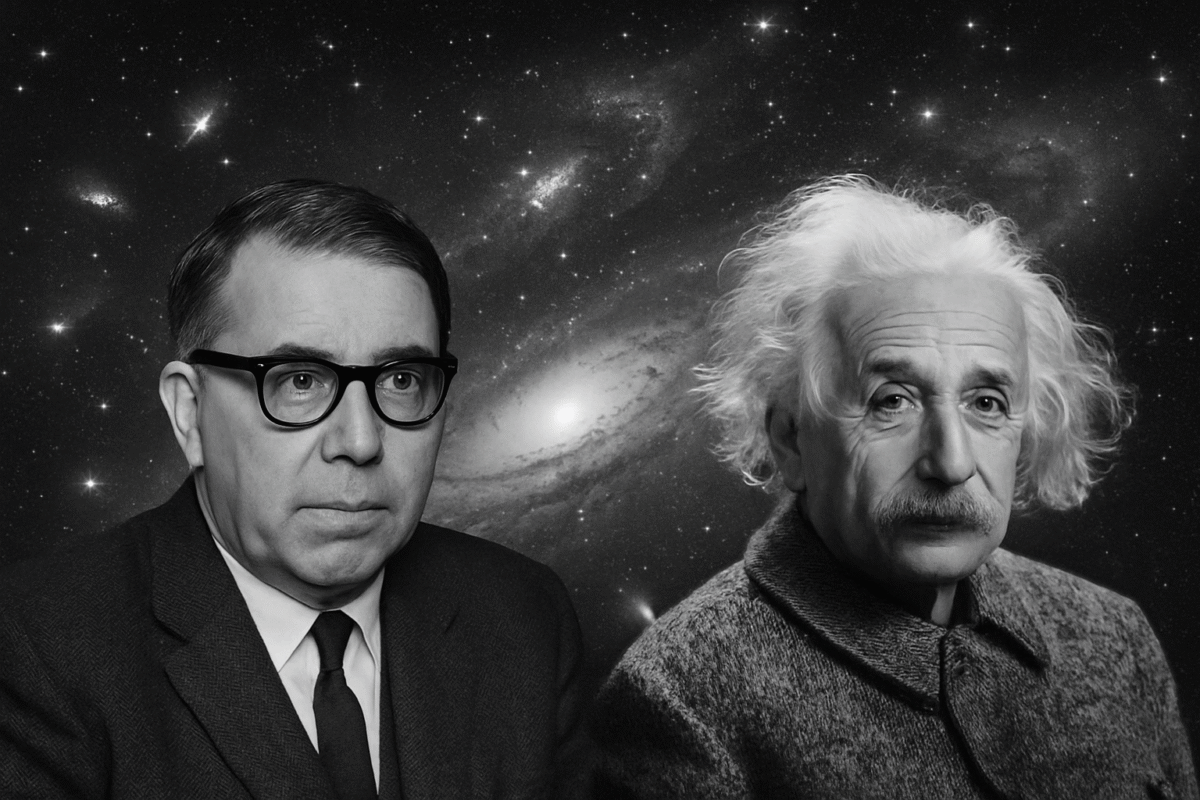
In a 1949 BBC radio broadcast, astronomer Fred Hoyle casually referred to the origin-of-the-universe idea as the “Big Bang.” He meant it as a jab—an offhand, sarcastic dig at a theory he didn’t buy. Hoyle was an astronomer. While he is mostly remembered today for ironically coining the term Big Bang, he was a very respected scientist. He’s the person who figured out how elements are forged in stars, and this part of his legacy, of his holistic eudaimonia, is hugely respected.
On that faithful day in 1949, he was championing the Steady State theory—a universe that had no beginning and no end. Always was, always will be. That kind of universe is comforting. Eternal. Predictable. And Hoyle wasn’t alone. Even Einstein strongly believed in the steady-state universe until evidence pointed elsewhere.
But here’s the twist: Hoyle’s nickname stuck. The label he meant as an insult became the name of the most widely accepted model in modern cosmology. And Hoyle? He never really changed his mind. Long after the cosmic microwave background was discovered—the echo of the Big Bang itself—he was still fighting for a steady state.
And honestly, can you blame him? The idea that the entire universe exploded into being from a single point of unimaginable density? That’s not just wild—it’s unsettling. No wonder humans instinctively prefer the steady state. In an impermanent universe where change rules all, we grasp at straws of permanence. We want the stars to be just as we left them. This old Steady State theory has an interesting intuition behind it. Perhaps reality may be eternal beyond our local observable universe. That aspect still survives in modern speculative cosmology.
But the universe doesn’t care what we want. It expands. It evolves. It changes. It’s a self-reconfiguring machine inside which nothing is ever truly created from the void, nor is anything truly destroyed.
And that’s the real story. Not just about Hoyle, but about us. Even brilliant minds can cling to comfortable ideas. After all, there are people today who believe the Earth is flat.
So yes, Hoyle coined the term Big Bang as an insult. And the universe had the last laugh.