
Explore Natural Philosophy

Phil • Cr. Think • Science • Hist •

Medieval

500 CE to 1500 CE

Medieval History

Practice by Topic

Medieval: 500 to 1500 CE
500 to 1500 CE

Knowledge in Motion

Tidbits:

Stories, Quotes, and FAQs.

The wisdom builder tidbits that feed the columns, articles, and trainer.
Medieval
Featured Story
History
Story
born 1473
Nicolas Copernicus
Lived 1473 to 1543, aged 70.
Copernicus
Copernicus was not a public rebel or celebrity thinker. He was a cautious scholar who spent decades refining an idea he feared releasing. By placing the Sun at the center, he didn’t just revise astronomy—he modeled a new way of thinking: slow, mathematical, and willing to let evidence outrank tradition.
Featured QUOTE
History
Quote
“The movement of the planets agrees best with actual observations.”
Copernicus
Written before 1543; published in 1543
Copernicus didn’t argue that heliocentrism felt right or sounded better. He argued that it worked. When competing explanations grew increasingly complex, he chose the one that aligned most cleanly with observation. Truth, in this view, isn’t about persuasion—it’s about coherence. The simplest explanation that fits reality deserves serious attention.
Featured FAQ
Updated This Week
Critical Thinking
FAQ
Who was William of Ockham, and what principle is named after him?
Idea Evaluation
Ockham’s Razor is a tool for disciplined restraint. It does not say reality is simple. It says our explanations should not add entities without need. In TST, this becomes a structural filter in idea evaluation: clarity first, excess last, evidence always.
Medieval History
A World in Transition.
500 CE to 1500 CE

Medieval History spans a millennium of global transformation. Empires rise and fall, religions consolidate, trade networks expand, and intellectual traditions cross continents. It is not merely Europe’s Middle Ages, but a worldwide period of structural reorganization and cultural exchange.

Deep-Dive Articles
1 Goal (Ethics)Ancient HistoryBook-30 Philosophers

No Kings Has Deep Historical Roots

Recent protests reflect the timeless struggle to limit power and oppression using checks and balances.
OVM

The Material-Spiritual Framework: A Philosophy of Spirituality

The Material-Spiritual Framework separates shared empirical reality from personal spiritual meaning, allowing people to respect belief while still testing public claims against the material world.
OVM

A Higher Power for Everyone: God, Logos, and Recovery

Recovery from addiction, or even just a bad habit, begins when the craving self stops acting like the highest authority. Build new habits with help: ...
Must-Reads
Particle Physics

The Double‐slit Experiment Explored

Reality may not be particles afterall. It may be more like waves, vibrations, or strings.
Ancient History

Pragmatism and Pythagoras

Pythagoras exemplifies rational pragmatism and reminds us that authority is often topic specific. Choose your authorities carefully, because good authority is usually limited to a ...
Authenticity

Existential Toolkit: Evolution’s Consciousness Misstep

At its core, existentialism is about discovering your authentic self. You, in your environment, in your time, living life your way.
New Ideas
OVM

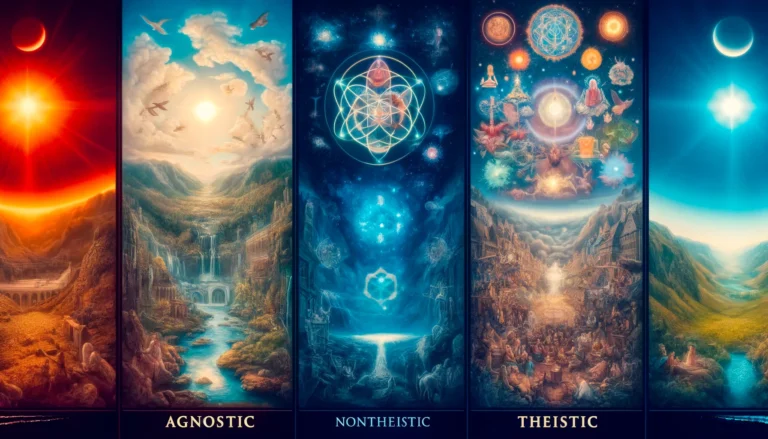
The Material-Spiritual Framework: A Philosophy of Spirituality

The Material-Spiritual Framework separates shared empirical reality from personal spiritual meaning, allowing people to respect belief while still testing public claims against the material world.

2 Layers (Metaphysics)

TST Metaphysics: The Split

The split separates our ideas and the material world. To live in harmony with nature, embrace the idea that our rational ideas must be internally ...
Idea of Ideas

Idea Theory Framework

The Idea Theory Framework within the Idea of Ideas is a promotion ladder for ideas to move from speculation to hypothesis, theory, and law.
Updated Articles
No more posts to show
Scroll to Top