


What is Confucianism?
Ethical applied philosophy emphasizing social harmony and personal virtue.

Is there evidence for other dimensions?
There is no empirical evidence for other dimensions—only mathematical speculation and theoretical exploration.

When did we discover stars are mostly made of hydrogen and helium?
In 1925, Cecilia Payne showed that stars are composed primarily of hydrogen and helium, overturning Earth-centered assumptions about the universe.

What is the history of Confucianism?
Confucianism began as an applied philosophy of social order and moral normalcy, teaching that a good life grows from our relationships and by managing normalcy.
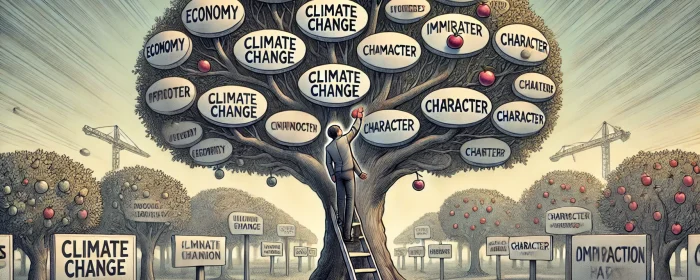
Is it logical to vote for a candidate based on just one issue?
Focusing on a single issue can feel logical, but it risks cherry-picking. When you do it, just be aware that you are simplifying complex decisions.

What’s the difference between common ions and ionization in physics?
None. Both describe the same process of atoms or molecules gaining or losing electrons.

How does consciousness differ from intelligence?
Consciousness is the experiencing of life which requires perception. Intelligence is the ability to solve problems.

Who was the first female philosopher?
While many preceded her, Gargi Vachaknavi is one of the earliest known female philosophers.

What is the cherry picking logical fallacy?
Cherry-picking turns partial truth into misleading truth. When a claim feels convincing, pause and ask: What evidence was left out? A single fact may be ...

Does sound change pitch in water?
Sound does not change pitch when it moves to a new medium. Frequency remains constant while speed and wavelength adjust, revealing the quiet coherence of ...

How are original Daoism, Mohism, Confucianism, and Legalism related?
Daoism emphasizes nature, Mohism balances nature and society, Confucianism harmonizes society, and Legalism brings authoritarianism.

When were toothpicks invented?
Fossil evidence shows that Homo habilis, living over 2 million years ago, used small sticks or similar objects to clean their teeth, leaving characteristic grooves.

Who was Friedreich Nietzsche?
Friedrich Nietzsche marks the moment in history, about 1890, when inherited moral certainty collapsed.

What is the difference between a heuristic and a cognitive bias?
Heuristics are natural mental shortcuts that speed decisions. Cognitive biases are ingrained thinking errors. Both are reinforced by experience. Both help us move forward quickly, ...

What is the difference between volume and mass?
Physics < Science

What are holism and reductionism?
Holism and reductionism are complementary lenses: one explains parts, the other explains patterns.

What do we know about the Indus Valley Civilization?
Rediscovered in the 1920s, they were a peaceful development. Their cities included Mohenjo-Daro and Harappa. Hence, they are sometimes called Harappans.

What is the difference between anthropology and paleontology?
Anthropology uncovers culture, and paleontology uncovers ancient life.

What’s the minimum change needed to breathe air on Mars?
We need to raise the atmospheric pressure, boost oxygen above Earth-levels, and strip out most of the carbon dioxide, but taking care of and fixing ...

What does the Kardashev Scale tell us about future civilizations?
The Kardashev Scale offers a cosmic yardstick for imagining how advanced civilizations become as they master ever-greater sources of energy.

What is the Updated History of Earth?
The updated history of Earth reveals a far more dynamic, violent, and interconnected story—one where geology and life co-evolved from the very beginning.

Was math discovered or invented?
Math is discovered in the structure of the Material World but invented in the symbolic systems minds use to describe that structure.

What great apes have fur and which have hair?
All great apes share the same general hair-follicle pattern and follicle count—a primate pattern that likely goes back over 50 million years.

What is fear-based ethics?
For a more solid life, understand the reasons behind fear-based ethics. Do not let consequences replace understanding, or obedience replace reasoning.

“Do not dwell in the past, do not dream of the future, concentrate the mind on the now.”
A reminder to release attachments to the past and future and focus on the now.

“We are all tattooed in our cradles with the beliefs of our tribe.”
Your initial baseline was chosen for you, not by you. Your birth givens are not your destiny.

“The first person who thought of saying ‘This is mine’ was the real founder of civil society.”
A Social Construct is a shared non-natural belief; created and maintained by groups; and they shape reality.

“No man ever steps in the same river twice.”
The Buddha gave the world a practical lesson: spirituality is best tested in the life we are actually living. Enjoy today in all its shades ...

“Of all possessions…the greatest is friendship.”
Live better by widening who matters. Epicurus reminds us that our own happiness begins with human dignity and grows into care for everyone touched by ...

“We must meditate on the things that make our minds at peace.”
A peaceful mind rarely happens by accident. Build some form of regular reflection into your life—meditation, long walks, quiet reading, journaling, or thoughtful conversation.