

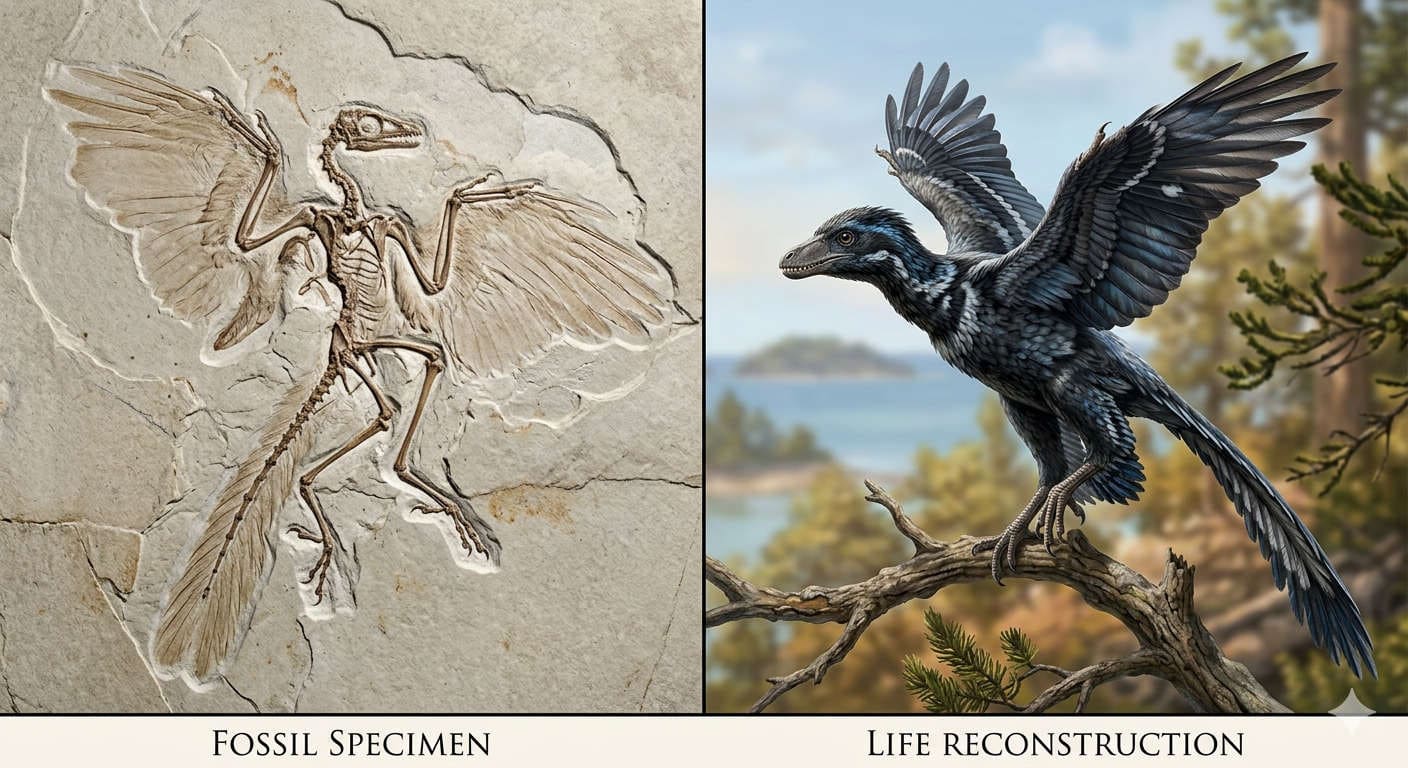
The air of the Late Jurassic did not belong to feathers alone. For millions of years, the skies were the domain of the pterosaurs—leathery, winged reptiles that soared over a world of giants. But deep within the theropod lineage, a radical experiment was unfolding. Small, nimble dinosaurs had already developed feathers for warmth and display; now, they began to use them for more. The divergence was not a sudden leap but a steady refinement of physics. As these creatures leaped from branches or sprinted after prey, the “bird line” crystallized into the Avialae. They were the pioneers of a new mechanics of flight, bridging the gap between the earth-bound predators of the past and the masters of the sky.
Archaeopteryx stands as the most famous witness to this transition. Discovered in the limestone quarries of Bavaria, it is a mosaic of evolutionary history. It possessed the killing claws, sharp teeth, and long, bony tail of a small dinosaur like Compsognathus, yet its arms were draped in advanced, asymmetrical flight feathers identical to those of modern birds. It was a transitional masterpiece. While it likely lacked the massive breast muscles for the sustained, powerful flapping we see today, its light bones and specialized “wishbone” (furcula) allowed for powered bursts and agile gliding. It lived a double life: a feathered dinosaur on the ground and a primitive aviator in the tropical archipelagos of prehistoric Europe.
This line did not end in the lagoons of the Jurassic; it radiated. From the foundation laid by Archaeopteryx and its kin, the avian lineage survived the fire of the K-Pg extinction that claimed the rest of the dinosaurs. They traded teeth for lightweight beaks and fused their tails into the stunted pygostyle seen in every backyard sparrow. Today, with over 10,000 species ranging from the deep-diving penguin to the high-altitude bar-headed goose, the birds remain the most diverse group of land vertebrates. Every time a hawk circles a field, the legacy of the theropods continues. The “ruling reptiles” never truly left; they simply took to the air.

