

Before Snowball Earth, before about 717 million years ago, Earth was already changing in big ways. The supercontinent Rodinia was breaking apart. Volcanic activity exposed vast stretches of fresh rock, and as that rock weathered, it pulled carbon dioxide from the atmosphere. With less greenhouse warming, the planet became more vulnerable to a runaway freeze. Life was still mostly microbial, along with simple eukaryotes, but the groundwork for later complexity was already quietly taking shape.
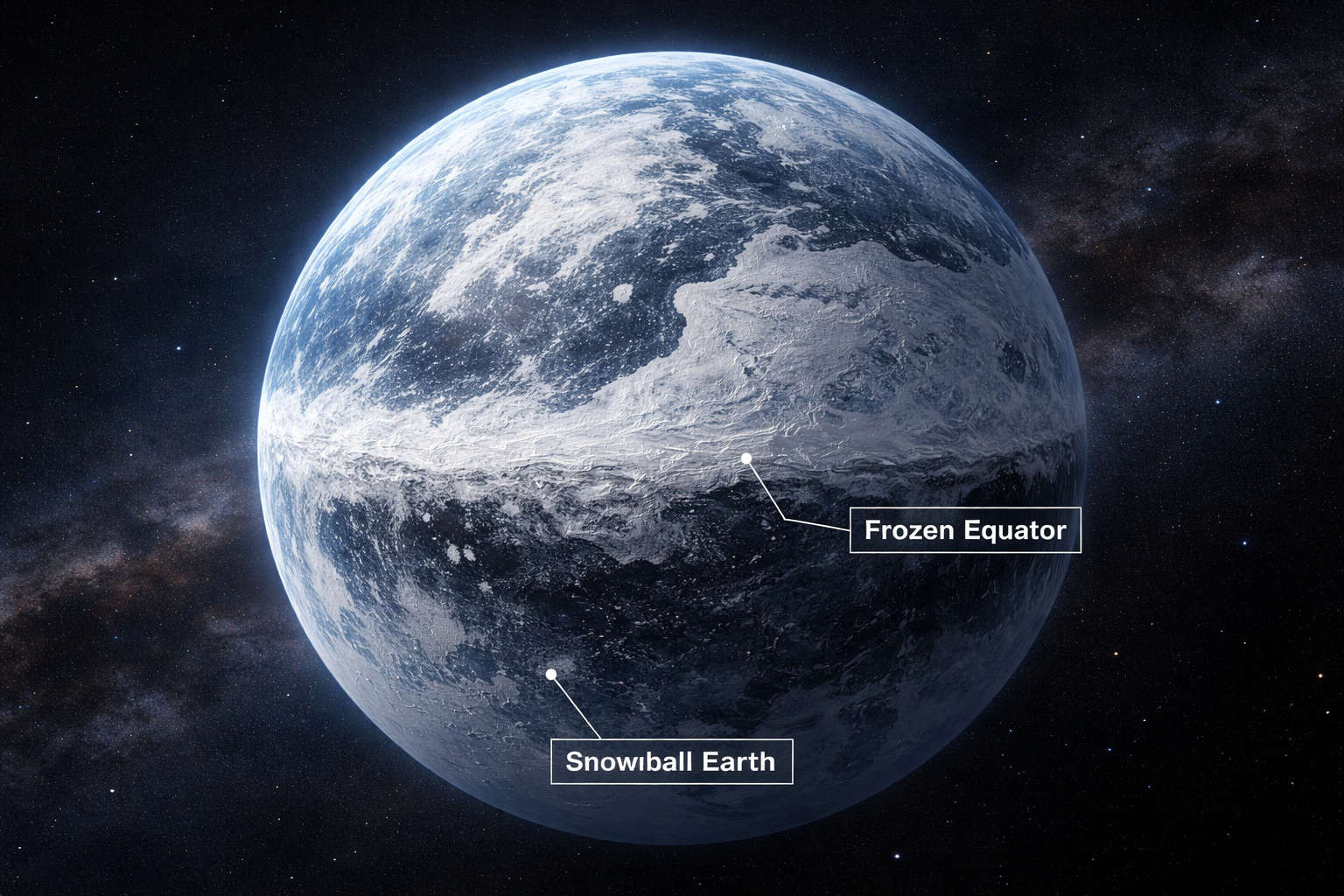
Then came the deep freeze. During the Cryogenian, Earth endured two immense glaciations: the Sturtian and the Marinoan. Geological evidence shows ice-related deposits formed at very low latitudes, strongly suggesting that ice reached close to the equator. Some researchers still debate whether Earth became a hard “Snowball” or a softer “Slushball,” but either way, it was one of the most extreme climate crises in the history of our planet.
When the ice finally retreated, Earth entered the Ediacaran world. The post-glacial planet was different. Its oceans, chemistry, and ecosystems had been shaken hard. Many researchers think these brutal Cryogenian conditions, along with the refuges life found during the freeze, helped drive a burst of evolutionary experimentation. Not long after, the fossil record begins to show a wider expansion of multicellular life, making Snowball Earth one of the great turning points in the long story of animals.

