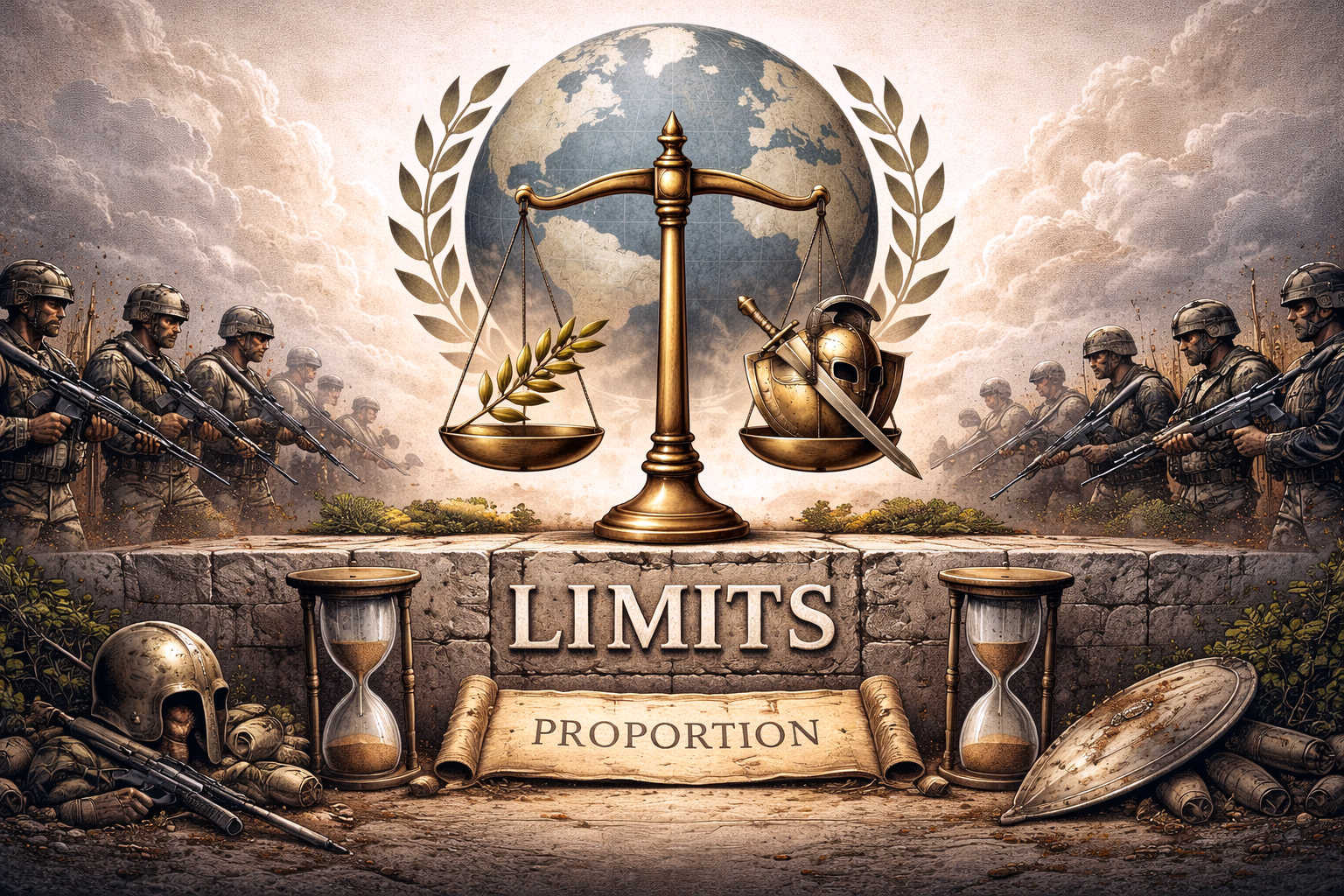
For centuries, Just War Theory has attempted to temper the rush to war by requiring legitimate authority, just cause, and right intent. Life does not always give us peaceful people or clean choices. Sometimes you must respond. But living well means resisting the urge to escalate. Situational ethics reminds us that a proportionate response protects dignity, limits damage, and keeps pain from multiplying. Even when you must push back, do not let someone else’s wrong turn you into more of the same.
< 1 minute read
Saint Augustine, born in 354, is widely cited as the founder of Christian Just War Theory. This area of thought takes a look at situational ethics and tries to add temperance to war. Augustine looked at a violent world and refused the fantasy that moral people can always stay clean. Augustine’s role in this story is that he established the tradition of wrestling with the brutal question of war. He gave us the sense that even a necessary war is still a tragedy, not a triumph.
Centuries later, around 1265, Thomas Aquinas clarified his message:
“In order for a war to be just, three things are necessary.”
A Dominican friar in the 13th century, Aquinas was born about 1225, gave us his famous three necessary conditions for war: proper authority, just cause, and right intent. In simple terms, war cannot just be somebody’s anger with weapons or private revenge. It must be in defense and answer a real wrong. It must be declared by the proper authority, and aim at restoring justice or peace rather than feeding corruption, greed, or bloodlust.
From there, Just War thinking spread far beyond medieval Christianity. Its descendants helped shape the broader moral grammar of war across the world, especially through international humanitarian law. The basic idea is simple but powerful: even war has limits. You do not target civilians. You do not torture prisoners. You do not take hostages. You do not humiliate detainees. You do not use force without restraint. So, in modern times, beyond Christian thought, nations strive to put a moral leash on organized violence.
Source: Summa Theologiae, II-II, Question 40, Article 1
Augustine. The City of God against the Pagans. Translated by R. W. Dyson. Cambridge: Cambridge University Press, 1998. Books XIX and XXII. Frames peace as the proper end of political life and war as a tragic response to disorder.
Aquinas, Thomas. Summa Theologiae. II–II, question 40, article 1. Translated by the Fathers of the English Dominican Province. New York: Benziger Brothers, 1947. Formalizes three conditions of just war: legitimate authority, just cause, and right intent.
International Committee of the Red Cross. “Geneva Convention Relative to the Protection of Civilian Persons in Time of War.” August 12, 1949, common article 3. Establishes minimum protections against murder, torture, hostage-taking, and execution without due process.
Prestwood, Michael Alan. 30 Philosophers. 2024. Chapter 15 on Augustine explores limiting war.
Just war theories use situational ethics to place moral limits on war, avoid its worst horrors, and establish when war is justified.
Michael Alan Prestwood Natural Philosopher & Author
Prestwood explores science-first philosophy, with particular attention to the convergence of disciplines. Drawing on his TST Philosophy, his work emphasizes rational inquiry grounded in empirical observation while engaging questions at the edges of established knowledge. With TouchstoneTruth positioned as a living touchstone, this work aims to contribute reliable, evolving analysis in an emerging AI era where the credibility of information is increasingly contested.