

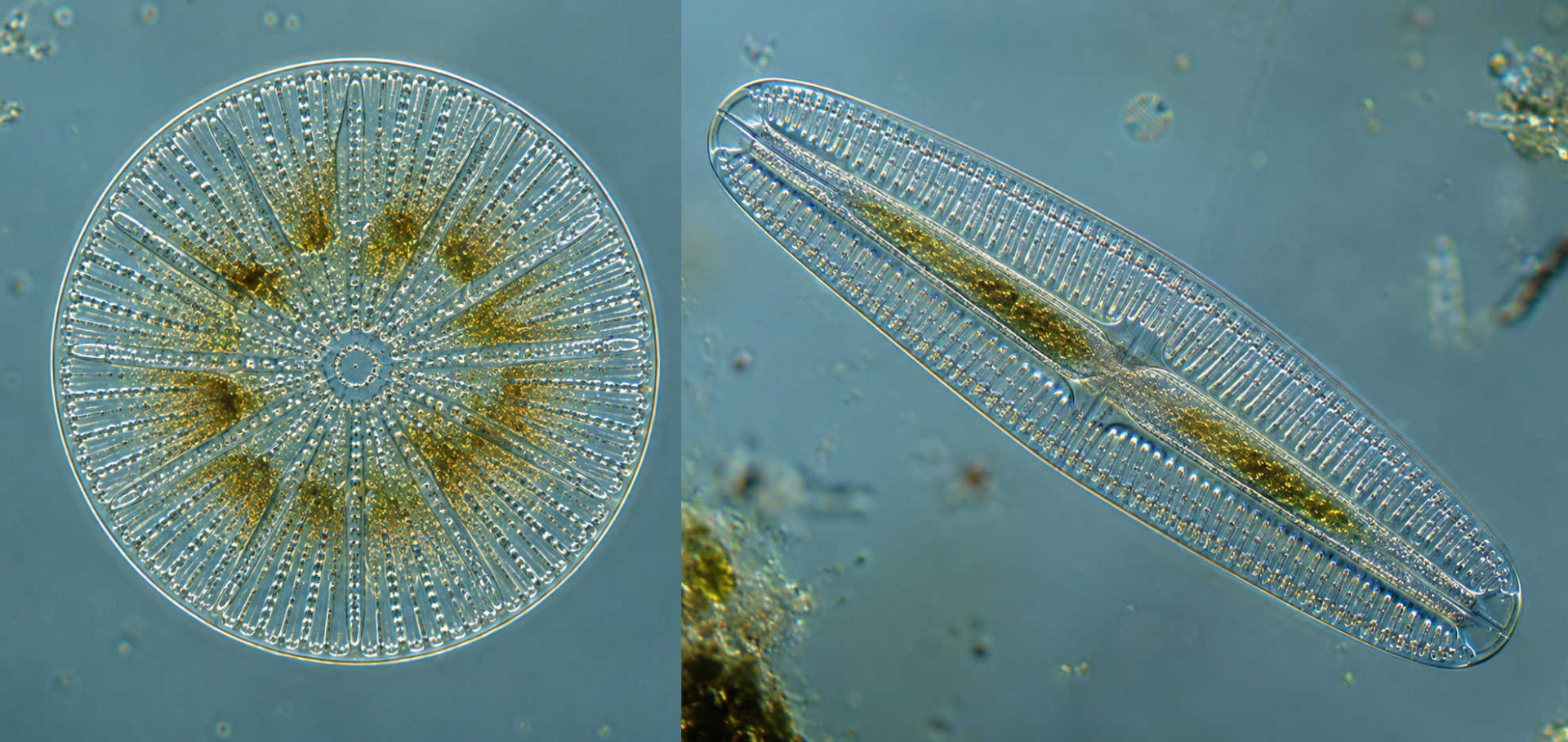
Diatoms remind us that single-celled life was not just the beginning of life’s story; it is still one of its great ongoing strategies. Each diatom is a single cell, wrapped in its own tiny glass-like shell, yet many link together in chains or colonies. That is the fascinating part: they can cooperate, gather, and shape entire ecosystems without becoming true multicellular organisms. In a way, they preserve an ancient truth about life on Earth. Before plants, animals, and fungi became large and complex, life was single-celled. And even today, much of the living world still is. Diatoms are not leftovers from the past. They are living proof that the single-cell strategy still works brilliantly.
Diatoms are tiny single-celled algae wrapped in glass-like shells of silica. They first appear clearly in the fossil record around 182 million years ago, during the Early Jurassic. Their deeper origin may reach back a bit earlier, but this is where the evidence becomes more solid: microscopic life building jewel-like armor in ancient seas.
Life on Earth is carbon-based, but silica-based life is not a ridiculous idea. In fact, Earth life already flirts with silica all over the place. Diatoms build glass-like frustules from silica and oxygen, wrapping their carbon-based cells in ornate microscopic armor. Radiolarians, another group of single-celled marine organisms, build intricate silica skeletons that look like tiny glass cathedrals. Some sponges grow silica spicules, needle-like supports that strengthen and protect their bodies. Even some plants, especially grasses, horsetails, and rice, deposit silica particles called phytoliths into their tissues, making them tougher and harder to eat. None of these are truly “silica-based life” in the science-fiction sense—their biology is still carbon-based—but they show that life can use silica as structure, armor, and architecture. Carbon writes the living chemistry; silica can help build the house.
The earliest familiar diatoms were mostly centric diatoms — round, radial, frisbee-like forms with patterns spreading outward from the center. These were among the first great diatom designs, floating through the oceans like tiny glass suns. Their symmetry made them both beautiful and effective, helping them thrive as part of the growing planktonic world.
Later came the pennate diatoms — the long, canoe-like forms. These became clear in the fossil record by about 75 million years ago, during the Late Cretaceous. Instead of radial symmetry, they had bilateral symmetry, with elongated bodies and intricate ridges running along their shells. Many later pennate forms developed ways to glide across surfaces, giving them a different lifestyle from their rounder ancestors.
The elongated pennate diatoms add an interesting philosophical wrinkle. Unlike the round centric forms, which radiate outward like tiny glass suns, pennate diatoms are organized along a long axis. They are not bilateral in the animal sense — no head, tail, nervous system, or true agency — but they do have direction. Their bodies suggest poles, sides, and orientation. Some even glide along surfaces using a slit-like structure called a raphe. In that modest sense, they hint at a deep pattern in life: once a body has direction, behavior can begin to organize around it. Bilateral structure does not create agency by itself, but it gives life a geometry that later agency can build on.
So the story is not simply “diatoms evolved once.” It is a layered evolutionary story. First came the single-celled glass builders, then the round centric forms flourished, and later the long pennate forms added a new shape, direction, and movement to the microscopic world. Tiny glass frisbees first. Tiny glass canoes later.

