
Phil • Cr. Think • Science • Hist •
TST PRACTICE

The Philosophy Website

STORY

Prokaryotic Life

☐ Read
☑ Read
You’ve read this 0 times.
You’ve listened to this 0 times.

By Michael Alan Prestwood

Sun 31 Mar 2024
Published 2 years ago.
Updated 4 months ago.
Related Stories
Earliest Known Hunter
Protozoa Evolve
Neornithes (Crown Birds) emerge
Oldest Known Air Breather
Fungi Ancestors Split Off: (aquatic Holomycota)
Zuniceratops
Share :
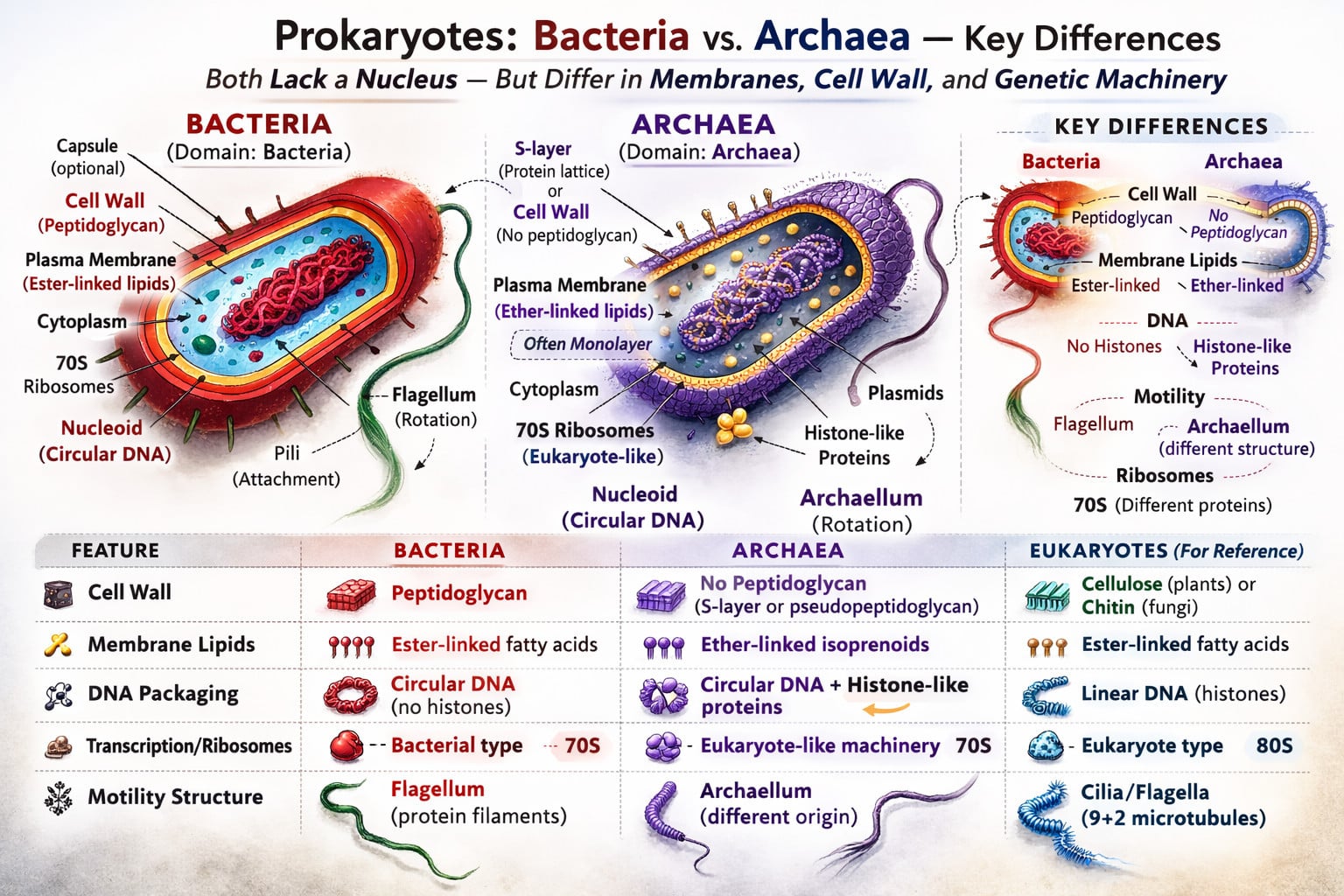
Archaea look like bacteria at first glance — small, simple, and lacking a nucleus. But they are fundamentally different.

Prokaryotic Life

3.73 Billion Years Ago (after LUCA)
Membrane and metabolic diversity.

First Prokaryotes: They evolved from replicating molecules and before LUCA (also a prokaryote). Prokaryotes lack a nucleus and organelles. Although research continues identifying when the first true prokaryotes evolved, it is believed they evolved sometime between 3.8 to 4 billion years ago. While the earliest prokaryotes are part of our direct-line ancestors, today we know their descendants as bacteria and archaea. Bacteria is part of our common knowledge, but archaea are mostly known to microbiologists because they mainly live in extreme temperatures. Interestingly, viruses are neither these prokaryotes nor later eukaryotes. They are a holdover from before prokaryotes and are not considered life.

  • Domain: Pre-Domain or none > Kingdom: not applicable

— map / TST —

TST Tracker
✓ Reading recorded.
Michael Alan Prestwood
Author & Natural Philosopher
Prestwood writes on science-first philosophy, with particular attention to the convergence of disciplines. Drawing on his TST Framework, his work emphasizes rational inquiry grounded in empirical observation while engaging questions at the edges of established knowledge. With TouchstoneTruth positioned as a living touchstone, this work aims to contribute reliable, evolving analysis in an emerging AI era where the credibility of information is increasingly contested.
Email
Print
The Prestwood Column
Menu
September 2026
Column Research….
1. Timeline Story
Hume’s Is–Ought Problem
2. Linked Quote
“I meet with no proposition that is not connected with an ought, or an ought not.”
3. Science FAQ »
Can science prove flourishing should be our goal?
4. Philosophy FAQ »
What is the difference between a normative aim and a normative directive?
5. Critical Thinking FAQ »
Is flourishing for all just utilitarianism?
6. History FAQ!
What is the history of the idea of flourishing in philosophy?
Bonus Deep-Dive Article
Flourishing for All: The Normative Aim of TST Philosophy

Comments

Join the Conversation! Currently logged out.

Leave a Reply

NEW BOOK! NOW AVAILABLE!!

30 Philosophers: A New Look at Timeless Ideas

by Michael Alan Prestwood
The story of the history of our best ideas!
Scroll to Top