
Explore Science-first Philosophy

STORY

Laozi

By Michael Alan Prestwood

Tue 9 Apr 2024
Published 2 years ago.
Updated 1 week ago.
Related Stories
Fuxi (伏羲)
The Yellow Emperor (Huangdi)
Fuente Magna Bowl: Forgery or Real?
Eudaimonia
3761 BCE, Judaic Earth Creation Date
Indus Valley Script: Northwest India
Share :
Laozi or Lou Tzu (604-517 BCE). Founder of Daoism, aka Taoism. The life of Laozi is shrouded in mystery, but he is the first philosopher in “30 Philosophers” that attempts to construct a precise biography.

Laozi

born circa 604 BCE
By tradition, he lived from 604 to 517 BCE.
Lived 105 Generations Ago.

30 Philosophers, Chapter 4: Laozi and Daoist Philosophy.
The life of Laozi is shrouded in mystery, but he is the first philosopher in “30 Philosophers” that attempts to construct a precise biography. The Spring and Autumn Period of China spanned nearly three centuries starting in 770 BCE, and Laozi lived about in the middle of that era. He was born about 604 BCE . His native language was Old Chinese, he authored the Dao De Jing, and founded the Daoist philosophy.

At its core, his Daoism is philosophy, not worship. Laozi did not present the Dao as a personal god, but as “the Way”: the natural order of reality, the path beneath all things, and the source our words can never fully capture. The unknowable Dao asks us to stand humbly before reality and admit that our ideas are always smaller than what is.

Laozi’s idea of wu-wei, often translated as “non-action,” is not laziness or withdrawal. It is effortless action like the flow of water. Move with the grain of life instead of against it. With other people, it means less forcing, less grasping, less domination. You can guide, speak, teach, and disagree, but you do so without trying to bend everyone to your will.

His idea of ziran, often translated as “naturalness” or “of itself,” points toward living in alliance with nature. Things have their own unfolding, their own pattern, their own way. To live well is not to conquer the world, but to harmonize with it. Daoism’s spirituality reflects a reverence for reality, a trust in natural flow, and a call to live simply, humbly, and in balance.

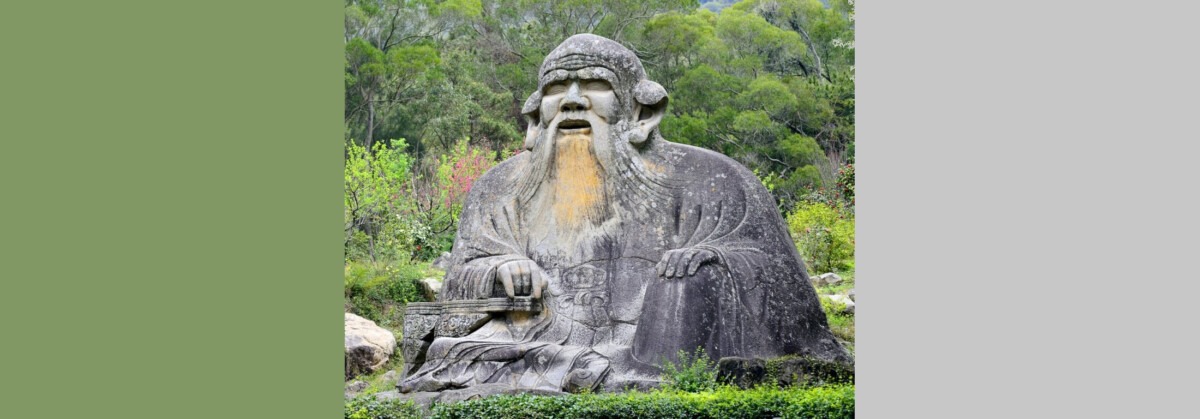
Pictured is the statue of Laozi at the base of mount Qingyuan in China.

— map / TST —

Michael Alan Prestwood
Author & Natural Philosopher
Prestwood writes on science-first philosophy, with particular attention to the convergence of disciplines. Drawing on his TST Framework, his work emphasizes rational inquiry grounded in empirical observation while engaging questions at the edges of established knowledge. With TouchstoneTruth positioned as a living touchstone, this work aims to contribute reliable, evolving analysis in an emerging AI era where the credibility of information is increasingly contested.
Email
Print
This month @ TST
Column Menu
May 2026
»COLUMN ARCHIVE
--COLUMN--
Column Research….
1. Timeline Story
Book: The Idea of History
2. Linked Quote
“The historian without his facts is rootless…the facts without their historian are…meaningless.”
3. Science FAQ »
Is science tainted by bias?
4. Philosophy FAQ »
Debating History: Should We Say “Dark Ages” or “Middle Ages?”
5. Critical Thinking FAQ »
What is the preservation bias?
6. History FAQ!
Did Einstein’s driver really give one of his early talks?
Bonus Deep-Dive Article
TST Philosophy of History

Comments

Join the Conversation! Currently logged out.

Leave a Reply

NEW BOOK! NOW AVAILABLE!!

30 Philosophers: A New Look at Timeless Ideas

by Michael Alan Prestwood
The story of the history of our best ideas!
Scroll to Top